
Marine life guide of Peru · Fistulariidae
Deepwater cornetfish
Fistularia corneta Gilbert & Starks, 1904
- Names in Peru
- Pez corneta
Species account
Summary
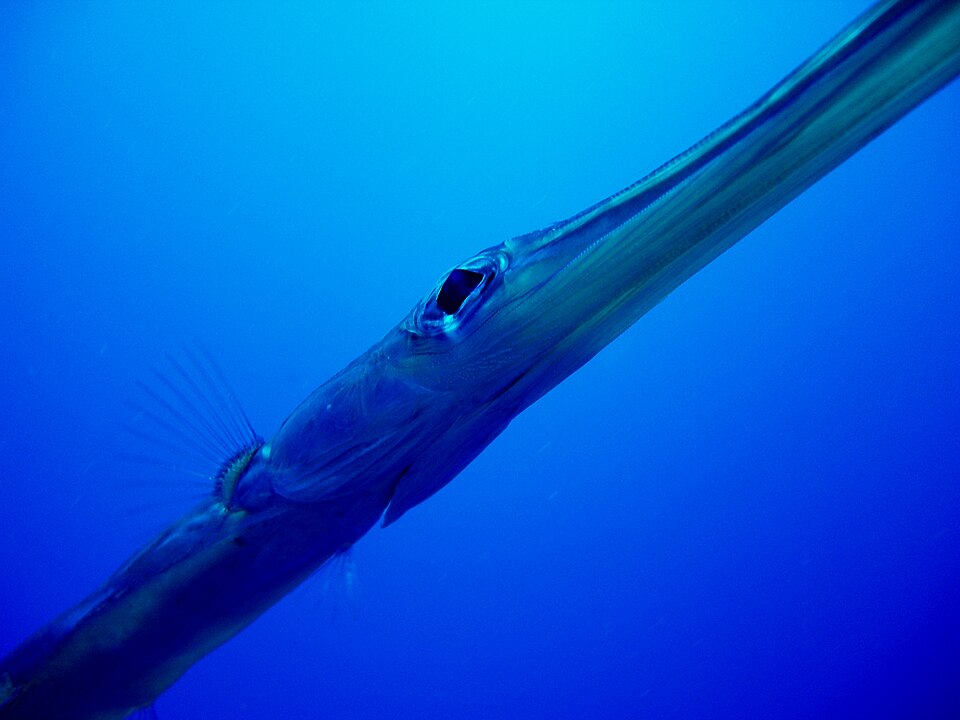
Fistularia corneta is an extremely elongate fish with a filament on its tail that lives in the eastern Pacific from southern California to Peru [1]. Adults are found deeper than 30 m and feed on small fishes [1].
It is the least studied species of its genus: a 2026 review found 13 sources on it, against 168 on its relative Fistularia commersonii [2]. The IUCN lists it as Least Concern [3].
Identification and similar species
The body is very long, flattened and tube-shaped, and the tail ends in an elongated filament [1]. The dorsal and anal fins have no spines: the dorsal has 17 to 20 soft rays and the anal 16 to 19, and there are 75 to 76 vertebrae [1].
In life the upper side is orange to red with brown and black blotches, and the belly is lighter; the dorsal and anal fins have orange bases and the tail filament is dusky [1]. Another review describes the caudal filament as white and the dorsal blotches as brown to black [2].
Like other cornetfishes, it changes pattern: dark bars have been observed when it is stationary and lighter stripes when it is moving [2]. Within the genus, Fistularia commersonii is brown to olive above with blue stripes or dots along the back, whereas Fistularia petimba is orange to brown above and silvery below [2]. Descriptions of adult morphology are enough to tell the four species of the genus apart [2].
Distribution and habitat
Fistularia corneta is the only species of its genus restricted to the eastern Pacific: it is recorded from southern California, the Gulf of California and the western coast of Baja California, in Mexico, to Peru, including many offshore islands [1]. In that region it is regarded as a pelagic-neritic species of tropical waters [1].
Adults live deeper than 30 m, along continental and island margins, over rocky substrates [1]. A recent review associates it with sand and rock bottoms and notes that it has the fewest habitat types of any cornetfish, probably because its habitat has been so little studied [2].
It seems to visit cooler waters farther north seasonally, which creates doubt about the northern limit of its range [2].
Biology
It is an egg-laying fish [1]. The eggs and larvae of Fistularia corneta, like those of other cornetfishes, are planktonic, so the life cycle includes a prolonged pelagic phase [2]. Descriptions of the larvae and early stages of this species exist [2].
It feeds on small fishes [1]. Very little else is known about its biology: the 2026 review found no data on population density, social groupings, or daily or seasonal movements, and no published length-weight relationship [2].
FishBase gives a maximum size of 106 cm total length, with a common length of 20 cm [1].
Ecology
It is a predator of small fishes [1]. Its only documented predator is the yellow-bellied sea snake (Pelamis platurus) [2].
Brischoux and Lillywhite found one Fistularia corneta among the prey regurgitated by sea snakes captured in the Gulf of Papagayo, Costa Rica, in October 2010; the authors also cite earlier records of the species in the stomach contents of these snakes in Ecuador and Panama [4]. They note that relatively large fishes such as this cornetfish are only infrequently found in the snake's stomach [4].
Conservation
The IUCN assessed the species in 2016 and listed it as Least Concern at the global level [3],[1]. All four species of the genus are currently in that category [2].
The 2026 review warns that data on survival, reproduction and population metrics for these fishes are extremely limited, and that there is no density information for Fistularia corneta [2]. The Least Concern category should therefore be read alongside that lack of data [2].
Health, toxicological and chemical relevance
Not medical advice. For a sting, a poisoning or an allergy, seek medical care.
FishBase classifies it as harmless to humans [1].
Human relevance
References (4)
- Froese, R., Pauly, D. (2026). Fistularia corneta, Pacific cornetfish. FishBase. https://www.fishbase.se/summary/8289 (accessed 2026-10-25)
- Ascione, S.J., Camins, E., Correia, M. et al. (2026). The state of knowledge on four families of Syngnathoidei fishes (Teleostei: Syngnathiformes): Aulostomidae, Centriscidae, Fistulariidae and Solenostomidae. Journal of Fish Biology 109, 400-449. doi:10.1111/jfb.70393 (accessed 2026-10-25)
- Pollom, R. (2016). Fistularia corneta: Pollom, R. The IUCN Red List of Threatened Species 2017: e.T178111A67620975. doi:10.2305/IUCN.UK.2017-3.RLTS.T178111A67620975.en (accessed 2026-10-25)
- Brischoux, F., Lillywhite, H.B. (2013). Trophic consequences of pelagic life-style in yellow-bellied sea snakes. Marine Ecology Progress Series 478, 231-238. doi:10.3354/meps10177 (accessed 2026-10-25)