
Bony fishes · Fistulariidae
Deepwater cornetfish
Fistularia corneta Gilbert & Starks, 1904
Spanish: Pez corneta
- Names in Peru
- Pez corneta
- Peruvian Register of Marine Species
- Listed in PeRMS (IMARPE)
Species account
Summary
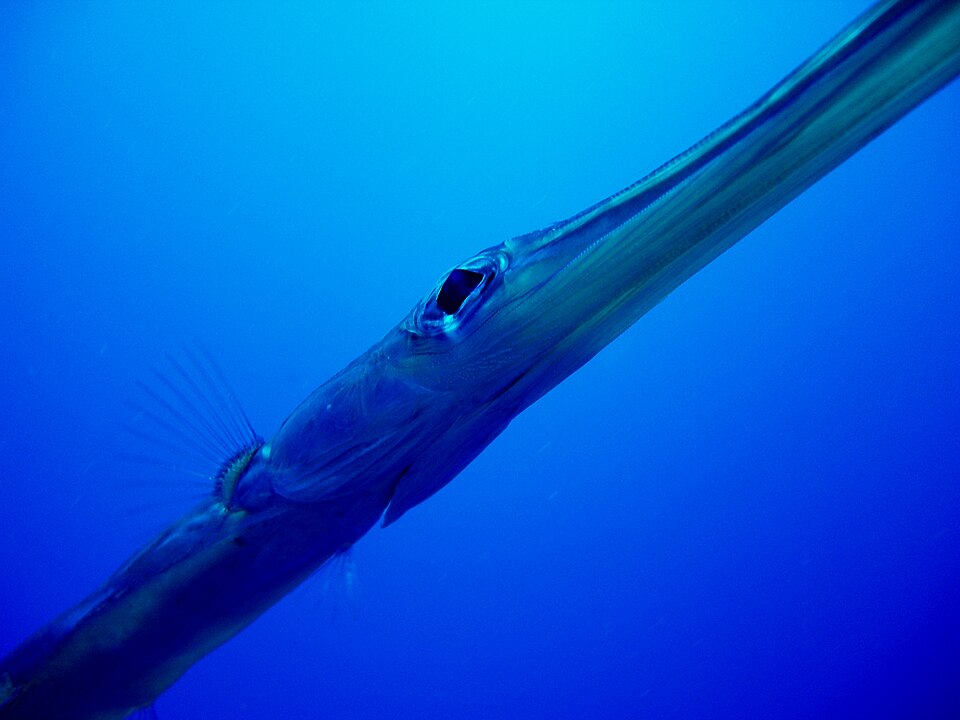
Fistularia corneta is an extremely elongate fish with a filament on its tail that lives in the eastern Pacific from southern California to Peru [1]. Adults are found deeper than 30 m and feed on small fishes [1].
It is the least studied species of its genus: a 2026 review found 13 sources on it, against 168 on its relative Fistularia commersonii [2]. The IUCN lists it as Least Concern [3].
Identification and similar species
The body is very long, flattened and tube-shaped, and the tail ends in an elongated filament [1]. The dorsal and anal fins have no spines: the dorsal has 17 to 20 soft rays and the anal 16 to 19, and there are 75 to 76 vertebrae [1].
In life the upper side is orange to red with brown and black blotches, and the belly is lighter; the dorsal and anal fins have orange bases and the tail filament is dusky [1]. Another review describes the caudal filament as white and the dorsal blotches as brown to black [2].
Like other cornetfishes, it changes pattern: dark bars have been observed when it is stationary and lighter stripes when it is moving [2]. Within the genus, Fistularia commersonii is brown to olive above with blue stripes or dots along the back, whereas Fistularia petimba is orange to brown above and silvery below [2]. Descriptions of adult morphology are enough to tell the four species of the genus apart [2].
Distribution and habitat
Fistularia corneta is the only species of its genus restricted to the eastern Pacific: it is recorded from southern California, the Gulf of California and the western coast of Baja California, in Mexico, to Peru, including many offshore islands [1]. In that region it is regarded as a pelagic-neritic species of tropical waters [1].
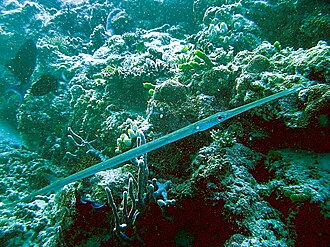
Adults live deeper than 30 m, along continental and island margins, over rocky substrates [1]. A recent review associates it with sand and rock bottoms and notes that it has the fewest habitat types of any cornetfish, probably because its habitat has been so little studied [2].
It seems to visit cooler waters farther north seasonally, which creates doubt about the northern limit of its range [2].
Biology
It is an egg-laying fish [1]. The eggs and larvae of Fistularia corneta, like those of other cornetfishes, are planktonic, so the life cycle includes a prolonged pelagic phase [2]. Descriptions of the larvae and early stages of this species exist [2].
It feeds on small fishes [1]. Very little else is known about its biology: the 2026 review found no data on population density, social groupings, or daily or seasonal movements, and no published length-weight relationship [2].
FishBase gives a maximum size of 106 cm total length, with a common length of 20 cm [1].
Ecology
It is a predator of small fishes [1]. Its only documented predator is the yellow-bellied sea snake (Pelamis platurus) [2].
Brischoux and Lillywhite found one Fistularia corneta among the prey regurgitated by sea snakes captured in the Gulf of Papagayo, Costa Rica, in October 2010; the authors also cite earlier records of the species in the stomach contents of these snakes in Ecuador and Panama [4]. They note that relatively large fishes such as this cornetfish are only infrequently found in the snake's stomach [4].
Conservation
The IUCN assessed the species in 2016 and listed it as Least Concern at the global level [3],[1]. All four species of the genus are currently in that category [2].
The 2026 review warns that data on survival, reproduction and population metrics for these fishes are extremely limited, and that there is no density information for Fistularia corneta [2]. The Least Concern category should therefore be read alongside that lack of data [2].
Health, toxicological and chemical relevance
Not medical advice. For a sting, a poisoning or an allergy, seek medical care.
FishBase classifies it as harmless to humans [1].
Human relevance
References (4)
- Froese, R., Pauly, D. (2026). Fistularia corneta, Pacific cornetfish. FishBase. https://www.fishbase.se/summary/8289 (accessed 2026-10-25)
- Ascione, S.J., Camins, E., Correia, M. et al. (2026). The state of knowledge on four families of Syngnathoidei fishes (Teleostei: Syngnathiformes): Aulostomidae, Centriscidae, Fistulariidae and Solenostomidae. Journal of Fish Biology 109, 400-449. doi:10.1111/jfb.70393 (accessed 2026-10-25)
- Pollom, R. (2016). Fistularia corneta: Pollom, R. The IUCN Red List of Threatened Species 2017: e.T178111A67620975. doi:10.2305/IUCN.UK.2017-3.RLTS.T178111A67620975.en (accessed 2026-10-25)
- Brischoux, F., Lillywhite, H.B. (2013). Trophic consequences of pelagic life-style in yellow-bellied sea snakes. Marine Ecology Progress Series 478, 231-238. doi:10.3354/meps10177 (accessed 2026-10-25)
More pictures
Where it has been recorded
- Filled: scientific records, or confirmed by a curator
- Hatched: isolated record
- Dotted outline: no scientific records and no curator's confirmation (an ORKA sighting is not drawn here)
- Tropical–cold transition zone
Scientific records (2 records)
- Cold central sea
Scientific records (2 records)
- Cold southern sea
Scientific records (6 records)
From openly licensed OBIS and GBIF records (CC0 or CC BY). How each list is built.
Related species
From the same genus (Fistularia).
Names and sources
In Spanish
- Pez corneta — Peru; fishbase; Wikidata · main name
- Corneta flautera — Wikidata; WoRMS
- Trompeta lisa — Wikidata
In English
- Deepwater cornetfish — WoRMS; Wikidata
- Pacific cornetfish — Wikidata
Classification
Learn more
Conservation status: Least Concern (IUCN Red List, according to Wikidata). Taxonomy: PeRMS / WoRMS (CC BY 4.0).