
Marine life guide of Peru · Engraulidae
Anchoveta
Engraulis ringens Jenyns, 1842
- Names in Peru
- Anchoveta · Anchoveta peruana
Species account
Summary
Engraulis ringens is a small pelagic fish that forms enormous schools in the coastal waters of the southeastern Pacific [1]; in Peru it is known as anchoveta or anchoveta peruana [1]. It is the keystone species of the food chain in the Peruvian upwelling and supports the country's most important fishing industry [2].
Identification and similar species
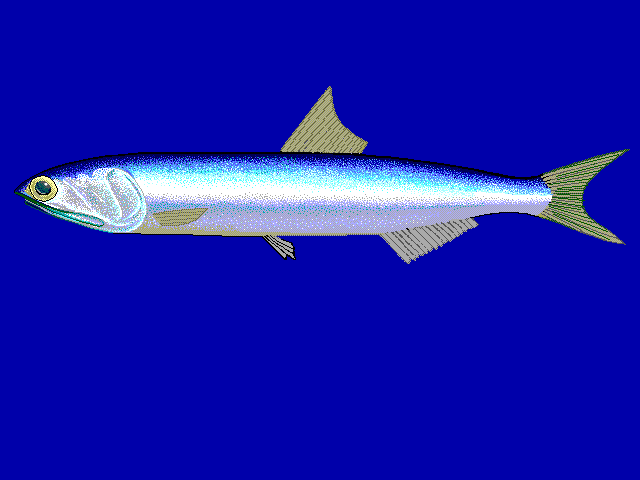
The body is slender, elongate and nearly round in cross-section, with a pointed snout. The maxilla is short with a blunt tip, reaching the front edge of the preoperculum but not beyond it; the tip of the lower jaw lies in front of the nostril. The lower gillrakers are long and slender, 38 to 49 of them, and increase with the size of the fish. The anal fin starts well behind the base of the last dorsal ray, and young fish carry a silver stripe along the flank that fades with age [1].
It reaches about 20 cm standard length [1]. The high gillraker count sets it apart from every Pacific species of Anchoa, and the other anchovies that may share northern Peru with it, in the genera Anchovia and Cetengraulis, have deeper and more compressed bodies [1].
Analysis of the complete mitochondrial genome places it closest to Engraulis japonicus and Engraulis encrasicolus within the family [3].
Similar species
- Engraulis mordax: Engraulis mordax, from the northeastern Pacific, has the tip of the lower jaw reaching only below the nostril, a sharply pointed maxilla that extends to the hind edge of the preoperculum, and a pseudobranch as long as the eye; in Engraulis ringens the jaw reaches the midpoint of the snout, the maxilla is blunter and the pseudobranch is longer than the eye [1].
Distribution and habitat
It lives in the southeastern Pacific, from northern Peru, around Punta Aguja at 6° S, to Chiloé in Chile at 42°31' S; its extent depends on how far the Peru Current reaches [1].
It is a marine, coastal fish, nearly always within 80 km of shore and sometimes out to 160 km. It forms enormous schools in surface waters: by day it descends to 50 m and by night it rises. In the years when a tongue of warmer, less saline surface water spreads southward, the El Niño phenomenon, its northern limit in Peruvian waters retreats [1].
Two stocks are recognised in Peru: the north-central one, from Zorritos at 4°30' S to 16° S, and the southern one, shared with northern Chile from 16°01' to 24° S. Their biological traits appear to differ, and the strong upwelling off San Juan, at 15° S, rarely leaves large concentrations of schools and acts as a natural barrier between them [2].
Biology
It is a partial spawner: at any time of year there are individuals at different stages of maturity. It spawns at all latitudes of the Peruvian sea, and the main areas run from Chicama to Chimbote and from Callao to Pisco. Spawning runs from July to February and peaks between July and October; in some years it extends into summer [2].
Another account gives a major spawning in winter and spring, from July to September, and a lesser one in February and March; it matures at about 1 year of age at around 10 cm standard length, reaches about 8 cm at 6 months and 12 cm at 18 months, and lives about 3 years [1]. Recruits, 8 to 12 cm in total length, appear in coastal waters from October to April, with peaks in January and February [2].
A strong El Niño event quickly lowers the gonadosomatic index and body condition, but the population recovers soon once conditions normalise, and its mortality falls as well [2].
Mitochondrial DNA analysis of fish from the Peruvian coast indicates the lowest genetic diversity among the congeners compared, although this kind of data can reflect either demographic history or natural selection [4].
Ecology
It feeds on plankton. Zooplankton makes up 80 to 95% of its diet; by carbon content the main prey are euphausiids and then copepods, and phytoplankton, although numerous in stomachs, is a minor component. The sardine Sardinops sagax has the same diet, with more preference for copepods [2].
A stable isotope study of 30 adults caught in northern Chile found that the assimilated diet was mainly zooplankton, chiefly crustacean larvae, with a negligible contribution from phytoplankton. The trophic position estimated for the sample as a whole was 3.2, and a group of individuals with high nitrogen 15 values appeared to eat larvae of their own species, that is, to be cannibalistic [5].
The schools move 5 to 20 km per day, and the plankton must be replenished quickly before the next school arrives. In warm years predators from warm waters move in, and the anchoveta seeks refuge in cold patches very close to shore [2].
A regional model of the 1980-2015 period suggests that, in years without El Niño, eggs hatch just as a plankton bloom begins. During the two strong warm anomalies of 1982-1983 and 1997-1998 that synchrony was lost and the water did not fall below 17 °C until August 1983 and June 1998, so larvae would have found less food in time [6].
In April 2024 the parasitic isopod Nerocila acuminata was recorded for the first time in Peru on the fins of fish of this species [7].
Conservation
Its global category on the IUCN Red List is Least Concern [8].
Its population fluctuates strongly with climate. In the period from 1972 to 1986, with warmer waters and fishing pressure, it declined and the sardine increased, and the anchoveta recovered when cold conditions returned [2]. Under climate-change scenarios, the same model projects that the spawning season could shorten and shift to the austral winter, with poorer food for larvae, although those results come from a simulation and not from direct field measurements [6].
The thesis author notes that the relationship between genetic variability and the fate of populations has implications for the sustainability of exploited populations, and that the low mitochondrial diversity observed should be verified with other markers [4].
Human relevance
According to the 1988 FAO catalogue, it is the most heavily exploited fish in history: the catch reached 13 million tonnes in 1971, with great fluctuations and a decline afterwards. In 1982, 94% of the catch was Peruvian and 6% Chilean, almost all of it reduced to meal and oil. Fishing is done with purse-seine vessels [1].
Today most of it still goes to fishmeal and fish oil. Between 2021 and 2023 an average of 81,000 tonnes was landed for direct human consumption, 54% of the permitted quota, and the Ministry of Production names a broken cold chain, weak enforcement and negative perceptions of eating it as obstacles [9].
The anchoveta fishery is the single-species fishery with the largest landings on the planet, and the Peruvian upwelling system, which covers under 1% of the ocean surface, supports more than 10% of the world fish catch [6].
Where to see it in Peru
In Peru it is not a species tied to one spot: it lives in the coastal sea, nearly always within 80 km of shore, in surface schools that rise further at night [1]. The main spawning areas run from Chicama to Chimbote and from Callao to Pisco, and in El Niño years it takes refuge in cold patches near the coast [2].
References (9)
- Whitehead, P.J.P., Nelson, G.J., Wongratana, T. (1988). FAO species catalogue. Vol. 7. Clupeoid fishes of the world (Suborder Clupeoidei). An annotated and illustrated catalogue of the herrings, sardines, pilchards, sprats, shads, anchovies and wolf-herrings. Part 2. Engraulididae. FAO Fisheries Synopsis No. 125, Vol. 7, Part 2. FAO, Rome, 321-323. https://www.fao.org/docrep/pdf/009/t0835e/t0835e03.pdf (accessed 2026-10-25)
- Bouchon, M., Ayón, P., Mori, J. et al. (2010). Biología de la anchoveta peruana, Engraulis ringens Jenyns. Boletín del Instituto del Mar del Perú 25(1-2), 23-30. https://revistas.imarpe.gob.pe/index.php/boletin/article/download/133/123/238 (accessed 2026-10-25)
- Sun, W. (2019). The complete mitochondrial genome of Engraulis ringens (Engraulidae, Clupeiformes) and phylogenetic studies of Engraulidae. Mitochondrial DNA Part B, 3525-3526. doi:10.1080/23802359.2019.1675553 (accessed 2026-10-25)
- Cueva Shapiama, D.A. (2021). Diversidad genética de la anchoveta Engraulis ringens a lo largo de la costa peruana basada en secuencias de ADN mitocondrial. Tesis de Biología Marina, Universidad Científica del Sur, Lima. https://repositorio.cientifica.edu.pe/bitstream/20.500.12805/2149/1/TL-Cueva%20D.pdf (accessed 2026-10-25)
- Pizarro, J., Docmac, F., Harrod, C. (2019). Clarifying a trophic black box: stable isotope analysis reveals unexpected dietary variation in the Peruvian anchovy Engraulis ringens. PeerJ, e6968. doi:10.7717/peerj.6968 (accessed 2026-10-25)
- Xue, T., Hill, M. (2025). Phenological mismatch contributes to anchoveta landings collapse under El Niño and climate change in the Peruvian upwelling system. ICES Journal of Marine Science, fsaf214. doi:10.1093/icesjms/fsaf214 (accessed 2026-10-25)
- Nizama Chapoñan, A., Cornejo Cruz, C. (2024). Primer registro de Nerocila acuminata (Isopoda: Cymothoidae) como ectoparásito de la anchoveta Engraulis ringens en el Perú. Revista Ciencias Marinas y Costeras, 71-78. doi:10.15359/revmar.16-4.2 (accessed 2026-10-25)
- Di Dario, F., Hüne, M., Pérez-Matus, A. et al. (2020). Engraulis ringens: Di Dario, F., Hüne, M., Pérez-Matus, A. & Vega, R. The IUCN Red List of Threatened Species 2021: e.T183775A102904317. doi:10.2305/IUCN.UK.2021-1.RLTS.T183775A102904317.en (accessed 2026-10-25)
- Ministerio de la Producción (2024). Potenciando el Consumo Humano Directo de la Anchoveta en la Región Andina. Nota de prensa, Plataforma del Estado Peruano (gob.pe), 13 de setiembre de 2024. https://www.gob.pe/institucion/produce/noticias/1021861-potenciando-el-consumo-humano-directo-de-la-anchoveta-en-la-region-andina (accessed 2026-10-25)