
Marine life guide of Peru · Echinorhinidae
Prickly shark
Echinorhinus cookei Pietschmann, 1928
- Names in Peru
- Tiburón negro espinoso
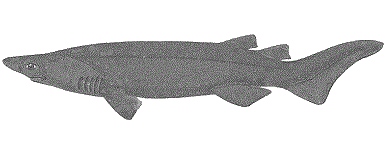
Species account
Summary
Echinorhinus cookei is a deep-water shark of the family Echinorhinidae and, with Echinorhinus brucus, one of only two species in its genus [1]. In the eastern Pacific it has been recorded from Oregon, in the United States, to Chile [1], and it appears on the 2015 checklist of Peru's chondrichthyans [2]. Little is known of its life: the most detailed data come from an acoustic-tagging study in California and a few recent observations in Mexico and Panama [3],[4]. Its global IUCN Red List category is Data Deficient [5].
Identification and similar species
The genus holds only one other species, Echinorhinus brucus, and the two are told apart mainly by the skin denticles: in Echinorhinus cookei they are comparatively small (under 5 mm), stellate at the base and packed tightly together, and do not enlarge into big plates or thorns [1].
A subadult female measuring 262.7 cm in total length washed up dead in 2021 on the shore of Bahía de los Ángeles, in the Gulf of California; it had two spineless dorsal fins set far back near the pelvic fins, star-shaped denticles and cutting teeth with several small cusps [6].
The animals that fishers catch in the Gulf of California measure between 1.5 and 3 m total length [7]. According to the literature that Dawson summarises, males mature at around 240 cm and females at around 290 cm [3], and it has been proposed that the species may reach about 400 cm [1].
Similar species
- Echinorhinus brucus: Echinorhinus brucus has denticles of varied sizes, spaced out over the body and some fused in groups, and there is no evidence that it lives in the Pacific, where only Echinorhinus cookei has been confirmed [1].
Distribution and habitat
Its range seems to span the whole Pacific and reach the eastern edge of the Indian Ocean off Australia; in the eastern Pacific it would be continuous from Oregon to Chile [1]. A Colombian study recalls that it was known from Oregon to Costa Rica and from Ecuador to Chile, with gaps along the coasts of Panama and Colombia, and confirms its presence in the Colombian Pacific, so that the range is continuous [8].
In Peru it appears on the updated checklist of chondrichthyans published in 2015 [2]. The table of captures and sightings in a 2024 genetic study gathers records that it attributes to Long and colleagues (2011) from Talara, in northern Peru, and from the Nazca Ridge and Peru-Chile Trench area [1].
It has been caught between 11 and 650 m deep and perhaps down to about 1000 m [3]; other authors cite down to 1100 m [1]. Off Panama, 12 individuals were sighted in May 2022 between 151 and 350 m deep on seamounts of the Coiba ridge [4]. Fishers in the Gulf of California catch them at 100 to 150 m [7].
Biology
It is aplacental viviparous, and a female with up to 114 pups has been recorded [7]. A recent genetic study cautions that what is known of its reproductive strategy is too little to draw conclusions [1].
Sexual maturity comes at about 290 cm total length in females and 240 cm in males [3]; maturity ages of about 18 years in females and 12 in males are cited [7].
From March 2005 to September 2006, researchers fitted acoustic tags to 15 subadults, each 170 to 270 cm long (total length), in Monterey Canyon, California. All showed strong fidelity to the site: the 3 tracked by hand used areas of 0.20, 2.20 and 1.46 km2, and at night they were near the canyon head while by day they were farther offshore [3]. The mean daily depth of 4 tracked individuals was 44.1 to 53.3 m [3].
In Hawaii the swimming effort of one individual was measured with an acceleration logger: it beat its tail harder going down than going up, which was read as positive buoyancy, something unexpected in a fish with no swim bladder [9].
Ecology
The literature that Dawson gathers points to a diet of small sharks, egg cases of sharks and rays, octopus, squid, chimaeras and small fishes, some of them mesopelagic; his study did not analyse stomach contents [3].
On the nights of tracking, the sounder showed large schools of small fish, mostly anchovies and sardines, and the authors think the night-time movements in mid-water are linked to feeding on them, though they did not test it [3]. In the Gulf of California it has been proposed that it also eats small hammerhead sharks [7].
It is not only a predator: near Cerralvo Island in the Gulf of California, a group of orcas overpowered a 180 cm total-length individual over about 40 minutes [7]. An individual stranded in 2021 was also scavenged by coyotes [6].
Off Panama 12 individuals were seen together on seamounts, which suggests that, at least there, they gather in groups [4].
Conservation
Its global IUCN Red List category is Data Deficient [5], meaning that data are lacking to assess its risk [1].
For both species of the genus the concern is bycatch in bottom trawls and line gear [1]. Late maturity leaves it little capacity to recover from human pressures [7]. In the Gulf of California, local fishers take about 10 to 12 individuals a year, from June to August, in bottom gillnets set for angel sharks, and the study area is not protected by the Mexican authorities [7].
The authors of the Panama finding point out that the Coiba seamounts could matter for the species and that it is a species threatened by commercial fishing [4].
Human relevance
In the works consulted, the species appears mainly as a catch of small-scale fishers: in the Gulf of California about 10 to 12 individuals a year were taken in bottom nets set for angel sharks [7].
It is of scientific interest for its positive buoyancy, measured with an acceleration logger in Hawaii alongside that of another deep-sea shark [9]. The only sightings of live animals in their habitat that a 2024 genetic study lists come from submersible missions, such as those at Cocos Island [1].
References (9)
- Battiata, M., Serena, F., Lo Brutto, S. (2024). Genetic and Distribution Data of the Bramble Shark Echinorhinus brucus (Bonnaterre, 1788) and the Prickly Shark Echinorhinus cookei Pietschmann, 1928 to Better Reconstruct Their Conservation Status. Animals, 993. doi:10.3390/ani14070993 (accessed 2026-10-25)
- Cornejo, R., Vélez-Zuazo, X., González-Pestana, A. et al. (2015). An updated checklist of Chondrichthyes from the southeast Pacific off Peru. Check List, 1809. doi:10.15560/11.6.1809 (accessed 2026-10-25)
- Dawson, C., Starr, R. (2009). Movements of subadult prickly sharks Echinorhinus cookei in the Monterey Canyon. Marine Ecology Progress Series, 253-262. doi:10.3354/meps08067 (accessed 2026-10-25)
- Guzman, H.M., Real, C.K., Kaiser, S. (2024). First evidence of prickly shark, Echinorhinus cookei Pietschmann 1928, aggregation on seamounts in the eastern Pacific, Panama. Journal of Fish Biology, 2081-2085. doi:10.1111/jfb.15720 (accessed 2026-10-25)
- Finucci, B. (2018). Echinorhinus cookei: Finucci, B. The IUCN Red List of Threatened Species 2018: e.T41802A68622003. doi:10.2305/IUCN.UK.2018-2.RLTS.T41802A68622003.en (accessed 2026-10-25)
- Rosales-Vásquez, J.I., Anislado-Tolentino, V., Escárcega-Miranda, B. (2023). New record of the prickly shark Echinorhinus cookei (Pietschmann, 1928) and evidence of scavenging by the coyote Canis latrans (Say, 1823) in Bahia de Los Angeles, Baja California, Mexico. Aquatic Research, 64-71. doi:10.3153/ar23007 (accessed 2026-10-25)
- Lara-Lizardi, F., Gómez, M.F., Quintero-Perez, A. (2025). First record of orcas (Orcinus orca) preying on a prickly shark (Echinorhinus cookei) in the Gulf of California: insights into shark ecology. Frontiers in Fish Science. doi:10.3389/frish.2025.1437507 (accessed 2026-10-25)
- Navia, A.F., Tobón-López, A., Segura, C.E. et al. (2023). Confirmación de la presencia y distribución latitudinal de Echinorhinus cookei en la zona costera del Pacífico Oriental Tropical. Boletín de Investigaciones Marinas y Costeras, 173-178. doi:10.25268/bimc.invemar.2023.52.2.1276 (accessed 2026-10-25)
- Nakamura, I., Meyer, C.G., Sato, K. (2015). Unexpected Positive Buoyancy in Deep Sea Sharks, Hexanchus griseus, and a Echinorhinus cookei. PLOS ONE, e0127667. doi:10.1371/journal.pone.0127667 (accessed 2026-10-25)