
Marine life guide of Peru · Dorididae
Doris fontainii
Doris fontainii A. d'Orbigny, 1836
Species account
Summary
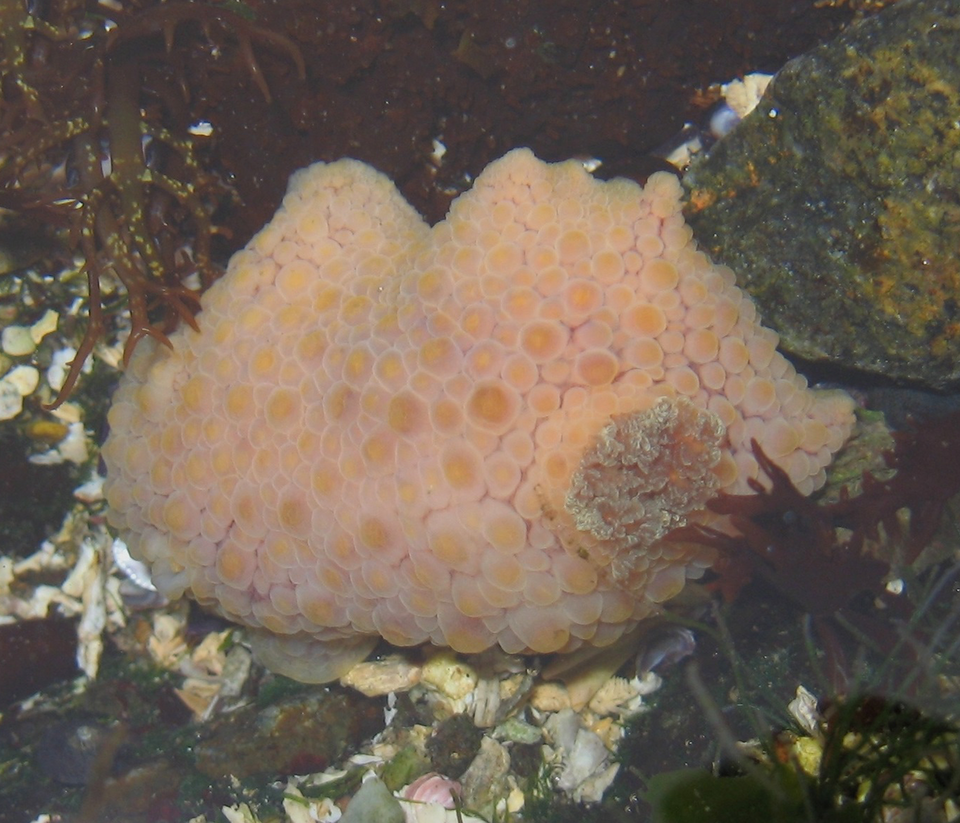
Doris fontainii is a nudibranch in the family Dorididae described by d'Orbigny, and that is its accepted name today in the World Register of Marine Species [1]. It is a large sea slug, bright orange to brownish, with a high back covered in rounded tubercles [2]. It lives on both sides of South America: in the Pacific from Peru to southern Chile, and in the Atlantic off Argentina [3].
Etymology
The original name is Doris fontainii, given by d'Orbigny [2]. Since then the species has been placed in other genera, for example as Anisodoris fontaini and as Archidoris fontaini, and its epithet was also spelled fontainei [2]. Valdés and Muniain returned it to the genus Doris and argued that the right spelling of the epithet was fontainei rather than the original fontainii [4]. The 2023 list of Peruvian nudibranchs notes that the form fontainei was used in error in earlier works [3], and the World Register of Marine Species accepts fontainii and flags fontainei as an incorrect spelling [1].
Identification and similar species
It is easy to recognise by its large size, its bright orange colour and a mantle full of conspicuous rounded tubercles [2]. The body, orange to brownish, is tall and domed and can reach 10 cm; the tubercles on the back are up to 5 mm across, and it has 5 to 7 richly branched gills [2]. Both the gills and the rhinophores are surrounded by raised sheaths that also bear small tubercles [2].
An earlier work regarded dark brown pigment between the tubercles as typical of animals from central and northern Chile, but none of the animals examined in Atacama had it [2].
Several externally similar Chilean species that had been described separately, such as Anisodoris tessellata, Archidoris incerta, Neodoris carvi and Neodoris erinacea, are in fact this same species: re-examining their type material, Schrödl found no differences in the mantle spicules or the radula, treated them as synonyms and designated a neotype for the species [5]. The 2023 Peruvian list records the type specimen under number ZSM 19983417, from Coliumo Bay in Chile [3].
Valdés and Muniain justified its move to the genus Doris with anatomical characters: they pointed to lateral extensions beside the mouth in place of oral tentacles, and a tubular prostate [4].
Distribution and habitat
Its distribution is amphi-South American, meaning it spans the coasts of both oceans around the continent [3]. In Chile it has been recorded from Arica (18° 28′ S) to the Chonos Archipelago (45° 08′ S), and in Argentina from 37° 50′ S to Rada Tilly (45° 55′ S) [3]. A revision published in 2000 already showed records with no gaps on the Atlantic side between northern Argentina and Cape Horn, and on the Pacific side northward along Chile as far as the Peruvian border [5].
In Peru, the 2023 nudibranch list gathers records from Independencia Bay (14° 14′ S), the San Fernando National Reserve (14° 58′ S) and Arequipa (15° to 17° S) [3]. A 2016 study places its northern limit further up, at Islote Ferrol in Áncash (09° 08′ S), based on a record published in 2013 [2].
It is a seafloor species. In Atacama, northern Chile, it occurs mainly below the low-tide line, although it was also collected in pools at low tide, and commercial divers describe it as common below 3 m near Bahía Inglesa [2]. The Peruvian list gives it a depth range of 8 to 17 m [3], and in Argentina it has been mentioned down to 100 m [6].
Biology
It belongs to a group whose members are mostly hermaphrodites with complex genital systems; after reciprocal mating, this species leaves its eggs in spirally coiled ribbons [6]. According to a laboratory study summarised in a 2026 synthesis, the larvae hatched after 14 days of incubation at 14.5 °C and were planktotrophic, that is, they feed while living in the plankton [6].
The animal photographed alive in a pool at Playa El Jefe, near Caldera, measured 54 mm in length [2].
Ecology
Around Caldera in northern Chile, it was the commonest of the 8 sea slug species found during surveys in the summers of 2010 to 2012 [2].
In the Atlantic it appears in the species list of the benthic community of the Argentine shelf-break front, an area 80 to 120 m deep where nudibranchs turn up only now and then [6].
Conservation
When publishing their Atacama survey in northern Chile, the authors stated that none of the species studied, this one included, enjoyed legal protection at the time [2].
Where to see it in Peru
References (7)
- MolluscaBase eds. (2026). Doris fontainii A. d'Orbigny, 1836. World Register of Marine Species. https://www.marinespecies.org/aphia.php?p=taxdetails&id=536827 (accessed 2026-10-20)
- Araya, J.F., Valdés, Á. (2016). Shallow water heterobranch sea slugs (Gastropoda: Heterobranchia) from the Región de Atacama, northern Chile. PeerJ, e1963. doi:10.7717/peerj.1963 (accessed 2026-10-20)
- Grández, A., Ampuero, A., Barahona, S.P. (2023). Peruvian nudibranchs (Mollusca, Gastropoda, Heterobranchia): an updated literature review-based list of species. ZooKeys, 117-163. doi:10.3897/zookeys.1176.103167 (accessed 2026-10-20)
- Valdés, Á., Muniain, C. (2002). Revision and taxonomic reassessment of Magellanic species assigned to Anisodoris Bergh, 1898 (Nudibranchia: Doridoidea). Journal of Molluscan Studies, 345-351. doi:10.1093/mollus/68.4.345 (accessed 2026-10-20)
- Schrödl, M. (2000). Taxonomic revision of the common South American nudibranch Anisodoris fontaini (d'Orbigny, 1837), with discussion of its systematic placement. Journal of Molluscan Studies, 69-82. doi:10.1093/mollus/66.1.69 (accessed 2026-10-20)
- Schejter, L., Bremec, C.S., Escolar, M. et al. (2026). Reproductive strategies of benthic macroinvertebrates at the Argentine shelf-break front, southwestern Atlantic Ocean. Marine and Fishery Sciences, 287-328. doi:10.47193/mafis.3922026010406 (accessed 2026-10-20)
- Valdivia-Chavez, D., Santamaría, J., Campos-León, S. et al. (2020). Lista taxonómica de invertebrados bentónicos marinos de Arequipa, Perú. Boletín Instituto del Mar del Perú 35(2), 378-395. https://revistas.imarpe.gob.pe/index.php/boletin/article/view/311 (accessed 2026-10-20)