
Marine life guide of Peru · Nototheniidae
Patagonian toothfish
Dissostichus eleginoides Smitt, 1898
- Names in Peru
- Bacalao de profundidad
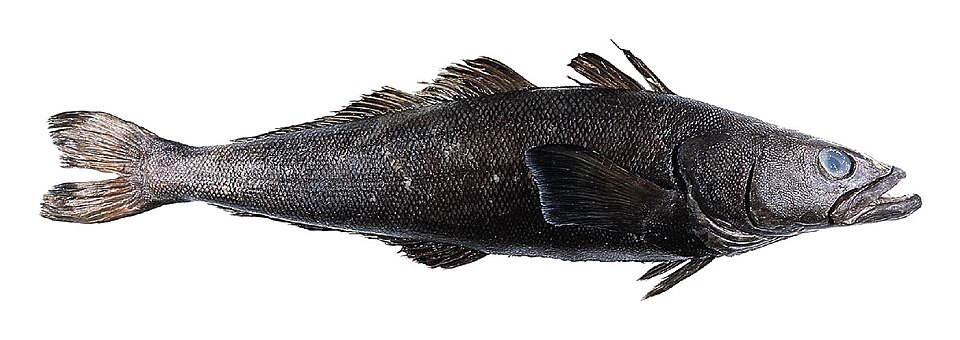
Species account
Summary
Dissostichus eleginoides is a large deep-water fish of the family Nototheniidae, known in Peru as bacalao de profundidad, that lives on the continental slope of the southern hemisphere [1]. In Peruvian waters it has been taken with deep-water longlines since the mid-1990s, the artisanal fleet exports 100 % of its catch according to a 2022 note, and its local biology is still poorly known [1],[2].
Distribution and habitat
It has a very wide range in the southern hemisphere, tied to cold Antarctic and sub-Antarctic waters, that includes the south-eastern Pacific, the western Pacific and the south-western Atlantic, and its true extent is thought to be larger than what is known [1]. A single fish caught off Greenland in 2003 opened the debate on whether the species can cross the equator through deep, cold corridors [1].
It has been recorded between 80 and 2500 m depth, mostly on the deep shelf and the continental slope and even in submarine canyons, and it has been suggested that adults and juveniles occupy different places [1]. The early stages are pelagic and adults are deep demersal fish [1].
Biology
It is a long-lived, very slow-growing species [1],[3]. Studies in the Southern Ocean put sexual maturity at 9-10 years, at about 90-100 cm in length [1]. In southern populations spawning takes place in deep water, near 1000 m, during the austral winter [3].
In Peru only one gonad examination is known, made in 1999 by IMARPE staff (an internal report cited by Aramayo) on 16 fish (12 females and 4 males) of 89 to 141 cm total length, caught between 1230 and 1380 m depth off 13°-14°S: the females had no mature oocytes and the testes were immature or lacked spermatogenic activity [1]. With so small a sample, genuine inactivity cannot be told apart from a gonadal resting phase, and the reproductive cycle in Peruvian waters remains undescribed [1].
Ecology
In Peruvian waters the stomachs of these fish hold bony and cartilaginous fishes and, less often, invertebrates such as jumbo squid, giant crabs or spider crabs and polychaetes, as well as pelagic fishes such as jack mackerel, chub mackerel and bonito [1]. The variety of prey suggests an opportunistic, unselective predator, although analysis is limited because fish are usually gutted on board and the stomachs thrown away [1].
The Peruvian fishery incidentally takes invertebrates such as spider crabs (Lithodes and Paralomis longipes), octopuses, jumbo squid and several fishes [2]. On two trips between December 2019 and March 2020, 5 chondrichthyans of 3 species were photographed at a mean depth of 1489 m (from 1360 to 1618 m); three were the chimaera Hydrolagus melanophasma and the other two were only tentatively identified, and all three species were new records for Peru [2].
Conservation
This account cites no global IUCN category for the species. In Peru, Ministerial Resolution 000187-2025-PRODUCE classifies it as a fully exploited resource, and the catch limit for 2026 is 170 tonnes under Ministerial Resolution 000434-2025-PRODUCE, both cited in the 2026 resolutions [4],[5].
A review of the Peruvian resource concludes that the scientific information needed to assess the population is incomplete, that regulation has little reach over catches and landings, and that fishing goes on in almost every month for a slow-growing species [1].
Health, toxicological and chemical relevance
Not medical advice. For a sting, a poisoning or an allergy, seek medical care.
Marko and colleagues analysed 38 fillets bought at retailers in 10 US states: total mercury ranged from 0.07 to 1.9 ppm wet weight [6]. They also cite that larger, older fish accumulate more mercury, and an earlier study in which fish from Chile averaged about 0.73 ppm, more than three times the 0.23 ppm of South Georgia fish [6]. Import limits are 0.5 ppm in New Zealand, Canada and Australia and 1.0 ppm in the European Union and the United States [6]. These are figures from commercial samples and other populations, not from Peruvian fish [6].
Human relevance
In Peru this resource has been recorded in fishery statistics since 1995 and is caught with deep-water longlines; the fleet has shrunk to 8-12 smaller-scale vessels of about 32 m3 hold capacity [1]. A 2022 note describes 7 artisanal vessels, none above 32.56 m3 of hold capacity, that export 100 % of their catch [2].
Abroad it is sold mainly under the trade name Chilean sea bass; in the samples of Marko and colleagues, according to an earlier genetic study, 20 % of products labelled that way were not Dissostichus eleginoides [6]. In 2026 IMARPE was authorised to run exploratory fishing with 3 smaller-scale vessels and a prospecting survey between the northern limit of the maritime domain and 09°00'S [4],[5].
Where to see it in Peru
It is not a species seen while diving: the Peruvian fishery works with longlines at depths of 1230 to 1380 m, far below recreational diving limits [2]. The bycatch data come from two trips in 2019 and 2020 aboard a vessel of the fishery whose fishermen shared photographs [2]. In 2026 IMARPE was authorised to survey between the northern limit of the maritime domain and 09°00'S, an area where the commercial fleet does not fish regularly [5].
References (6)
- Aramayo, V. (2016). Breve síntesis sobre el recurso bacalao de profundidad Dissostichus eleginoides en Perú. Revista de Biología Marina y Oceanografía 51(2), 229-239. doi:10.4067/s0718-19572016000200002 (accessed 2026-10-25)
- Alfaro-Shigueto, J., Ebert, D.A., Guidino, C. et al. (2022). Deep-sea Chondrichthyans associated with the Patagonian toothfish Dissostichus eleginoides fishery off the coast of Peru. Revista de Biología Marina y Oceanografía 57 (especial), 249-254. doi:10.22370/rbmo.2022.57.especial.3415 (accessed 2026-10-25)
- Collins, M.A., Brickle, P., Brown, J. et al. (2010). The Patagonian Toothfish. Advances in Marine Biology 58, 227-300. doi:10.1016/b978-0-12-381015-1.00004-6 (accessed 2026-10-25)
- Ministerio de la Producción (2026). Resolución Ministerial N.° 00336-2026-PRODUCE: autorizan al Instituto del Mar del Perú - IMARPE la ejecución de la pesca exploratoria del recurso bacalao de profundidad 2026 en el ámbito marítimo nacional. El Peruano (24-09-2026). https://busquedas.elperuano.pe/dispositivo/NL/2557408-1 (accessed 2026-10-25)
- Ministerio de la Producción (2026). Resolución Ministerial N.° 00276-2026-PRODUCE: autorizan al Instituto del Mar del Perú - IMARPE la ejecución de la prospección biológico-pesquera del recurso bacalao de profundidad en área marítima. El Peruano (20-08-2026). https://busquedas.elperuano.pe/dispositivo/NL/2545116-1 (accessed 2026-10-25)
- Marko, P.B., Nance, H.A., van den Hurk, P. (2014). Seafood Substitutions Obscure Patterns of Mercury Contamination in Patagonian Toothfish (Dissostichus eleginoides) or “Chilean Sea Bass”. PLoS ONE 9(8), e104140. doi:10.1371/journal.pone.0104140 (accessed 2026-10-25)