
Marine life guide of Peru · Diodontidae
Balloonfish
Diodon holocanthus Linnaeus, 1758
Species account
Summary
Diodon holocanthus is a porcupinefish of the family Diodontidae, described by Linnaeus in 1758 [1]. It lives in tropical seas around the world, and its young spend months in open water before settling near the coast [2]. Faced with a predator it can make its body three times bigger by filling its stomach with water, ending up as a ball of raised spines [3]. The IUCN Red List classifies it as Least Concern [4].
Etymology
Linnaeus coined the name in 1758, basing it on Artedi's account of 1738, and gave India as its home, which, according to Leis, could mean present-day India or the whole Indo-Pacific; no holotype or type series is known [2]. That original account is short, and the only useful detail in it is that the spines are round in cross-section and very long on the head and nape [2]. Linnaeus and Artedi always wrote holocanthus, which is why Leis keeps that spelling rather than holacanthus, the one many authors used, and does not regard it as a misprint, as Jordan and Evermann had claimed in 1891 [2].
Identification and similar species
It is a round-bodied porcupinefish with a short caudal peduncle that bears no spines of its own, although the strong spines at the base of the dorsal and anal fins project over it [2]. Its spines are long and nearly all erectile: there are 12 to 16 between the snout and the dorsal fin, and those on the forehead are usually the longest on the body [2]. It has a short fixed spine just above the gill opening, 2 small barbels on the chin and, in fish from inshore waters, fleshy tentacles over the eyes, on the back and along the sides, some or all of which are often missing; the dorsal and anal fins each have 13 to 15 rays [2].
Its colour pattern is dominated by several large dark brown to black blotches on the back and sides: one around the base of the dorsal fin, another in the middle of the back, one above each pectoral fin, a bar across the nape and another that starts below each eye and runs up onto the space between the eyes, where in the Pacific and Indian oceans it is usually continuous [2]. Between them are small spots of the same colour, the fins have no spots and in life they may be yellowish [2]. Fish caught in open water always have a spotted belly, and that spotting is often kept by inshore fish of 60 to 200 mm, apparently above all in the eastern Pacific [2].
In a DNA barcoding study of rocky reef fishes from northern Peru, the specimens of Diodon holocanthus differed from one another by at most 0.31 %, and the closest species in the set, Diodon hystrix, stood at a distance of 10.07 % [5].
Similar species
- Diodon hystrix: It has a longer body, 2 or more small spines on the caudal peduncle itself and a pattern of small spots that in adults reaches at least the dorsal, pectoral and caudal fins, whereas Diodon holocanthus has no peduncle spines, carries large blotches and has unspotted fins; in life, Diodon hystrix can show dorsal blotches much like its own [2].
Distribution and habitat
It is found throughout the tropics, but appears to be missing from the southwestern and central Pacific east of the andesite line, the boundary between continental and oceanic rocks; it turns up again in Hawaii and at Pitcairn and Easter Islands [2]. It has not been found in the Red Sea or the Mediterranean, so Atlantic and Indo-Pacific populations could only mix around southern Africa, and the features of the specimens suggest that the Atlantic one has drifted apart from the rest [2].
In Hawaii its eggs turned up mostly near the coast, but its larvae seldom within 1 km of it [2]. The young live in open water: the largest caught there measured 86 mm, and the smallest found close to shore, 60 mm [2].
In the central Mexican Pacific, on the continental shelf off Jalisco and Colima, it is regularly taken by shrimp trawlers [6]. According to a 2025 paper, the Tropical Eastern Pacific reaches south to Cabo Blanco, in Piura; no coral reefs are known on the northern coast of Peru, but rocky reefs have been described between Cabo Blanco and Punta Sal [5].
Biology
The largest fish Leis examined measured 289 mm in standard length; there are reports of much bigger sizes, perhaps owing to confusion with other species, but it does not reach the size of Diodon hystrix [2]. In the central Mexican Pacific, 400 fish taken between December 1995 and December 1998 were measured, from 5 to about 40 cm in total length [6].
Of the 253 fish that could be sexed, 136 were females and 117 males, a ratio that does not differ from 1:1; half of the females were mature at 19.7 cm and half of the males at 20.1 cm [6]. Its ovaries hold oocytes at several stages at once, an asynchronous pattern that lets it spawn more than once a year, and breeding activity was highest in June and from September to December [6].
At Okinawa, in southern Japan, yolk-laden oocytes were seen from April to June; in May and June, females caught at spring tides had well-developed oocytes while those caught at neap tides showed signs of having spawned, so the authors suggest that it spawns between one tidal phase and the other [7].
Its eggs are pelagic and spherical, 1.7 to 1.8 mm across when alive, with 10 to 30 oil droplets; rearing experiments indicate that they are spawned at dusk and hatch in 4 to 5 days at about 25 °C, and the larvae emerged at 1.9 to 2.1 mm [2]. In Hawaii its eggs and larvae appeared from February to September, with an apparent peak in May and June, though they were never common, and the open-water juvenile phase lasts for months [2].
To inflate it pumps water into a highly stretchable, folded stomach that no longer digests food; as it fills, it takes up the body cavity and pushes the lining out under the head and around the dorsal and anal fins and the caudal peduncle [3]. Its skin, whose collagen fibres are wavy, stretches easily by as much as 40 % and then suddenly turns stiff, so that together with the water it forms a firm frame that holds the spines upright [3].
Porcupinefishes have a genome about double the size of that of smooth-skinned pufferfishes; in 776 kb of sequenced Diodon holocanthus DNA there were fewer genes per stretch, more repeated elements and longer introns than in those species [8].
Ecology
On the coast of Jeju Island, Korea, the stomachs of 155 fish of 11.5 to 31.5 cm caught in gill nets from June to December 2009 were examined; 25.2 % were empty, and the main prey were gastropods (51.9 % of the index of relative importance), crabs (43.6 %) and bivalves (2.8 %) [9]. Crabs dominated in fish of 20 cm or less and made up less of the diet as the fish grew, while gastropods gained in importance [9].
In the Mexican Pacific, an earlier study cited in a 2011 paper found 61 kinds of food in its diet, with bivalves, gastropods and crabs among the most frequent [6].
Inflating serves it as a defence against predators [3]. That defence can kill whatever swallows it: in northeastern Brazil, a study of 30 loggerhead turtles stranded between 2015 and 2025 found the mouth and oesophagus of every one blocked by the fish, and the authors regard this cause of death as recurring and under-recorded [10].
Conservation
Health, toxicological and chemical relevance
Not medical advice. For a sting, a poisoning or an allergy, seek medical care.
According to a 2011 paper summing up earlier work, the species may carry tetrodotoxin, a nerve toxin made by bacteria, in its skin and in several organs, as other marine animals do [6].
In 2 fish, a female and a male of 30 to 35 cm caught in 2014 in Marovo Lagoon, Solomon Islands, neither tetrodotoxin nor its analogues were detected in skin, liver, gonads, stomach, intestine or flesh, with a detection limit of 0.01 µg/g; the authors caution that these were very few specimens [11]. In Japan, eating the skin, flesh and testes of fish caught in that country is officially allowed [11].
Human relevance
In Mexico it carries little weight in trade or as direct human food, but in some states dried specimens are sold as handicrafts; besides, its juveniles are traded as aquarium fish and in China it is used in traditional medicine [6].
At Okinawa its liver, which is not used commercially, proved rich in fat: in liver and muscle alike, long-chain omega-3 fatty acids made up 44 % of the total, with DHA the main one (42 %), and there were 14.8 g of DHA in every 100 g of liver, so the author puts it forward as a raw material for food supplements [12].
On the Gopalpur coast of eastern India it was first recorded on 17 November 2013, and it became frequent as bycatch after the super cyclone Phailin; according to the authors, the fish tore fishers' nets and cut their catches of commercial species [13].
Where to see it in Peru
A study published in 2025 included the species among the rocky reef fishes of northern Peru that it sequenced, collected by diving in 3 areas inside a northern marine national reserve: Isla Foca, the coast between Cabo Blanco and Los Órganos and the reefs of Punta Sal, in Tumbes; the paper does not say in which of them this species was taken, and the authors warn that sampling and reaching those reefs is difficult [5].
At the Lobos de Afuera Islands, a 2022 paper lists it among the species named in historical reports, but neither baseline studies published in 2019 nor the environmental DNA sampling of November 2018 detected it; according to the authors, the distance from the coast and the complex seabed limit access to the islands [14].
References (14)
- WoRMS Editorial Board (2026). Diodon holocanthus Linnaeus, 1758. World Register of Marine Species. https://www.marinespecies.org/aphia.php?p=taxdetails&id=127402 (accessed 2026-10-20)
- Leis, J.M. (1978). Systematics and zoogeography of the porcupinefishes (Diodon, Diodontidae, Tetraodontiformes), with comments on egg and larval development. Fishery Bulletin 76(3), National Marine Fisheries Service, NOAA, 535-567. https://spo.nmfs.noaa.gov/sites/default/files/pdf-content/fish-bull/leis.pdf (accessed 2026-10-20)
- Brainerd, E.L. (1994). Pufferfish inflation: Functional morphology of postcranial structures in Diodon holocanthus (Tetraodontiformes). Journal of Morphology, 243-261. doi:10.1002/jmor.1052200304 (accessed 2026-10-20)
- Leis, J.L., Matsuura, K., Shao, K.-T. et al. (2011). Diodon holocanthus: Leis, J.L., Matsuura, K., Shao, K.-T., Hardy, G., Zapfe, G., Liu, M., Jing, L., Tyler, J. & Robertson, R. The IUCN Red List of Threatened Species 2015: e.T193817A2282138. doi:10.2305/IUCN.UK.2015-4.RLTS.T193817A2282138.en (accessed 2026-10-20)
- Zavala, E., Britzke, R., Siccha-Ramírez, Z. et al. (2025). DNA barcoding of marine rocky reef fishes from northern Peru suggests a parapatric speciation in the Tropical Eastern Pacific. Ecology and Evolution, e70125. doi:10.1002/ece3.70125 (accessed 2026-10-20)
- Lucano-Ramírez, G., Peña-Pérez, E., Ruiz-Ramírez, S. et al. (n.d.). Reproducción del pez erizo, Diodon holocanthus (Pisces: Diodontidae) en la plataforma continental del Pacífico Central Mexicano. Revista de Biología Tropical, 217-232. doi:10.15517/rbt.v59i1.3192 (accessed 2026-10-20)
- Fujita, T., Hamaura, W., Takemura, A. et al. (1997). Histological Observations of Annual Reproductive Cycle and Tidal Spawning Rhythm in the Female Porcupine Fish Diodon holocanthus. Fisheries Science, 715-720. doi:10.2331/fishsci.63.715 (accessed 2026-10-20)
- Guo, B., Zou, M., Gan, X. et al. (2010). Genome size evolution in pufferfish: an insight from BAC clone-based Diodon holocanthus genome sequencing. BMC Genomics, 396. doi:10.1186/1471-2164-11-396 (accessed 2026-10-20)
- Kim, M.J., Han, S.-H., Song, C.B. (2023). Diet composition of the Longspined, Diodon holocanthus inhabiting the Coastal Waters of Jejudo Island, Korea. The Journal of Fisheries and Marine Sciences Education, 1202-1209. doi:10.13000/jfmse.2023.12.35.6.1202 (accessed 2026-10-20)
- Gavilan, S.A., Farias, D.S.D., Bomfim, A.C. et al. (2026). A deadly meal: fatal ingestion of porcupinefish (Diodon holocanthus Linnaeus, 1758) by loggerhead turtles (Caretta caretta (Linnaeus, 1758)) in the Atlantic Ocean. Marine and Freshwater Research. doi:10.1071/MF25040 (accessed 2026-10-20)
- Puilingi, C.G., Kudo, Y., Cho, Y. et al. (2015). Tetrodotoxin and Its Analogues in the Pufferfish Arothron hispidus and A. nigropunctatus from the Solomon Islands: A Comparison of Their Toxin Profiles with the Same Species from Okinawa, Japan. Toxins, 3436-3454. doi:10.3390/toxins7093436 (accessed 2026-10-20)
- Tashiro, Y. (2021). Long-chain n-3 polyunsaturated fatty acids contained in liver and muscle tissues of Okinawan long-spine porcupinefish (Diodon holocanthus Linnaeus 1758). Nutrition & Food Science, 163-170. doi:10.1108/NFS-03-2021-0089 (accessed 2026-10-20)
- Mahapatro, D., Naik, S., Behera, D.P. et al. (2015). First distributional record of an Indo-Pacific porcupine puffer fish Diodon holocanthus (Diodontidae) from the Gopalpur coast, Bay of Bengal. Marine Biodiversity Records. doi:10.1017/S1755267214001250 (accessed 2026-10-20)
- Alfaro-Cordova, E., Ortiz-Alvarez, C., Alfaro-Shigueto, J. et al. (2022). What lies beneath? Revealing biodiversity through eDNA analysis in Lobos de Afuera Islands, Peru. Latin American Journal of Aquatic Research, 642-659. doi:10.3856/vol50-issue4-fulltext-2782 (accessed 2026-10-20)
More pictures
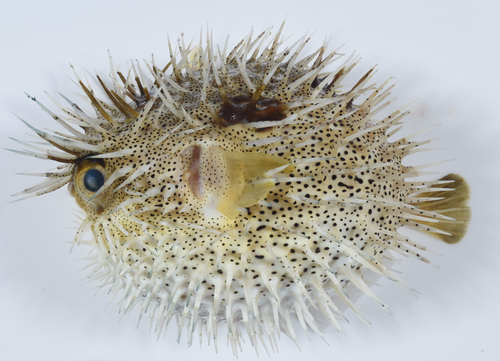
Photo: Peter Shanks · CC0 · Wikimedia Commons Photo: Raúl A. Ruiz M. · CC BY 4.0 · GBIF (iNaturalist research-grade observations)
