
Marine life guide of Peru · Muricidae
Crassilabrum crassilabrum
Crassilabrum crassilabrum (G. B. Sowerby II, 1834)
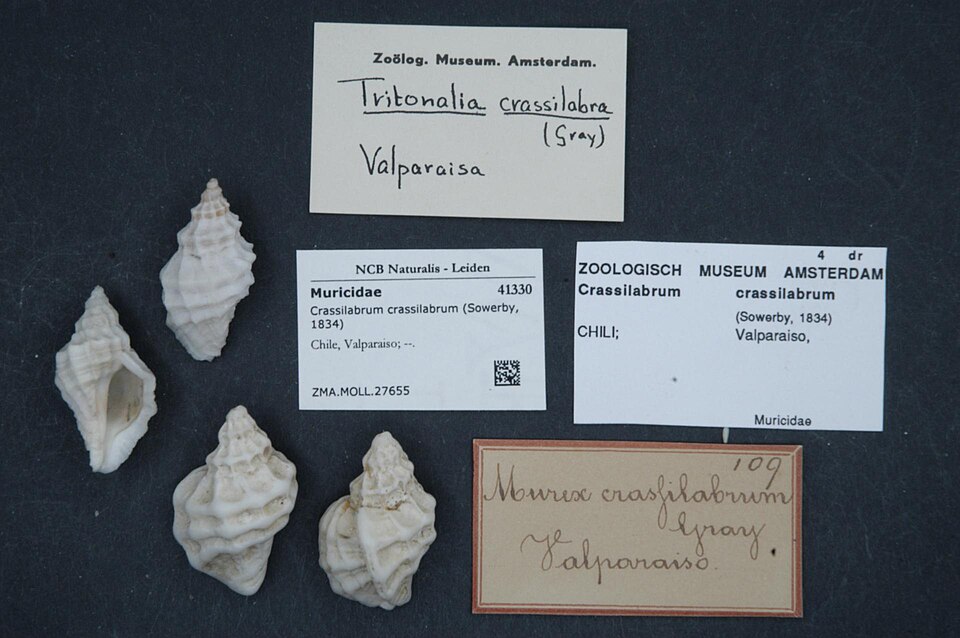
Species account
Summary
Crassilabrum crassilabrum is a muricid snail of the rocky intertidal of the south-eastern Pacific. Its known northern limit in Peru is Pucusana, and southward it reaches 46° S in Chile [1]. Nearly all that is known of its biology comes from Chile, where it was studied as Nucella crassilabrum: it lays capsules containing nurse eggs, and the young leave already metamorphosed, as small snails [2]. The Peruvian study consulted dates from 2017: on two beaches of Lima nearly all females showed imposex, a change linked to contamination by organotin compounds [1].
Identification and similar species
The snails measured in Peru are small. In Pucusana, shell length of 82 individuals ranged from 13.5 to 29.1 mm, and in Playa Hermosa (Ancón), that of 100 individuals ranged from 17.5 to 31.7 mm [1]. In that sample, shell length differed significantly between the sexes on both beaches, and sex was recognised by dissecting the soft tissues, not from outward shape [1]. In that study the species was identified with taxonomic keys to the molluscs of the rocky intertidal of south-central Chile [1].
Distribution and habitat
The accepted name of the species is Crassilabrum crassilabrum (G. B. Sowerby II, 1834); the original combination was Murex crassilabrum [3]. It is a marine animal [3]. The Peruvian authors describe its range as a stretch of coast running from Pucusana, in Lima, to 46° S in southern Chile [1]. Another study, working with Chilean material, places it along the Chilean coast as far as the Strait of Magellan [2].
It lives in the rocky intertidal. At Mehuín, Chile (39° 25' S), egg masses were found most often in crevices and on vertical surfaces, in permanently wet and shaded places, between the level of spring low tides and about the neap low-tide level [2]. In Lima, specimens were collected by hand in the intertidal zone at low tide [1].
Biology
The reproduction data come from the Mehuín population, studied from March 1976 to April 1977 [2]. Each capsule is flattened and measures 5.0 to 12.8 mm excluding the stalk; at its top there is an exit hole of 875 to 1200 µm, closed by a plug [2]. Capsules are laid very close together in clusters of up to 60, which suggests communal spawning [2].
The eggs measure 204 to 293 µm (mean 240 µm), and each capsule holds between 134 and 1116 [2]. Fertile eggs make up just 6.6 to 7.9 %; the remainder serve as food (nurse eggs) that each embryo swallows, from 3 to 20 per individual [2]. Embryos metamorphose before leaving the capsule, and newborn snails measure between 0.82 and 1.3 mm, larger if the embryo ate more nurse eggs [2].
Development inside the capsule takes 70 to 80 days in autumn and winter, with water at 9.67–10.60 °C, and 55 to 65 days in late spring and early summer, with water at 11.40–14.10 °C [2]. In egg masses exposed to air at low tide, many do not complete development, probably because of that stress, and embryos killed by physical stress change from the normal yellow to pink or purple [2].
Ecology
It is a predator of other invertebrates of the rocky intertidal. In laboratory and field experiments on a shore in southern Chile, it fed on the mussels Semimytilus algosus and Perumytilus purpuratus and on the barnacle Chthamalus scabrosus; of the two mussels it preferred Semimytilus algosus [4]. Small individuals chose mussels of 5 to 10 mm, and large ones preferred those of 15 to 20 mm, although they accepted mussels up to 30 mm [4].
The same work compared its diet with that of juveniles of Concholepas concholepas. The two overlap strongly but differ in the prey and the size they choose, which could ease competition when prey abundance changes [4]. In the study, each animal rarely ate more than one mussel in 7 days, and barnacle consumption in the field was about 30 % higher than in the laboratory [4].
Health, toxicological and chemical relevance
Not medical advice. For a sting, a poisoning or an allergy, seek medical care.
The sources consulted give no data on toxins or on risks to people who handle it. There is, however, a toxicological finding about the snail itself: in Pucusana (100 %) and Playa Hermosa, Ancón (98.3 %), nearly all females examined in December 2014 and January 2015 had imposex, that is, had developed a pseudopenis behind the right tentacle [1]. Imposex is linked to organotin compounds such as tributyltin, used in antifouling paints on hulls [1].
The relative penis length severity index (RPLI) was 52.3 % in Pucusana and 44.5 % in Ancón; the authors recall that values above 25 % have been postulated to indicate a high risk of population decline [1]. They link the pattern to traffic of fishing and recreational boats, although they did not measure tributyltin in water or sediment [1].
Human relevance
The sources consulted mention no food or commercial use of the species. Its interest for people is scientific: the authors of the Lima study propose it as a sentinel for imposex on the central coast of Peru and the South American Pacific, being the third imposex bioindicator species of the central coast [1]. They suggest using it in monitoring to detect organotin hot spots and in coastal management programmes [1].
Where to see it in Peru
The published Peruvian data come from two beaches of Lima. Between December 2014 and January 2015, specimens were collected at Pucusana, a fishing cove and resort 60 km south of Lima, and at Playa Hermosa, in Ancón, 43 km north [1]. The authors collected by hand in the intertidal at low tide, and mention diving among the activities at Pucusana [1]. That article mentions no access restrictions on those beaches [1].
References (4)
- Rivas, R., Pradel, R., Hurtado, S. et al. (2017). Imposex en Crassilabrum crassilabrum (Neogastropoda: Muricidae) en la Costa Central del Perú. Revista de Investigaciones Veterinarias del Perú 28(4), 834-842. doi:10.15381/rivep.v28i4.13873 (accessed 2026-10-25)
- Gallardo, C.S. (1979). Developmental pattern and adaptations for reproduction in Nucella crassilabrum and other muricacean gastropods. The Biological Bulletin 157(3), 453-463. doi:10.2307/1541030 (accessed 2026-10-25)
- MolluscaBase eds. (2026). Crassilabrum crassilabrum (G. B. Sowerby II, 1834). World Register of Marine Species (MolluscaBase). https://www.marinespecies.org/aphia.php?p=taxdetails&id=404382 (accessed 2026-10-25)
- Dye, A.H. (1991). Feed preferences of Nucella crassilabrum and juvenile Concholepas concholepas (Gastropoda: Muricidae) from a rocky shore in southern Chile. Journal of Molluscan Studies 57(3), 301-307. doi:10.1093/mollus/57.3.301 (accessed 2026-10-25)