
Marine life guide of Peru · Muricidae
El loco
Concholepas concholepas (Bruguière, 1789)
- Names in Peru
- Chanque · Tolina
Species account
Summary
Concholepas concholepas is a marine snail of the family Muricidae [1]. It is the only living species of a genus with six described species, nearly all fossil, and it lives on the southeastern Pacific coast from 6° S in Peru to 56° S at the tip of Chile [2]. Its embryos develop inside capsules, the larva is planktonic and the juvenile settles on rock [3]. In Peru the fishing regulations call it "chanque" or "tolina", and its harvest has been regulated since 2000 through closed seasons and a minimum size [4],[5].
Identification and similar species
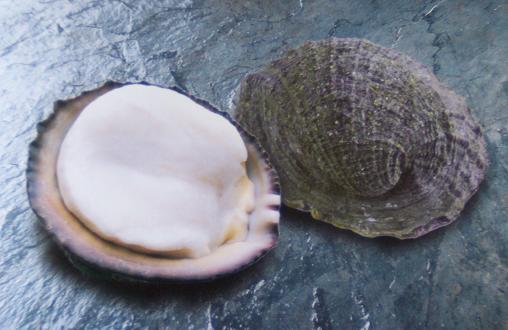
It is a thick-shelled snail. According to Vermeij's (1998) analysis as summarised in the cited review, in this species the spire extends above the adapical end of the aperture and the spiral cords are strongly ornamented with scales and nodes, whereas in the related genus Edithais, which holds non-South American species, the cords are finer and lack axial ornament [2]. The authors of the review themselves regard the usefulness of shell characters for the taxonomy of the group as ambiguous [2].
Shell shape changes with the environment. The ratio of total length (from the edge of the siphonal canal to the posterior edge of the aperture) to maximum width averaged 1.31 in 112 subtidal specimens and 1.39 in 46 intertidal ones; in two localities habitat had a significant effect, and the authors suggest the variation may reflect phenotypic plasticity in response to hydrodynamic stress or other environmental cues [2].
In the Peruvian fishery size is measured as peristomal length, from the apex to the edge of the siphonal canal, and the 2008 regulation sets the minimum harvest size at 8 cm [5]. According to the literature cited by Manríquez and colleagues, an individual reaches sexual maturity when that length exceeds 4 cm, and small juveniles can achieve cryptic shell colouration [6].
Distribution and habitat
Its range covers more than 7000 km of the southeastern Pacific coast, from 6° S in Peru to 56° S at the tip of Chile; it was also sampled in the Juan Fernández archipelago [2]. The fossil record of the species includes deposits of the Talara Basin, at 4°15' S in northern Peru, from the late Pliocene to the middle Pleistocene [2].
Using sequences of the mitochondrial COI gene from 179 individuals, the authors found a single lineage along the whole coast; between Matarani, in southern Peru, and Puerto Aguirre, in Chile, more than 3000 km apart, divergence was only 0.9 % [2].
It lives on the rocky intertidal and in the shallow subtidal. Newly settled individuals have been seen in the intertidal, on the shells of adults of their own species in the shallow subtidal and in aggregations in the low intertidal [3]. According to Manríquez and colleagues, on wave-exposed intertidal shores it clings tightly to the rock with its foot [6].
Biology
Development comprises an embryonic phase inside capsules, a planktonic larval phase and a competent veliger larva that floats near the surface. Early veligers measure 250 to 1300 µm, competent ones more than 1300 µm, and newly settled individuals, with the first adult shell already visible, less than 3 mm [3].
The sources consulted have no equivalent data for Peru. In the fjords and channels of southern Chile, 13035 larvae were counted in 395 plankton samples taken between September 2000 and December 2001. Of these, 99 % were early veligers; competent ones appeared only from June to August and settlement was recorded in August, with 69 settlers. These data suggest a planktonic development of 6 to 12 months, much longer than the 3 months measured in the laboratory, in water of 8 to 15 °C [3].
According to Manríquez and colleagues, when feeding on and handling prey the foot is often lifted off the rock and the snail is exposed to being torn off by waves; dropping voluntarily is also an escape tactic [6]. The small genetic difference between distant localities is a pattern that is usually due to high gene flow, typical of species with planktotrophic larvae, and the authors treat the species as a single taxonomic unit along the whole continental coast [2].
Ecology
In the study by Manríquez and colleagues, juveniles (1.5 to 2.1 cm, collected from the intertidal of Antofagasta, in northern Chile) were reared in the laboratory on small mussels of the species Perumytilus purpuratus, and each individual was kept alone to avoid cannibalism [6].
The authors recall that, in earlier laboratory work, the species responded negatively to the odours of predatory crabs and sea stars and avoided crawling toward the odour source [6]. In their experiment, juveniles turned upside down righted themselves generally about twice as fast with the odour of the crab Acanthocyclus hassleri as without it [6]. In an 83-day experiment, higher CO2 in the water changed neither growth nor net shell calcification, but did speed up that righting, a change that, in the authors' view, could alter how the snail responds to its predators in nature [6].
Conservation
This account gives no IUCN category. In Peru, Ministerial Resolution 080-2000-PE suspended harvest, processing, transport and sale along the whole coast from 11 March 2000. Resolution 155-2000-PE authorised it from 29 May 2000 south of 18° S, with a minimum size of 80 mm peristomal length (or 35 mm opercular length) and a tolerance of 3 % of undersized animals [4].
The 2008 regulation records that in 2004 the resource was declared in recovery in Moquegua and Tacna. It set a total closure of one year along the whole coast and, after that, two annual closed seasons, from 1 April to 30 June and from 1 October to 31 December. It fixed a minimum size of 8 cm and banned shucking at sea [5].
The same regulation set aside the natural banks of Las Lozas and Chero, in Tacna, to protect juveniles, with harvest banned all year, and charged IMARPE with assessing the banks and monitoring the harvest. These are the measures of the 2008 regulation, which is the one read for this account; later changes were not checked [5].
Human relevance
Peruvian regulations call it "chanque" or "tolina" and govern its harvest, processing and sale. In 2000 it could be used only for freezing and canning, and plants could not accept animals without the operculum attached to the foot [4].
In 2008 the regulation required a current fishing permit and obliged artisanal boat owners to take IMARPE staff and inspectors on board when asked [5]. In Chile, where it is known as "loco", it is one of the main invertebrates caught by artisanal divers [2].
Where to see it in Peru
The sources consulted do not say where the species can be seen in Peru. What they do document: the review by Cárdenas and colleagues gives a range that starts at 6° S, a study collected specimens from the subtidal at Matarani, at 17° S, and the 2008 regulation declares the natural banks of Las Lozas and Chero, in Tacna, reserved, where harvest is banned at any time of year [2],[5]. The 2000 regulation mentions the area south of 18° S only to authorise harvest, not as a limit of the species [4].
References (6)
- WoRMS Editorial Board (2026). Concholepas concholepas (Bruguière, 1789). World Register of Marine Species. https://www.marinespecies.org/aphia.php?p=taxdetails&id=395353 (accessed 2026-10-25)
- Cárdenas, L., Viard, F., Castilla, J.C. (2008). Paleobiogeography and taxonomy of the genus Concholepas (Lamarck, 1801): a review and new evidences. Revista Chilena de Historia Natural 81(3), 417-436. doi:10.4067/s0716-078x2008000300010 (accessed 2026-10-25)
- Molinet, C., Arévalo, A., González, M.T. et al. (2005). Patterns of larval distribution and settlement of Concholepas concholepas (Bruguiere, 1789) (Gastropoda, Muricidae) in fjords and channels of southern Chile. Revista Chilena de Historia Natural 78(3), 409-423. doi:10.4067/s0716-078x2005000300005 (accessed 2026-10-25)
- Ministerio de Pesquería (2000). Resolución Ministerial N° 155-2000-PE. Autorizan extracción del recurso chanque, abalón o tolina desde el extremo sur del dominio marítimo al Paralelo 18 Latitud Sur. El Peruano, 27 May 2000. https://faolex.fao.org/docs/pdf/per20607.pdf (accessed 2026-10-25)
- Ministerio de la Producción (2008). Resolución Ministerial N° 772-2008-PRODUCE. Establecen veda del recurso chanque o tolina (Concholepas concholepas) en todo el litoral peruano. Lima, 4 November 2008. https://faolex.fao.org/docs/pdf/per85903.pdf (accessed 2026-10-25)
- Manríquez, P.H., Jara, M.E., Mardones, M.L. et al. (2013). Ocean Acidification Disrupts Prey Responses to Predator Cues but Not Net Prey Shell Growth in Concholepas concholepas (loco). PLoS ONE 8(7), e68643. doi:10.1371/journal.pone.0068643 (accessed 2026-10-25)