
Marine life guide of Peru · Chaetodontidae
Threebanded butterflyfish
Chaetodon humeralis Günther, 1860
- Names in Peru
- Mariposa
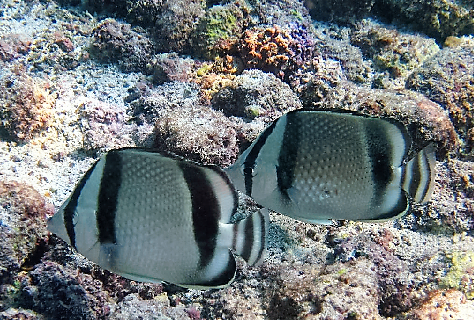
Species account
Summary
Chaetodon humeralis is a butterflyfish of the family Chaetodontidae, described by Günther in 1860 [1]. In Peru it is called «mariposa» [2]. It lives on reefs of the eastern Pacific, from southern California to Peru, the Galápagos Islands included [3]. The IUCN Red List assesses it as Least Concern [4].
Etymology
Identification and similar species
It is a tall fish, strongly flattened from side to side and almost disc-shaped, with a steeply sloping forehead and a somewhat projecting snout [3]. Its creamy-yellow body is crossed top to bottom by 5 or 6 dark bars, from the head back to the tail [3]. The dorsal fin has 12 to 13 spines and 18 to 20 soft rays, and the anal fin 3 spines and 15 to 17 rays; it reaches 25.4 cm in total length, although about 12 cm is usual [3].
In a DNA barcoding study (COI gene) of rocky reef fishes from northern Peru, specimens of Chaetodon humeralis differed from one another by at most 1.24 %, below the 2 % threshold the authors used, while the closest species in the dataset, Anisotremus interruptus, sat at 21.05 %; in other words, the result agrees with current taxonomy [5].
Distribution and habitat
It occurs in the eastern Pacific, from San Diego (California, United States) to Peru, with the Galápagos Islands included [3]. It is tied to reefs and has been reported between 3 and 50 m deep, although it is commonest between 3 and 12 m, usually in pairs or small groups over rocky bottoms close to shore [3].
It can go deeper: in technical-diving counts made in 2018 and 2019 in the submarine canyon in the south of Banderas Bay (Mexico), it was recorded between 60 and 70 m, with 13 individuals in all, and was the most abundant species at 70 m [6]. It also turns up, in low numbers, in samples from the Santa María la Reforma coastal lagoon in the Gulf of California [7].
In Peru it lives on the rocky reefs of the north: specimens were collected by diving inside the Mar Tropical de Grau National Reserve for a genetic study [5]. Farther south, in diving counts in 1999 and 2000, after the 1997-98 El Niño, it was one of the abundant species in the Bahía Sur of San Bartolo, about 50 km south of Lima and 4 m deep at most; that paper's table, based on a 1998 key, places its southern limit at Pucusana [8].
Biology
FishBase states that adults eat algae and bottom-dwelling invertebrates [3]. A study of the mesophotic fishes of Banderas Bay counted it among the carnivorous species [6], and an analysis of the evolution of coral-eating fishes, which sorted butterflyfishes by diet, placed it among the non-corallivores [9].
In the stomachs of adult fish speared in Mazatlán and Banderas bays, on the Mexican Pacific coast, no sponge remains were found in Chaetodon humeralis, unlike the angelfishes Pomacanthus zonipectus and Holacanthus passer, which did eat sponges [10].
It is oviparous and pairs up to breed; its mating system has been described as monogamous [3].
Ecology
On the reefs of Punta Veleros (Los Órganos, Piura), 9 interactions in which reef fishes cleaned green turtles were documented between October 2022 and March 2023, at 5 to 8 m depth. The turtles stayed close to a rock wall dominated by aggregations of Chaetodon humeralis and Johnrandallia nigrirostris, but Chaetodon humeralis is not on the list of fishes that cleaned them [11].
In the Bahía Chamela sanctuary, on the central Mexican Pacific coast, an annotated fish checklist rated it as an abundant species [12]. In Banderas Bay it was one of the species that weighed most in the difference between the fish community at 70 m and the one at 50 m [6].
Conservation
Human relevance
Where to see it in Peru
On the reefs of Punta Veleros, at Los Órganos (Piura), scuba observations between October 2022 and March 2023 described a rock wall dominated by aggregations of this species and of Johnrandallia nigrirostris, on a reef 5 to 10 m deep. One of the places observed is known to local divers as the butterflyfish wall [11].
At the Lobos de Afuera Islands, some 32 nautical miles offshore and hard to reach because of the distance and the seabed relief, it is among the species recorded by the baseline studies published in 2019, although environmental DNA sampled in November 2018 did not detect it [14].
Toward central Peru there are records from after El Niño: in 1999 and 2000 it was abundant in the Bahía Sur of San Bartolo, in Lima [8].
References (14)
- WoRMS Editorial Board (2026). Chaetodon humeralis Günther, 1860. World Register of Marine Species. https://www.marinespecies.org/aphia.php?p=taxdetails&id=273343 (accessed 2026-10-20)
- Froese, R., Pauly, D. (2026). Common names of Chaetodon humeralis. FishBase. https://www.fishbase.se/ComNames/CommonNamesList.php?ID=8278&GenusName=Chaetodon&SpeciesName=humeralis&StockCode=8473 (accessed 2026-10-20)
- Froese, R., Pauly, D. (2026). Chaetodon humeralis Günther, 1860. Threebanded butterflyfish. FishBase. https://www.fishbase.se/summary/8278 (accessed 2026-10-20)
- Rocha, L.A., Pyle, R., Myers, R. et al. (2009). Chaetodon humeralis: Rocha, L.A., Pyle, R., Myers, R., Craig, M.T., Allen, G., Robertson, R., Lea, B., Rivera, F., Zapata, F., Barraza, E., Merlen, G. & Edgar, G. The IUCN Red List of Threatened Species 2010: e.T165635A6075192. doi:10.2305/IUCN.UK.2010-4.RLTS.T165635A6075192.en (accessed 2026-10-20)
- Zavala, E., Britzke, R., Siccha-Ramírez, Z. et al. (2025). DNA barcoding of marine rocky reef fishes from northern Peru suggests a parapatric speciation in the Tropical Eastern Pacific. Ecology and Evolution, e70125. doi:10.1002/ece3.70125 (accessed 2026-10-20)
- Arreola, J.L., Galván-Villa, C.M., Perfecto-Avalos, Y. et al. (2024). Upper mesophotic reef fish assemblages at Bahía de Banderas, Mexico. Biodiversity Data Journal, e113125. doi:10.3897/BDJ.12.e113125 (accessed 2026-10-20)
- Amezcua, F., Amezcua-Linares, F. (2014). Seasonal Changes of Fish Assemblages in a Subtropical Lagoon in the SE Gulf of California. The Scientific World Journal, 968902. doi:10.1155/2014/968902 (accessed 2026-10-20)
- Gárate, A., Pacheco, A. (2016). Cambios en la distribución y abundancia de la ictiofauna de aguas someras en San Bartolo (Lima, Perú) después del ENSO 1997-98. Ecología Aplicada 3(1-2) (número de 2004), 148-153. doi:10.21704/rea.v3i1-2.284 (accessed 2026-10-20)
- Marrable, I., Peoples, N., Kolmann, M.A. et al. (2026). The Evolutionary History and Morphological Divergence of Corallivorous Fishes on Coral Reefs. Integrative Organismal Biology, obag032. doi:10.1093/iob/obag032 (accessed 2026-10-20)
- Verdín, C.J., Carballo, J.L., Camacho, M.L. (2010). A Qualitative Assessment of Sponge-Feeding Organisms from the Mexican Pacific Coast. The Open Marine Biology Journal, 39-46. doi:10.2174/1874450801004010039 (accessed 2026-10-20)
- Cuba, D., Zavala, A., Epstein, M. (2023). Primeros registros de relación simbiótica entre la tortuga verde (Chelonia mydas) y peces de arrecife en el norte del Perú. South Sustainability, e086. doi:10.21142/SS-0402-2023-e086 (accessed 2026-10-20)
- Galván-Villa, C.M., Ríos-Jara, E., Bastida-Izaguirre, D. et al. (2016). Annotated checklist of marine fishes from the Sanctuary of Bahía Chamela, Mexico with occurrence and biogeographic data. ZooKeys, 139-157. doi:10.3897/zookeys.554.6106 (accessed 2026-10-20)
- Tirado-Ibarra, J.J., Loya-Rodriguez, M., Morales-Arevalo, J.C. et al. (2018). Reproduction and community structure of fish from winter catch sites from industrial shrimp bycatch from the northeast and southeast Mexican Pacific. PeerJ, e4460. doi:10.7717/peerj.4460 (accessed 2026-10-20)
- Alfaro-Cordova, E., Ortiz-Alvarez, C., Alfaro-Shigueto, J. et al. (2022). What lies beneath? Revealing biodiversity through eDNA analysis in Lobos de Afuera Islands, Peru. Latin American Journal of Aquatic Research, 642-659. doi:10.3856/vol50-issue4-fulltext-2782 (accessed 2026-10-20)