
Marine life guide of Peru · Carcharhinidae
Copper shark
Carcharhinus brachyurus (Günther, 1870)
- Names in Peru
- Cazón · Tollo mantequero
Species account
Summary
Carcharhinus brachyurus is a large shark of the family Carcharhinidae, in the order Carcharhiniformes [1]. It is bronze to olive grey above and white below, and reaches about 292 cm [2]. It lives from the surf zone down to at least 100 m deep and its range includes Peru [2]. In Peru it is known as «cazón» and «tollo mantequero», and there is no fishery aimed at it: it is caught incidentally [3]. Its global category on the IUCN Red List is Vulnerable [4].
Etymology
Günther described it in 1870 as Carcharias brachyurus; its type locality is New Zealand, and the neotype, a 2420 mm female held at the National Museum of New Zealand as NMNZ 2262, was caught at Wanganui and designated by Garrick in 1982 [2]. The original specimens in the British Museum appear to be lost, and two Australian foetuses that Günther assigned to the species are in fact Carcharhinus leucas [2]. The FAO catalogue lists 6 synonyms and gives tiburón cobrizo as the Spanish name; the name bronze whaler is used in Australia and narrowtooth shark in the United States [2].
Identification and similar species
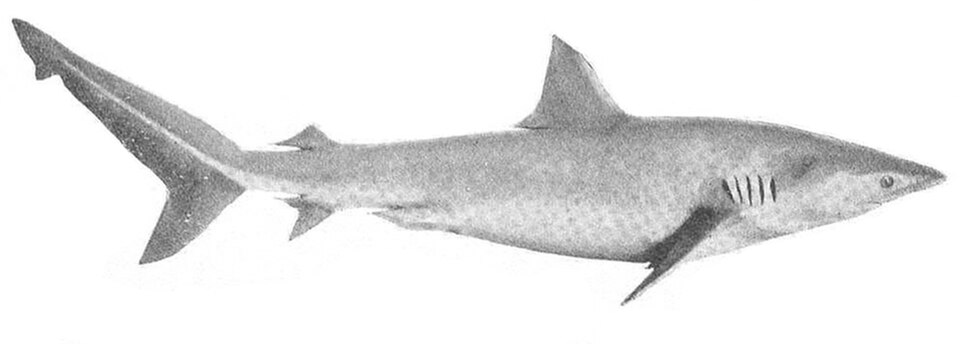
It is a large, fairly slender shark with a moderately long snout, narrowly rounded or pointed, and circular eyes of moderate size [2]. The upper teeth are narrow, serrated and have a bent or hooked cusp, with no smaller cusplets at the base, in 15 or 16 rows on each side of the upper jaw [2]. There is usually no ridge between the two dorsal fins, the pectoral fins are long, the first dorsal is falcate and the second is small and low [2].
The colour is bronze to olive grey above and white below, with a fairly conspicuous white band on the flank; the fins have somewhat darker edges and inconspicuous dark tips [2]. It reaches 292 cm; males mature between 200 and 229 cm, females below 240 cm, and pups are 59 to 67 cm long at birth [2]. Checking its size at the landing sites is difficult: it is sometimes landed eviscerated or without its tail fin, which makes verifying its total length hard [3]. The FAO catalogue also warns that its biology is poorly known because of confusion with other species [2].
In Peru it is recorded in the updated checklist of chondrichthyans of the Peruvian sea [5]. The finding cites an IMARPE field guide for identifying sharks in the small-scale fishery, and shark landings are recorded at authorised points by means of a landing certificate [3].
Similar species
- Carcharhinus falciformis: Carcharhinus falciformis is a dark, slim oceanic shark with a ridge between the dorsal fins, upper teeth with small cusplets or very coarse serrations at the base, and a first dorsal that starts behind the tips of the pectorals; Carcharhinus brachyurus usually has no ridge and its first dorsal starts over those tips or slightly ahead of them [2].
- Carcharhinus galapagensis: Carcharhinus galapagensis has broad, triangular upper teeth, with about 14 rows on each side, and a low ridge between the dorsals; in Carcharhinus brachyurus the upper teeth are narrow and hook-cusped, with 15 or 16 rows [2].
Distribution and habitat
It has an irregular distribution in temperate and tropical waters; in the eastern Pacific it is reported from southern California to the Gulf of California and Peru [2],[3]. In Peru it appears on the checklist of chondrichthyans of the Peruvian sea [5], and the Ministry of the Environment's 2025 finding places its presence along the whole coast of the country [3].
It is found from near the surf line to at least 100 m deep; in the northern parts of its range it seems to move north in spring and summer and south in autumn and winter [2]. The genetic studies cited in the finding indicate that southern hemisphere populations are isolated from one another, with a southeastern Pacific stock distinct from the southwestern Pacific one [3].
Biology
It is viviparous, with a yolk-sac placenta, and the sex ratio at birth is 1 to 1 [2]. The FAO catalogue gives litters of 13 to 20 pups [2] and the Ministry of the Environment's finding, 8 to 20 [3].
It matures late and lives long. For southern Africa the finding reports that males mature at 13 years and females at 20, and a maximum recorded age of 30 years in males and 25 in females [3]. The FAO catalogue gave a much earlier maturity, at about 5 years, and a maximum age of at least 12 [2]. This slow pace makes it biologically vulnerable to fishing [3].
Ecology
It eats a wide variety of bony fishes, among them sardines, sea catfish, mullets, jacks, hakes and soles, as well as spiny dogfish of the genus Squalus, torpedo rays, sawfish, squid and cuttlefish [2]. Off South Africa, in winter, large numbers follow sardine shoals along the southern coast of Natal [2].
The diet studies gathered in the Peruvian finding come from New Zealand and South Africa, and give a mean trophic position of 4.5, that of a high-level predator [3].
Conservation
Its global category on the IUCN Red List is Vulnerable [4]. The finding reports that, on a precautionary basis, a population reduction of between 30 and 49 % is presumed over the last three generations, which are 71 years, attributed to fishing pressure [3].
In Peru there is no regional or national stock assessment, and the 2025 finding notes that no national Red List assessment has been made either [3]. Shark landings are only allowed at authorised points, with a landing certificate, and Ministerial Resolution 209-2001-PE sets a minimum catch size of 150 cm total length for species of the genus Carcharhinus, with a tolerance of 15 % [3].
The species is subject to CITES controls, and the Peruvian Scientific Authority issued in 2025 a non-detriment finding for its fins, positive with conditions and valid for 1 year [3]. That finding rates fishing pressure as low between 2020 and 2022 and moderate in 2023 and 2024, when fishing mortality came close to natural mortality, and recommends, within 3 years, using interdorsal length as an alternative measure to monitor the minimum size [3].
Health, toxicological and chemical relevance
Not medical advice. For a sting, a poisoning or an allergy, seek medical care.
The FAO catalogue considers it a dangerous species, to which a few provoked and unprovoked attacks on swimmers and divers are attributed; it is probably much less dangerous than the tiger shark and the bull shark, because of its slender teeth and feeding habits [2].
Human relevance
In Peru it is known as «cazón» and «tollo mantequero» [3]. There is no fishery aimed at it: it is caught incidentally in the dolphinfish fisheries, with longlines and gillnets, and the tuna fisheries, with longlines and purse seines, and longlines and gillnets are the main gears [3].
The meat is eaten fresh in the country and the dried fins are exported [3]. Exports of dried fins of this species peaked in 2022, at 419.63 kg, fell to 53.05 kg in 2023 and none were recorded in 2024 [3]. In 2023 and 2024 the main landing places were Tumbes, Piura, La Libertad, Áncash and Lima [3].
In the small-scale longline fishery of Ilo, in the south of the country, 145 trips were observed between 2005 and 2010: of the sharks identified to species, 1 % were species other than the blue shark and the mako, this one among them [6].
Where to see it in Peru
In Peru it is known mainly through fishing. According to the data for 2023 and 2024, it is landed in Tumbes, Piura, La Libertad, Áncash and Lima [3], and between 2005 and 2010 it was recorded in the small-scale longline fishery of Ilo [6]. The Ministry of the Environment's finding places it along the whole coast [3].
References (6)
- WoRMS Editorial Board (2026). Carcharhinus brachyurus (Günther, 1870). World Register of Marine Species. https://www.marinespecies.org/aphia.php?p=taxdetails&id=217341 (accessed 2026-10-21)
- Compagno, L.J.V. (1984). FAO species catalogue Vol. 4. Sharks of the world. An annotated and illustrated catalogue of shark species known to date. Part 2. Carcharhiniformes. FAO Fisheries Synopsis No. 125, Vol. 4, Part 2. FAO, Rome, 464-466. https://www.fao.org/4/ad123e/ad123e00.htm (accessed 2026-10-21)
- Ministerio del Ambiente (MINAM) (2025). Dictamen de Extracción No Perjudicial (DENP) de aletas de tiburón mantequero (Carcharhinus brachyurus) en el Perú - 2025. Ministerio del Ambiente, Dirección General de Diversidad Biológica, Autoridad Científica CITES-Perú, Lima. https://cdn.www.gob.pe/uploads/document/file/8193117/6848872-rd-448-2025-produce-dgpchdi-anexo.pdf (accessed 2026-10-21)
- Huveneers, C., Rigby, C.L., Dicken, M. et al. (2020). Carcharhinus brachyurus: Huveneers, C., Rigby, C.L., Dicken, M., Pacoureau, N. & Derrick, D. The IUCN Red List of Threatened Species 2020: e.T41741A2954522. doi:10.2305/IUCN.UK.2020-3.RLTS.T41741A2954522.en (accessed 2026-10-21)
- Cornejo, R., Vélez-Zuazo, X., González-Pestana, A. et al. (2015). An updated checklist of Chondrichthyes from the southeast Pacific off Peru. Check List, 1809. doi:10.15560/11.6.1809 (accessed 2026-10-21)
- Doherty, P.D., Alfaro-Shigueto, J., Hodgson, D.J. et al. (2014). Big catch, little sharks: Insight into Peruvian small-scale longline fisheries. Ecology and Evolution, 2375-2383. doi:10.1002/ece3.1104 (accessed 2026-10-21)