
Marine life guide of Peru · Callorhinchidae
Plownose chimaera
Callorhinchus callorynchus (Linnaeus, 1758)
- Names in Peru
- Ñato · Peje gallo
Species account
Summary
Callorhinchus callorynchus is a chimaera of the family Callorhinchidae; Linnaeus described it in 1758 as Chimaera callorynchus [1]. In Peru it is called «ñato» and «peje gallo» [2]. It lives only in the Southern Hemisphere, close to the bottom, and in Pisco it reaches the table even though it is caught incidentally [3]. The IUCN Red List classifies it as Vulnerable [4],[3].
Identification and similar species
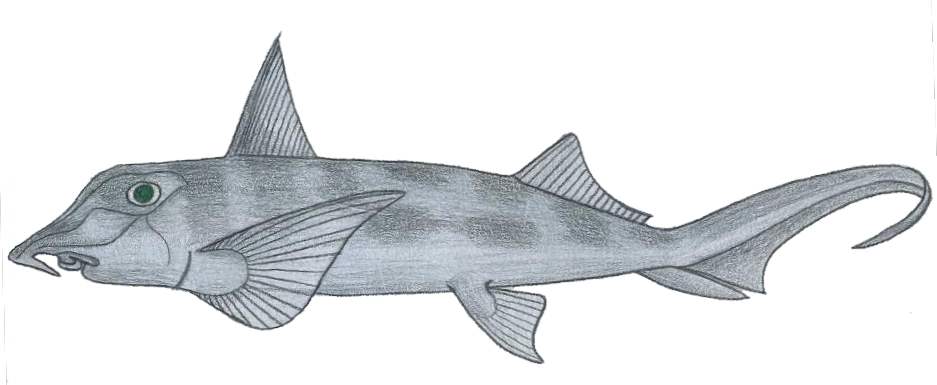
It is a cartilaginous fish of the subclass Holocephali with a rostral appendage on its snout; in San Matías Gulf its length was measured from that appendage to the start of the upper lobe of the caudal fin [5]. Among the 6 chimaeras recorded in Peruvian waters it is the only member of the family Callorhinchidae [6].
Mature males have fully calcified claspers that reach past the rear edge of the pelvic fin [5]. In front of each pelvic fin they also have a slit holding a retractable pre-pelvic clasper; in 22 males from Coquimbo this structure was twisted, ended in a funnel-shaped lobe and carried dermal denticles with 3 to 8 cusps [7].
Females grow larger: in the northern Argentine Sea the largest female measured 630 mm precaudal length and weighed 3330 g, against 482 mm and 1630 g for the largest male [8]. The 3 living species of the genus occupy separate regions of the Southern Hemisphere, and their mitochondrial sequences vary very little, both within each species and between them [9].
Distribution and habitat
In the Pacific it ranges from northern Peru, with records on the coast of Ecuador, to the Strait of Magellan; in the Atlantic it lives off Brazil, Uruguay and Argentina, down to the Beagle Channel [3]. It is demersal, has been recorded between 10 and 116 m depth and is usually found over sand and mud bottoms [3].
In San Matías Gulf, Argentina, there are feeding, breeding and nursery grounds; the shallower parts of the gulf are described as nursery and recruitment areas [5].
Mitochondrial sequences proved homogeneous across its range, with haplotypes shared between very distant places in Chile and Argentina, which points to gene flow along the South American coast [9]. For the genus, that exchange seems to follow continuous coastlines, while deep ocean waters act as a barrier [9].
Biology
In San Matías Gulf, with samples from September 2011 to November 2012, females reached an asymptotic length of 70.75 cm with K = 0.17 per year, and males 56.11 cm with K = 0.257 per year [5]. Half of the males were mature at 43.39 cm and half of the females at 47.48 cm; theoretical longevity was estimated at 13.7 years for males and 21.4 years for females [5]. There the peak of reproductive activity runs from August to November, when more females carrying egg capsules appear [5].
In coastal waters of northern Argentina, which it visits in winter and spring, females matured at 466 mm precaudal length and held on average 8.37 ovarian follicles [8]. No females with egg capsules or spermatophore masses were found, and the authors conclude the area is not a breeding ground [8]. Off Coquimbo, Chile, it has been suggested that it forms breeding aggregations from early spring and through summer [7].
At Pisco, out of 31 specimens, the 13 females averaged 64.12 cm total length and the 18 males 55.70 cm [3].
Ecology
It is a secondary consumer that crushes hard prey: off northern Argentina it ate mostly bivalves (55.61 % of the PSIRI index), followed by brachyuran crabs (10.62 %) and isopods (10.13 %), with a trophic level of 3.15 [10]. The diet of females changed with size, season and region, and as it grows the species can take larger bivalves [10].
In northern Argentine Patagonia, males ate mainly the bivalves Ennucula puelcha, Pitar rostratus and Aequipecten tehuelchus, and females the scallop Zygochlamys patagonica; juveniles fed on small snails, thin-shelled bivalves, amphipods and polychaetes [11]. The largest scallop it can take appears to be limited by the strength of its crushing apparatus [11].
At Pisco, 90.32 % of the fish carried at least one parasite, and 263 parasites of 6 species were counted [3]. The most frequent was the tapeworm Gyrocotyle rugosa, in the spiral valve of 77.42 % of the fish, followed by the monogenean Callorhynchocotyle callorhynchi on the gills (54.84 %) and the copepod Prokroyeria meridionalis (16.13 %) [3].
Conservation
Its global category is Vulnerable [4],[3]. In Chile and Argentina it is fished as a target and also kept when it turns up as bycatch, and because of its wide range its management may need cooperation between countries [9].
Argentine landings made up about 97 % of the species' catch in the southwest Atlantic: the minimum was 490 tonnes in 1992 and the maximum 2780 in 2009, with an annual average of 1600 tonnes between 1992 and 2011 [5]. There it is taken mainly as bycatch in trawls aimed at hake and at coastal species [5].
Health, toxicological and chemical relevance
Not medical advice. For a sting, a poisoning or an allergy, seek medical care.
In Argentine coastal waters, organochlorine pesticides, polychlorinated biphenyls (PCB), polybrominated diphenyl ethers (PBDE) and chlorpyrifos were measured in muscle, gonads and liver [12]. The liver had the highest levels, followed by muscle and gonads; endosulfan dominated among the organochlorines, and females and mature adults accumulated more [12]. The authors propose females as good indicators of this pollution [12].
At Pisco an unidentified nematode of the family Anisakidae was found in the spiral valve of 1 of 31 fish (3.23 %), recorded for the first time in this host [3].
Human relevance
At San Andrés, Pisco, it matters economically to the small-scale fishery: although it is caught incidentally, it is sold and eaten almost all year round, in ceviche, stewed or fried [3].
In San Matías Gulf it has historically been the second species by tonnes landed by the trawl fleet, and it is caught all year [5]. Off Coquimbo it is taken as bycatch by the small-scale flounder fishery and by industrial crustacean trawlers [7].
Where to see it in Peru
The most recent Peruvian study worked with 31 specimens fished at Lagunillas, in Paracas Bay, and at Laguna Grande, in Independencia Bay, and landed at San Andrés, Pisco, between June 2018 and October 2019 [3]. Earlier Peruvian work on the monogeneans of its gills used fish from Chorrillos, in Lima, and the tapeworm Gyrocotyle maxima had been recorded in specimens from Lima and La Libertad [3].
References (12)
- WoRMS Editorial Board (2026). Callorhinchus callorynchus (Linnaeus, 1758). World Register of Marine Species. https://www.marinespecies.org/aphia.php?p=taxdetails&id=278468 (accessed 2026-10-20)
- Froese, R., Pauly, D. (2026). Common names of Callorhinchus callorynchus. FishBase. https://www.fishbase.se/comnames/CommonNamesList.php?ID=8399&GenusName=Callorhinchus&SpeciesName=callorynchus&StockCode=8713 (accessed 2026-10-20)
- Iannacone, J., Rey, C., Minaya, D. (2022). Community of metazoan parasites of the cockfish Callorhinchus callorynchus (Linnaeus ,1758) (Chimaeriformes: Callorhinchidae) from artisanal fishing in Pisco, Ica, Peru. Revista del Museo Argentino de Ciencias Naturales, 77-87. doi:10.22179/revmacn.24.756 (accessed 2026-10-20)
- Finucci, B., Cuevas, J.M. (2019). Callorhinchus callorynchus: Finucci, B. & Cuevas, J.M. The IUCN Red List of Threatened Species 2020: e.T63107A3117894. doi:10.2305/IUCN.UK.2020-2.RLTS.T63107A3117894.en (accessed 2026-10-20)
- Bernasconi, J., Cubillos, L., Acuña, E. et al. (2015). Crecimiento, madurez y mortalidad del pez gallo, Callorhinchus callorynchus, en el Golfo San Matías, Patagonia norte, Argentina. Revista de Biología Marina y Oceanografía, 283-298. doi:10.4067/S0718-19572015000300007 (accessed 2026-10-20)
- Cornejo, R., Vélez-Zuazo, X., González-Pestana, A. et al. (2015). An updated checklist of Chondrichthyes from the southeast Pacific off Peru. Check List, 1809. doi:10.15560/11.6.1809 (accessed 2026-10-20)
- López-Jofré, Á., Hernández, S., Flores, H. (2023). Description of the dermal denticles on pre-pelvic claspers of the Cockfish, Callorhinchus callorynchus (Holocephali: Callorhinchidae), from Coquimbo, Chile. Revista de Biología Marina y Oceanografía, 186-193. doi:10.22370/rbmo.2023.58.3.4279 (accessed 2026-10-20)
- Chierichetti, M.A., Scenna, L.B., Di Giácomo, E.E. et al. (2017). Reproductive biology of the cockfish, Callorhinchus callorynchus (Chondrichthyes: Callorhinchidae), in coastal waters of the northern Argentinean Sea. Neotropical Ichthyology. doi:10.1590/1982-0224-20160137 (accessed 2026-10-20)
- Erk, C.P., Concha, F.J., Awruch, C. et al. (2025). Genetic diversity in the American elephantfish (Chimaeriformes: Callorhinchus callorynchus) and among its congeners. Journal of Fish Biology, 743-757. doi:10.1111/jfb.70073 (accessed 2026-10-20)
- Roman, J.M., Chierichetti, M.A., Barbini, S.A. et al. (2020). Feeding habits of the cockfish, Callorhinchus callorynchus (Holocephali: Callorhinchidae) from off northern Argentina. Neotropical Ichthyology. doi:10.1590/1982-0224-2018-0126 (accessed 2026-10-20)
- Di Giacomo, E.E., Perier, M.R. (1996). Feeding habits of cockfish, Callorhinchus callorhynchus (Holocephali: Callorhynchidae), in Patagonian waters (Argentina). Marine and Freshwater Research, 801-808. doi:10.1071/MF9960801 (accessed 2026-10-20)
- Chierichetti, M.A., Scenna, L.B., Ondarza, P.M. et al. (2021). Persistent organic pollutants and chlorpyrifos in the cockfish Callorhinchus callorynchus (Holocephali: Callorhynchidae) from Argentine coastal waters: Influence of sex and maturity. Science of The Total Environment, 148761. doi:10.1016/j.scitotenv.2021.148761 (accessed 2026-10-20)