
Marine life guide of Peru · Balaenopteridae
Eden's whale
Balaenoptera edeni Anderson, 1878
- Names in Peru
- Rorcual tropical · Ballena bryde · Ballena de Bryde
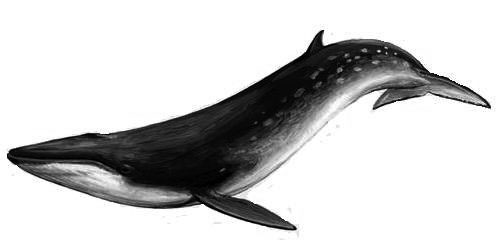
Species account
Summary
Balaenoptera edeni is a rorqual of the family Balaenopteridae, described by Anderson in 1878 [1]. For a long time it was treated together with Bryde's whale as a single species with two provisional subspecies, a small coastal one and a larger oceanic one [2]. A genomic study from 2025 proposes that they are separate species and that Balaenoptera brydei should be reinstated [3]. The 2026 master plan of the Mar Tropical de Grau National Reserve names the rorcual tropical and the ballena de Bryde as two species, both sighted in the Cabo Blanco – El Ñuro sector [4]. Its global IUCN Red List category is Least Concern [5].
Identification and similar species
The original description of Balaenoptera edeni was based on a mature specimen of 11.3 m, whereas Balaenoptera brydei was described from individuals of 12.4 to 15.0 m, larger at sexual and physical maturity [3]. The two original descriptions were thus distinguished by adult size [3]. The authors of a 2018 review warn that the labels coastal and oceanic can lead to an animal being assigned wrongly: the coastal population of New Zealand belongs to the large, oceanic form [2].
Whales of this group are often mistaken for other species [2]. An analysis of the mitochondrial DNA control region, with 56 new samples from Oman, the Maldives and Bangladesh, found 9 diagnostic characters that distinguish the small coastal subspecies from the large oceanic one [6]. The same 2018 review adds that the taxonomy will not be settled until the type specimen of Balaenoptera brydei is described and all molecular data are analysed globally [2].
Distribution and habitat
Bryde's whales in the broad sense live in warm-temperate and tropical waters worldwide, with a coastal and offshore presence that is hard to predict [2]. According to the authors of the 2025 genomic study, older proposals placed the small form along the coasts of the western Pacific and the Indian Ocean [3].
The genetic data for the small subspecies come from the northern Indian Ocean, with samples from Oman and Bangladesh, and from the coasts of Japan, and those two groups proved to be distinct population units [6]. The reference genome came from an animal stranded at Port Shelter, Hong Kong, on 31 July 2023 [3]. A 2018 review notes that some populations of the group are small, with fewer than 100 mature individuals [2].
Ecology
Bryde's whales eat pelagic and mesopelagic fishes, squid, krill and other zooplankton, and the diet changes from place to place [2]. In the upper Gulf of Thailand they feed on small fish, mostly anchovies, and besides oblique, vertical and lateral lunges they showed a new behaviour: lifting the head above the surface with the mouth open, seen on 58 occasions with 31 whales, among them 8 adult–calf pairs [7].
Unlike most baleen whales, they do not make the long seasonal migrations, although they can travel far: movements of 2000 to 3500 km were recorded off South Africa [2]. At Madeira, dives of up to 250 m were documented that follow the daily vertical migration of zooplankton [2].
Conservation
The species' global IUCN Red List category is Least Concern [5]. Few populations have abundance estimates, and those that do usually number in the hundreds of individuals, while others hold fewer than 100 adults [2].
The threats described for the group are entanglement in fishing gear and aquaculture lines, ship strikes, shipping noise that masks their calls, and hunting [2]. Classification also affects management: the 2025 authors ask for Balaenoptera brydei to be reinstated as a valid species [3], and the 2018 authors warn that the proposal cannot be adopted until its type specimen is described [2].
Human relevance
Bryde's whale was not extensively hunted in the commercial whaling era; in the early 1900s the two forms were caught together off South Africa and recorded as sei whales [2]. A Japanese scientific programme killed up to 50 whales a year until 2016, and in Southeast Asia opportunistic hunting may also take Omura's whale [2].
In Peru, the 2026 MINCETUR good-practice manual lists the ballena bryde among the cetaceans longer than 5 m, for which it sets a minimum approach distance of 100 m and 300 m if the animal is feeding or socialising [8].
Where to see it in Peru
The 2026 master plan of the Mar Tropical de Grau National Reserve records 13 of the 32 cetacean species cited for Peruvian waters in the Cabo Blanco – El Ñuro sector, among them the rorcual tropical and the ballena de Bryde, alongside the humpback, the fin whale and the blue whale [4].
The plan gives no dates, precise places or number of sightings of the rorcual tropical [4]. Because the taxonomy of the group is unresolved, this account cannot promise it can be seen on a given trip [2],[4].
References (8)
- WoRMS Editorial Board (2026). Balaenoptera edeni Anderson, 1878. World Register of Marine Species. https://www.marinespecies.org/aphia.php?p=taxdetails&id=137089 (accessed 2026-10-25)
- Constantine, R., Iwata, T., Nieukirk, S.L. et al. (2018). Future Directions in Research on Bryde's Whales. Frontiers in Marine Science, 333. doi:10.3389/fmars.2018.00333 (accessed 2026-10-25)
- Lin, Y.-T., Hui, F., Han, W. et al. (2025). Chromosome-Level Genome Assembly of Eden's Whale Clarifies the Taxonomy and Speciation of Bryde's Whale Complex. Molecular Biology and Evolution, msaf234. doi:10.1093/molbev/msaf234 (accessed 2026-10-25)
- Servicio Nacional de Áreas Naturales Protegidas por el Estado (2026). Plan Maestro de la Reserva Nacional Mar Tropical de Grau 2026–2031. Anexo de la Resolución de Presidencia Ejecutiva N.° 000052-2026-SERNANP/PE. https://cdn.www.gob.pe/uploads/document/file/9468842/7752998-5-pm_2026-2031_rnmtg-f-f-f-f.pdf (accessed 2026-10-25)
- Cooke, J.G., Brownell Jr., R.L. (2017). Balaenoptera edeni: Cooke, J.G. & Brownell Jr., R.L. The IUCN Red List of Threatened Species 2018: e.T2476A50349178. doi:10.2305/IUCN.UK.2018-1.RLTS.T2476A50349178.en (accessed 2026-10-25)
- Kershaw, F., Leslie, M.S., Collins, T. et al. (2013). Population Differentiation of 2 Forms of Bryde's Whales in the Indian and Pacific Oceans. Journal of Heredity. doi:10.1093/jhered/est057 (accessed 2026-10-25)
- Iwata, T., Akamatsu, T., Thongsukdee, S. et al. (2017). Tread-water feeding of Bryde's whales. Current Biology. doi:10.1016/j.cub.2017.09.045 (accessed 2026-10-25)
- Ministerio de Comercio Exterior y Turismo (2026). Manual de buenas prácticas de gestión de servicio turístico para la actividad de observación de fauna marina, 3.ª ed. MINCETUR. https://cdn.www.gob.pe/uploads/document/file/10041919/8184632-mbp_faunamarina_3ra.pdf (accessed 2026-10-25)