
Marine life guide of Peru · Batrachoididae
Monkfish
Aphos porosus (Valenciennes, 1837)
- Names in Peru
- Pez bagre · Pez fraile
Species account
Summary
Aphos porosus is a bottom-dwelling fish of the family Batrachoididae, order Batrachoidiformes, and the only species in its genus [1],[2]. It lives along the Southeast Pacific coast, from Puerto Pizarro, in Peru, to the Strait of Magellan, in Chile [2]. In the Chilean literature it is called «bagre de mar» [3] and it breeds in spring: the adults come to rocky shore pools, stick their eggs to the rock and guard them, and the larvae stay attached to the substrate for weeks [2]. Its global category on the IUCN Red List is Least Concern [4].
Etymology
Valenciennes described it in 1837 under the name Batrachus porosus, and it is now accepted as Aphos porosus [1]. The genus Aphos is monotypic [2]. In 1917 Evermann and Radcliffe described a new species, Porichthys afuerae, from a single 12.6 cm specimen from Lobos de Afuera, in Peru, and it is now listed as a synonym of Aphos porosus [5],[1]. The original description mentions lines of phosphorescent organs [5], which later literature says Aphos lacks [2], so that synonymy has not been checked here [1],[5].
Identification and similar species
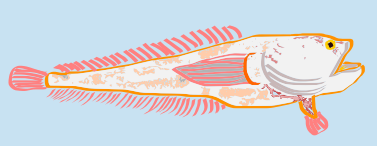
Batrachoidids live associated with the bottom and nearly all have luminous organs on the body; Aphos is the exception [2]. It is a small fish: the Chilean literature gives it about 28 cm total length [3]. In the Valparaíso pools, adult females averaged 17.2 cm and males 24.6 cm [2].
The early stages help to recognise it: its eggs are yellow-orange and 5.3 mm across, much larger than those of other fishes of the Chilean coast [2]. In a free-swimming larva of 25.0 mm, 2 spines and 34 rays were counted in the dorsal fin, 31 rays in the anal fin and 19 in the pectoral [2]. By 24.0 mm TL the larvae already show the juvenile pigmentation pattern, with dorsal pigment patches and a soft yellow-orange belly [2].
Distribution and habitat
Its range runs from Puerto Pizarro, in Peru, to the Strait of Magellan [2],[6], that is, between 3° and 53° S, and from the shore down to about 100 m depth [7]. In Chile it is the only species of its family [6].
In central Chile, in spring, it moves from shallow soft bottoms to intertidal zones to breed [3]. There it lays its eggs in crevices and on the vertical or lower faces of stones in sheltered pools, in 10 to 30 cm of water [2]. In Coliumo Bay, which is less than 25 m deep and mostly sandy, it is the dominant fish of the soft bottom [6].
Biology
In Valparaíso Bay the males arrive at the pools from October and the females from mid-November to December, and spawning was seen in November and December [2]. Two clutches that were counted held between 103 and 167 eggs, laid in a single, almost continuous layer and fixed to the rock by an adhesive substance that the males apparently produce [2]. The males guard the clutch and, if something approaches, move toward it aggressively while making sounds like grunts [2].
Eggs took 18 d to hatch in water at 18.6 °C and 21 d at 16.3 °C; the newly hatched larvae averaged 4.8 mm and stayed attached to the rock by the yolk sac [2]. They released from the substrate between 60 and 65 d of age, at 20.5 to 24.0 mm length [2].
In Coliumo Bay the size at first maturity was estimated at 15.3 cm total length, and females with hydrated ovaries had gonads making up between 32 and 40 % of their body weight [6]. In that bay there were 3 recruitment events between 2007 and 2010, of individuals of about 4 cm [6]. The generation time is about 3 years [7].
Ecology
It is a strict carnivore that, according to the studies cited by Cortés and Muñoz, eats gastropods, bivalves, bony fishes and decapod crustaceans [3]. Hernández-Miranda and colleagues describe it as a predator of small gastropods, fishes and amphipods, that is, a consumer of intermediate trophic level [6].
Of 30 fish from El Tabo, 93 % had parasites: 2104 individuals of 9 taxa were collected [3]. Of 101 fish from three springs, 94.1 % were parasitised, with 5532 parasites of 12 taxa, mostly larval tetraphyllidean cestodes and anisakid nematodes [8]. All the endoparasites were in larval stages, so the toadfish is an intermediate or paratenic host, and the adult parasites live in elasmobranchs and marine mammals, which suggests that the fish is prey for those groups [3].
A stranding caused by lack of oxygen in Coliumo Bay in January 2008 left 396 individuals, of which 95.0 % were juveniles [6]. Mean density fell from 96.98 individuals per 500 m2 in 2007 to 25.82 in 2008 and 13.6 in 2009 [6].
Conservation
Its global category on the IUCN Red List is Least Concern [4].
Even so, local populations can be fragile: the eggs stick to the rock and the larvae have no pelagic phase, so dispersal is limited [7]; in addition, Hernández-Miranda and colleagues propose that after the 2008 hypoxia the fall in population size reduced encounters between reproductive adults and may have pushed the species toward an Allee effect [6].
In the 2008 hypoxia density fell by 75 % in Coliumo Bay and by 54 % on the Itata shelf, and after the earthquake and tsunami of February 2010 it dropped again by 83 % and 64 %, respectively [7]. With 13 microsatellites, genetic diversity and effective population size (below 20) were lower after both disturbances, and the authors call for continued genetic monitoring [7].
Human relevance
The family has no commercially valuable species, and in Chile Aphos porosus appears mainly as bycatch of the industrial and artisanal common hake fisheries [6].
Its interest is scientific: it has been used to study the parasite community of intertidal fishes, the effect of hypoxia on a coastal population and population genetics after natural disturbances [3],[6],[7].
Where to see it in Peru
In Peru the literature that places the species is scarce and this account has no recent record to cite. In 1917 Evermann and Radcliffe documented a 12.6 cm specimen from Lobos de Afuera, then described as Porichthys afuerae (identity doubtful, see Etymology) [5], and Chilean works put the northern end of its range at Puerto Pizarro, in Peru [2].
References (8)
- WoRMS Editorial Board (2026). Aphos porosus (Valenciennes, 1837). World Register of Marine Species. https://www.marinespecies.org/aphia.php?p=taxdetails&id=279640 (accessed 2026-10-25)
- Balbontín, F., Bustos, C.A., Landaeta, M.F. (2018). Comportamiento reproductivo y desarrollo de los estadios tempranos del bagre marino Aphos porosus, de la bahía de Valparaíso, Chile. Revista de Biología Marina y Oceanografía, 77-87. doi:10.22370/rbmo.2018.53.0.1257 (accessed 2026-10-25)
- Cortés, Y., Muñoz, G. (2008). Infracomunidades de parásitos eumetazoos del bagre de mar Aphos porosus (Valenciennes, 1837) (Actinopterygii: Batrachoidiformes) en Chile central. Revista de biología marina y oceanografía, 255-263. doi:10.4067/s0718-19572008000200004 (accessed 2026-10-25)
- Collette, B., Acero, A., Betancur, R. (2007). Aphos porosus: Collette, B., Acero, A. & Betancur, R. The IUCN Red List of Threatened Species. doi:10.2305/IUCN.UK.2010-3.RLTS.T183734A8166907.en (accessed 2026-10-25)
- Evermann, B.W., Radcliffe, L. (1917). The fishes of the west coast of Peru and the Titicaca Basin. Bulletin of the United States National Museum, 152-153. doi:10.5479/si.03629236.95.i (accessed 2026-10-25)
- Hernández-Miranda, E., Quiñones, R.A., Aedo, G. et al. (2012). The impact of a strong natural hypoxic event on the toadfish Aphos porosus in Coliumo Bay, south-central Chile. Revista de biología marina y oceanografía, 475-487. doi:10.4067/s0718-19572012000300010 (accessed 2026-10-25)
- Vásquez, C., Vera-Escalona, I., Brante, A. et al. (2023). Natural mega disturbances drive spatial and temporal changes in diversity and genetic structure on the toadfish Aphos porosus. Scientific Reports. doi:10.1038/s41598-023-40698-1 (accessed 2026-10-25)
- Cortés, Y., Muñoz, G. (2009). Metazoan Parasite Infracommunities of the Toadfish Aphos porosus (Pisces: Batrachoidiformes) in Central Chile: How Variable Are They over Time?. Journal of Parasitology, 753-756. doi:10.1645/ge-1651.1 (accessed 2026-10-25)