
Marine life guide of Peru · Actiniidae
Anemonia alicemartinae
Anemonia alicemartinae Häussermann & Försterra, 2001
Species account
Summary
Anemonia alicemartinae is a sea anemone of the family Actiniidae, order Actiniaria [1]. It is regarded as cryptogenic, that is, of unknown origin: since its first record in northern Chile, cited as Actinia sp. in 1979, its range has spread southward over the last 50 years and now covers more than 1900 km of coastline [2]. It lives in the low intertidal zone and the shallow subtidal, and seems to reproduce mainly by fission [2].
Identification and similar species
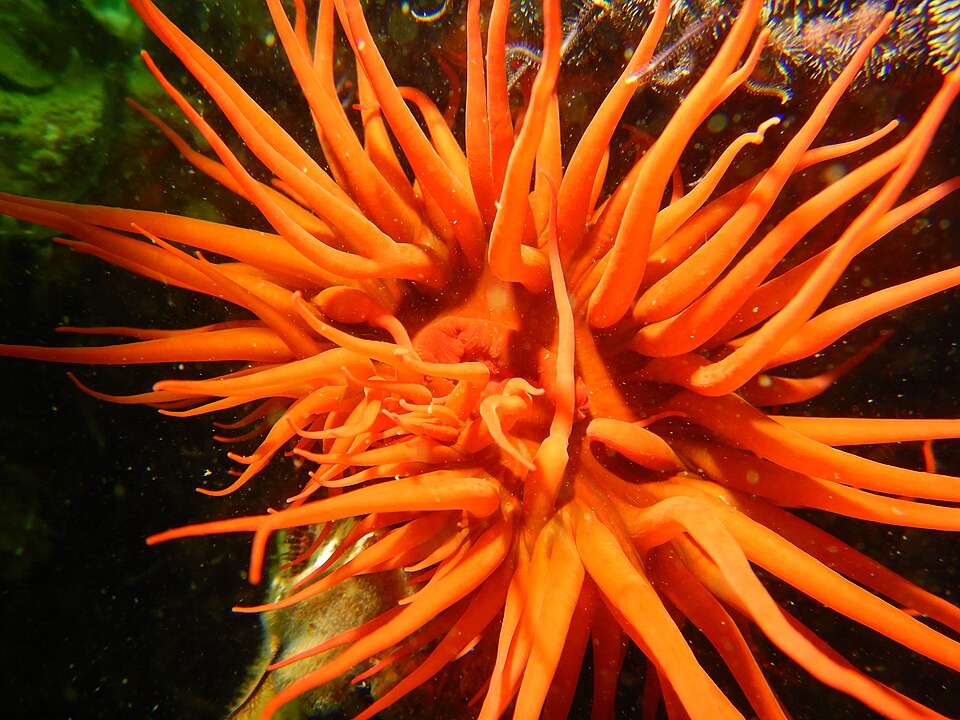
The Anemonia alicemartinae specimens used in a behavioural study in south-central Chile were light red, with a pedal disc 35 to 40 mm across [3]. In the field it is found attached to rocks and algae, and even half-buried in sand [2].
The sources consulted for this account describe its behaviour rather than its anatomy and give no diagnostic characters; a secure identification requires the original description, published in 2001 [1].
Similar species
- Phymactis papillosa: It shares the low intertidal zone with it in south-central Chile. The Anemonia alicemartinae in the study were light red, whereas the red-phenotype Phymactis papillosa were a darker red; this second species also has green and blue phenotypes [3].
Distribution and habitat
Published studies place it on the south-eastern Pacific coast, from Arica at 18° S to the Concepción region at about 36° S [4]. Its range is estimated to have grown by about 1928 km in 50 years [4], at an estimated 38 km per year [3], and it already crosses the biogeographic limit at 30° S [4]. A genetic study, cited by Brante and colleagues, suggested that the present population descends from a small ancestral population, probably from southern Peru, and that its southward spread was helped by maritime transport [3]. WoRMS gives the south-eastern Pacific as its region and, for the Chilean part, an uncertain origin [1].
It occupies the low intertidal zone and the shallow subtidal, including tide pools, on rocks, algae, or half-buried in sand [2]. In an ecological niche model, surface salinity and the annual variation in sea surface temperature best explained where it lives, and the areas most susceptible to its arrival further south were Biobío, the inland sea of Chiloé, Aysén and Chacabuco [4].
Biology
Fission seems to be its main way of reproducing, which probably makes up for the scarcity or absence of fertile males in populations [2]. It is not choosy about substrate and can let go and reattach [2].
In an experiment with about 100 individuals from Lirquén (36° S), 58 % let go of their substrate after two hours of treatment, and 64 % of those did so without being sprayed. More let go when on algae than on rock, more when exposed to air than when submerged, and more at 30 °C than at 10 °C [2].
In the field 51 individuals were marked: in tide pools 86 % were seen again after 24 hours, but on a boulder beach no more than 42 % were, and only 28 % at the wave-exposed site. Those on algae tended to disappear. In aquaria, 20 individuals moved less than 3 cm a day on average [2].
Ecology
In south-central Chile it shares the low intertidal zone with the native anemone Phymactis papillosa [3]. In 20 replicates per treatment, a single Anemonia alicemartinae lost 80 % of its contests against a single green Phymactis papillosa, and when groups of both species met it lost 75 % [3]. Against the red phenotype the results were less uniform, although in several arrangements it also lost, up to 60 % of the time [3].
Between individuals of its own species there were few aggressive interactions and most encounters ended in a tie, perhaps because asexual reproduction yields many clones that recognise one another [3]. Attacks by Phymactis papillosa caused no necrosis or death at least within 2 days: the attacked anemone lost some tentacles and sometimes let go and drifted away [3].
It reaches its highest densities in intertidal and subtidal zones where no other anemones are present [3]. It is a weak competitor, and its success could instead be explained by escape, asexual reproduction and high dispersal capacity [3].
Conservation
The sources consulted contain no assessment of its threat status. It is rather a cryptogenic species that is spreading, and WoRMS records its origin as uncertain in Chilean waters [1].
In an ecological niche model, the areas the model rated most suitable showed a positive and significant relationship with the number of ship landings, taken as a measure of human activity [4]. In addition, according to a genetic study by Canales-Aguirre and colleagues cited in that work, genetic diversity was higher near the main Chilean ports and there was no genetic structure along the coast, which points to maritime transport as an aid to its dispersal [4]. The competition experiments suggest, by contrast, that it does not prevail over the native anemone through aggressive interactions [3].
Human relevance
Its interest is mainly scientific: it is a case study of marine invasion in the Humboldt-current ecosystem, used to test hypotheses about human-mediated dispersal [4] and about the role of competition in the success of an expanding species [3].
Knowing its distribution and the factors that limit it helps in planning management and control measures for non-native species, and the niche model points out where it might arrive next [4].
References (4)
- Rodríguez, E., Fautin, D., Daly, M. (2026). Anemonia alicemartinae Häussermann & Försterra, 2001. World Register of Marine Species (World List of Actiniaria). https://www.marinespecies.org/aphia.php?p=taxdetails&id=283318 (accessed 2026-10-25)
- López, D.N., Arancibia, P.A., Neill, P.E. (2013). Potential dispersal mechanisms of the cryptogenic anemone, Anemonia alicemartinae. Revista chilena de historia natural, 369-372. doi:10.4067/s0716-078x2013000300014 (accessed 2026-10-25)
- Brante, A., Riera, R., Riquelme, P. (2019). Aggressive interactions between the invasive anemone Anemonia alicemartinae and the native anemone Phymactis papillosa. Aquatic Biology, 127-136. doi:10.3354/ab00718 (accessed 2026-10-25)
- Pinochet, J., Rivera, R., Neill, P.E. et al. (2019). Spread of the non-native anemone Anemonia alicemartinae Häussermann & Försterra, 2001 along the Humboldt-current large marine ecosystem: an ecological niche model approach. PeerJ, e7156. doi:10.7717/peerj.7156 (accessed 2026-10-25)