
Marine life guide of Peru · Epinephelidae
Pacific mutton hamlet
Alphestes immaculatus Breder, 1936
Species account
Summary
Alphestes immaculatus is a fish of the family Epinephelidae, the groupers, described by Breder in 1936 [1]. In English it is called the Pacific mutton hamlet, and in Spanish WoRMS gives it the name guaseta del Pacífico [1]. It lives in the eastern Pacific, from the northern Gulf of California to Peru, and is a small fish that does not exceed about 30 cm [2]. By day it hides in crevices or among seaweed, and at night it hunts [2]. Its global category on the IUCN Red List is Least Concern [3].
Etymology
Identification and similar species
It is a grouper with a fusiform body, bearing 11 spines and 17 to 19 soft rays in the dorsal fin, and 3 spines and 9 soft rays in the anal fin [2]. The rear edge of the preopercle is rounded and serrated, and at its angle there is a large spine, usually covered by skin [2].
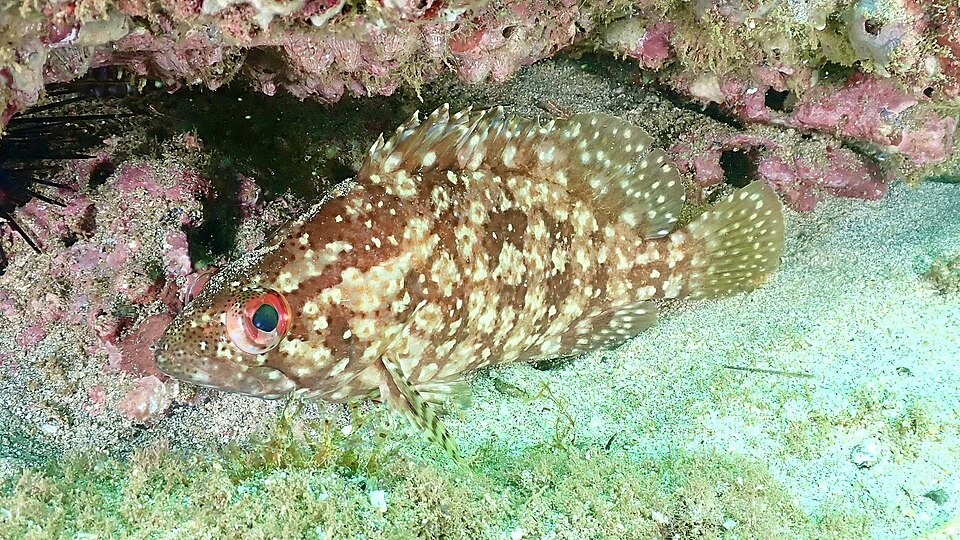
In life, the body is marbled reddish brown, with indistinct bars and small dark and pale spots on the head, body and median fins [2]. Each pectoral fin has 7 or 8 irregular rows of small dark spots [2]. Body depth is less than or equal to head length, and the eye diameter is similar to the snout length [2].
Distribution and habitat
It occurs in the eastern Pacific, from the northern Gulf of California to Peru, including the Galapagos Islands [2]. The tropical limits given by FishBase run from 32° north to 13° south latitude [2]. WoRMS treats it as a strictly marine species [1].
It is a demersal, non-migratory fish, recorded between 1 and 50 m deep [2]. It lives in seagrass beds and also on rocky reefs [2]. A 2025 Peruvian study of DNA tools for authenticating seafood included Alphestes immaculatus among 10 commercially important Peruvian marine species [4].
Biology
FishBase describes it as a cryptically coloured, secretive fish: by day it shelters in crevices or among seaweed, sometimes partly covering itself with sand; at night it hunts, feeding mainly on benthic crustaceans [2]. The largest recorded size is 30 cm in total length, and the usual size is around 18 cm [2].
Part of its molecular biology is known from a study of the hepcidin gene, a peptide whose expression in muscle the authors consider possibly relevant to the immune response [5]. In that work, the species' HAMP1 gene turned out to have 3 exons and 2 introns, and to encode a molecule of 90 amino acids [5]. Baseline expression was high in the liver and muscle; in fish stimulated with bacterial lipopolysaccharide, the highest levels shifted to the spleen and head kidney [5].
Ecology
Conservation
Human relevance
In Peru, many groupers of the family Epinephelidae (for example species of Alphestes, Epinephelus and Mycteroperca) are sold under one generic commercial label, and groupers in general are fish of high economic value and a frequent target of substitution [4].
References (5)
- Froese, R., Pauly, D. (2026). Alphestes immaculatus Breder, 1936. World Register of Marine Species. https://www.marinespecies.org/aphia.php?p=taxdetails&id=279568 (accessed 2026-10-25)
- Froese, R., Pauly, D. (2026). Alphestes immaculatus, Pacific mutton hamlet. FishBase. https://www.fishbase.se/summary/Alphestes-immaculatus.html (accessed 2026-10-25)
- Erisman, B., Craig, M.T. (2016). Alphestes immaculatus: Erisman, B. & Craig, M.T. The IUCN Red List of Threatened Species 2018: e.T132754A100391528. doi:10.2305/iucn.uk.2018-2.rlts.t132754a100391528.en (accessed 2026-10-25)
- Marín, A., Alfaro, R., Reyes-Flores, L.E. et al. (2025). Development and validation of versatile species-specific primer assays for eDNA monitoring and authentication of 10 commercially important Peruvian marine species. PLOS One 20, e0313181. doi:10.1371/journal.pone.0313181 (accessed 2026-10-25)
- Masso-Silva, J.A., Diamond, G., Macias-Rodriguez, M.E. et al. (2011). Genomic organization and tissue-specific expression of hepcidin in the pacific mutton hamlet, Alphestes immaculatus (Breder, 1936). Fish & Shellfish Immunology 31, 1297-1302. doi:10.1016/j.fsi.2011.10.007 (accessed 2026-10-25)