
Marine life guide of Peru · Alopiidae
Thresher shark
Alopias pelagicus Nakamura, 1935
Species account
Summary
Alopias pelagicus is a thresher shark in the family Alopiidae, order Lamniformes [1]. It is recognised by an upper tail lobe almost as long as the rest of the body and by a very narrow head with an arched profile; it reaches at least 365 cm total length [2]. It is an epipelagic Indo-Pacific species taken in several fisheries, including longline fisheries [2]. In Peru it entered the chondrichthyan checklist in 2015 as a recent record [3].
Etymology
Nakamura described it in 1935 from three large individuals of 270, 285 and 330 cm, plus an illustrated specimen of uncertain size, all from the Suô fish market in Taiwan [2]. He designated no types, and the FAO catalogue notes that a neotype from Taiwanese material may be needed [2].
A 96.5 cm foetus that Nakamura included in the description is probably Alopias vulpinus, so the name is now used in the restricted sense of Bass and colleagues (1975) and later revisions, based on the illustrated adult [2]. It was often confused with Alopias vulpinus, and several older illustrations from the Red Sea, eastern Pacific, New Caledonia, Tahiti and Hawaii carried that wrong name [2]. Its FAO name in Spanish is «zorro pelágico» [2].
Identification and similar species
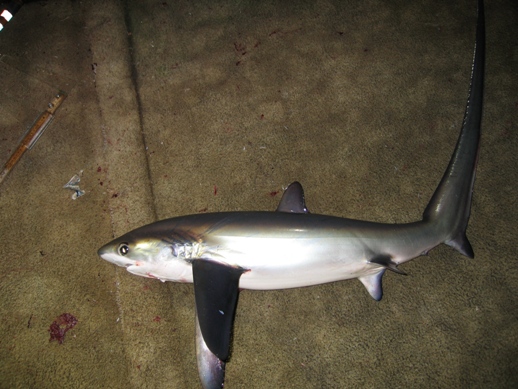
The upper tail lobe is very long, close to the length of the remainder of the body, and the tip of the caudal fin is very slender. The head is very narrow with an arched dorsal profile, the snout is conical and moderately long, and the eyes are moderate in adults but very large in newborns and foetuses; there are no labial furrows [2].
The body is deep blue to grey above, with silvery sides and a white belly; the white of the abdomen does not extend over the pectoral-fin bases and there is no white dot on the upper pectoral-fin tips. The pectoral fins are straight with very broad tips, and the teeth are very small, in 75 to 86 rows in total [2].
It is apparently smaller than Alopias superciliosus and Alopias vulpinus: it reaches at least 365 cm total length, and adult males measure from about 259 cm and adult females from about 265 cm in Taiwan [2].
Similar species
- Alopias vulpinus: Alopias vulpinus has a broad head with a strongly convex profile, a short snout, labial furrows and falcate pectoral fins, and the white of the belly rises over the pectoral-fin bases [2][2].
- Alopias superciliosus: Alopias superciliosus has huge eyes extending onto the top of the head, a notched head profile and strong grooves on the nape [2].
Distribution and habitat
It is an oceanic, wide-ranging species of the Indo-Pacific; in the eastern Pacific it has been recorded off California, Baja California, the Gulf of California, equatorial waters northwest of French Polynesia and the Galapagos Islands, and it has not been found in the Atlantic or the Mediterranean [2]. For Peru, the 2015 updated chondrichthyan checklist counts it among 9 records published since 2009 that were not listed before [3].
It is mostly epipelagic and circumtropical; it is sometimes caught near shore where the shelf is narrow, and has been recorded from the surface to at least 152 m [2]. A recent study reports that it typically spends most of the day at 200–300 m and most of the night at 50–150 m [4].
Biology
It is ovoviviparous, with uterine cannibalism: embryos live on their yolk sac until about 12 cm and then eat unfertilised eggs. The litter is 2 pups, one per uterus, and females give birth all year without a defined season [2].
The young are very large: the largest foetus measured off Taiwan was 158 cm. There, 50% of males are mature at 267 to 276 cm and 50% of females at 282 to 292 cm [2].
The vertebrae lay down one ring a year; females mature at about 8 or 9 years and males at about 6 to 9 years, and the maximum age estimated from growth curves is 20 years for males and 29 for females [2]. The catalogue estimates that a female could bear about 40 pups in her lifetime if she bred every year [2].
Ecology
It is presumed to eat small fishes and squid, but the FAO catalogue gives no details [2]. In mainland Ecuadorian waters its main prey are three squids, including the jumbo squid Dosidicus gigas, according to a 2020 study cited by the Galapagos paper [4].
A stable-isotope study of 33 vertebrae of the species from the Galapagos Marine Reserve found differences between neonates and juveniles and no contrast between males and females [4]. Off Costa Rica, 32 individuals caught in 2022 on longlines measured between 222 and 300 cm; all were parasitised, with 24 parasite taxa in total, and squid and fishes of the family Scombridae were seen in their stomachs [5].
It probably migrates, although its movements are poorly known, and one observer saw it leap out of the water repeatedly [2]. Genetic analysis of 351 samples from 6 Pacific localities indicates two distinct evolutionary units, one in the western Pacific and one in the eastern Pacific [6].
Conservation
The species is listed in Appendix II of the Convention on Migratory Species (CMS) since 2014 [7]. The FAO catalogue says its conservation status is uncertain, and reports that Liu and colleagues (1999) considered it extremely vulnerable to overexploitation, because of its very low fecundity and relatively high age at maturity, and in need of close monitoring [2].
Cardeñosa and colleagues recommend revising management plans across its range, given the two evolutionary units they found [6]. In the Central and South American Pacific, the species is a qualifying species in 12 Important Shark and Ray Areas (ISRAs) [8].
Health, toxicological and chemical relevance
Not medical advice. For a sting, a poisoning or an allergy, seek medical care.
The FAO catalogue describes it as harmless to people, and reports that according to Michael (1993) it is shy and hard to approach underwater [2].
Human relevance
People use its meat, its liver oil (a source of vitamin A), its skin as leather and its fins in soup; about 222 tonnes are landed yearly in Taiwan [2]. In Colombian ports and in seizures from vessels finning sharks illegally, more than 95% of genotyped samples were this species [6].
A 2024 study reports that in the Ecuadorian Pacific thresher sharks (Alopias spp.) exceed 70% of the shark catch [4].
Where to see it in Peru
In Peru it is on the 2015 chondrichthyan checklist, but that source does not say where it is seen [3]. It is an oceanic species that divers seldom encounter; some have seen and photographed it on reefs and seamounts in the Gulf of California and the Red Sea, and it is not a regular subject of ecotourism diving [2].
References (8)
- WoRMS Editorial Board (2026). Alopias pelagicus Nakamura, 1935. World Register of Marine Species. https://www.marinespecies.org/aphia.php?p=taxdetails&id=220019 (accessed 2026-10-25)
- Compagno, L.J.V. (2001). FAO species catalogue for fishery purposes No. 1. Sharks of the world. An annotated and illustrated catalogue of shark species known to date. Volume 2. Bullhead, mackerel and carpet sharks (Heterodontiformes, Lamniformes and Orectolobiformes). FAO Species Catalogue for Fishery Purposes No. 1, Vol. 2. FAO, Rome, 81-83. https://www.fao.org/docrep/pdf/009/x9293e/x9293e05.pdf (accessed 2026-10-25)
- Cornejo, R., Vélez-Zuazo, X., González-Pestana, A. et al. (2015). An updated checklist of Chondrichthyes from the southeast Pacific off Peru. Check List, 1809. doi:10.15560/11.6.1809 (accessed 2026-10-25)
- Arnés-Urgellés, C., Galván-Magaña, F., Elorriaga-Verplancken, F.R. et al. (2024). Ontogenetic feeding shifts in two thresher shark species in the Galapagos Marine Reserve. PeerJ, e18681. doi:10.7717/peerj.18681 (accessed 2026-10-25)
- Santoro, M., Occhibove, F., Cusano, L.M. et al. (2025). Parasite community of the pelagic thresher Alopias pelagicus (Lamniformes) as additional indicator of trophic network status and functioning. Scientific Reports, 26473. doi:10.1038/s41598-025-11572-z (accessed 2026-10-25)
- Cardeñosa, D., Hyde, J., Caballero, S. (2014). Genetic Diversity and Population Structure of the Pelagic Thresher Shark (Alopias pelagicus) in the Pacific Ocean: Evidence for Two Evolutionarily Significant Units. PLoS ONE, e110193. doi:10.1371/journal.pone.0110193 (accessed 2026-10-25)
- Convention on the Conservation of Migratory Species of Wild Animals (2026). Alopias pelagicus. CMS species pages. https://www.cms.int/en/species/alopias-pelagicus (accessed 2026-10-25)
- García-Rodríguez, E., Gonzalez-Pestana, A., Charles, R. et al. (2025). Mapping Important Shark and Ray Areas (ISRAs) in the Central and South American Pacific: Existing knowledge and data needs. PLOS One, e0322445. doi:10.1371/journal.pone.0322445 (accessed 2026-10-25)