
Marine life guide of Peru · Rhopalonematidae
American pipit
Aglaura hemistoma Péron & Lesueur, 1810
Species account
Summary
Aglaura hemistoma is a tiny hydromedusa, under 4 mm across, that drifts in the water column of warm and temperate seas worldwide [1],[2]. In the eastern tropical Pacific it was one of the most abundant and constant medusae in the 1967 to 1968 plankton collections, including waters off southern Peru [1].
Identification and similar species
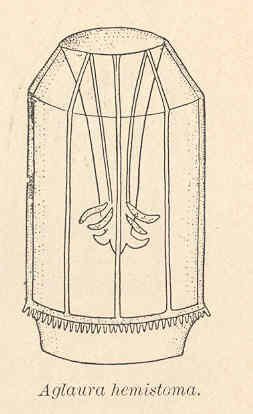
The bell is dome-shaped with a flat apex, 0.5 to 4.0 mm across and 0.5 to 5.0 mm high; the jelly is thin but stiff and the velum is wide [1]. The stomach is small and hangs from a conical peduncle; the mouth has 4 simple lips. Sausage-shaped gonads sit on the peduncle, where the 8 radial canals meet the stomach [1].
The 8 radial canals are straight and broad, as is the ring canal. There are 48 to 85 solid, brittle marginal tentacles that usually break off; when whole they reach about 3/4 of the bell diameter and end in a club shape. There are 8 statocysts, one in each space between radial canals [1]. The species belongs to the family Rhopalonematidae and has had several synonyms, among them Aglantha globuligera [3].
Distribution and habitat
It is a species of warm and temperate waters in all oceans, the Mediterranean included, between roughly 40°N and 40°S [1]. WoRMS describes it as circum(sub)tropical and gives Nice as the type locality [3]. In the eastern tropical Pacific the 1967 to 1968 nets took it between 20°N and 20°S and from the coast out to 126°W, in samples from the upper 200 m [1].
In the southern Gulf of Mexico (cruise of May to June 2006) it concentrated on Campeche Bank and was scarce in Campeche Bay. Its density correlated negatively with water temperature (23.4 to 29.1 °C in the upper 30 m), with the highest concentrations in the cooler waters of Campeche Bank; salinity was mostly above 36 [4].
Biology
It feeds omnivorously: in a study of gut contents and prey capture, protists were its main food, and its feeding current is effective at capturing protists of low motility [2].
According to WoRMS only its medusa phase is known and development is direct [3]. In 13 of 11,723 specimens from the eastern tropical Pacific, narcomedusa larvae were found attached under the bell, near the base of the peduncle [1].
Ecology
It was among the most abundant and common species at most stations and through all 5 bimonthly periods of 1967 to 1968, although its abundance fell in April-May 1967 [1]. In February-March 1967 it was missing from a coastal strip, except for one patch from southern Ecuador to northern Peru; the author possibly links this to cold Peru Current water advancing, since the species is typical of warm settings [1].
In August-September 1967 it was absent from a wide zone off Ecuador and Peru, with other populations off the southern coasts of Peru [1]. In the Gulf of Mexico its high-density areas were separate from those of Liriope tetraphylla (segregation index 0.88) and Nausithoe punctata (0.84) [4].
Where to see it in Peru
The study that records it off Peru was based on plankton nets, not diving: in 1967 and 1968 it was collected with conical nets 0.5 m across and 333 micron mesh, mostly at night, in the upper 200 m [1]. Its bell measures 0.5 to 4.0 mm across [1].
That study recorded it off the southern coasts of Peru in August-September 1967, when it was absent from a wide zone off Ecuador and Peru [1].
References (4)
- Segura-Puertas, L. (1984). Morfología, sistemática y zoogeografía de las medusas (Cnidaria: Hydrozoa y Scyphozoa) del Pacífico Tropical Oriental. Publicaciones Especiales del Instituto de Ciencias del Mar y Limnología, UNAM, núm. 8. https://biblat.unam.mx/hevila/PublicacionesespecialesInstitutodeCienciasdelMaryLimnologiaUNAM/1984/no8/8.pdf (accessed 2026-10-25)
- Colin, S.P., Costello, J.H., Graham, W.M. et al. (2005). Omnivory by the small cosmopolitan hydromedusa Aglaura hemistoma. Limnology and Oceanography, 1264-1268. doi:10.4319/lo.2005.50.4.1264 (accessed 2026-10-25)
- WoRMS Editorial Board (2026). Aglaura hemistoma Péron & Lesueur, 1810. World Register of Marine Species. https://www.marinespecies.org/aphia.php?p=taxdetails&id=117851 (accessed 2026-10-25)
- Flores-Coto, C., Puente-Tapia, A., Sanvicente Añorve, L. et al. (2016). Segregated Distribution of <i>Liriope tetraphylla</i>, <i>Aglaura hemistoma</i> and <i>Nausithoe punctata</i> (Cnidaria) in the Southern Gulf of Mexico. Open Journal of Ecology, 568-578. doi:10.4236/oje.2016.69055 (accessed 2026-10-25)