
Marine life guide of Peru · Etmopteridae
Hooktooth Dogfish
Aculeola nigra de Buen, 1959
- Names in Peru
- Tollo negro
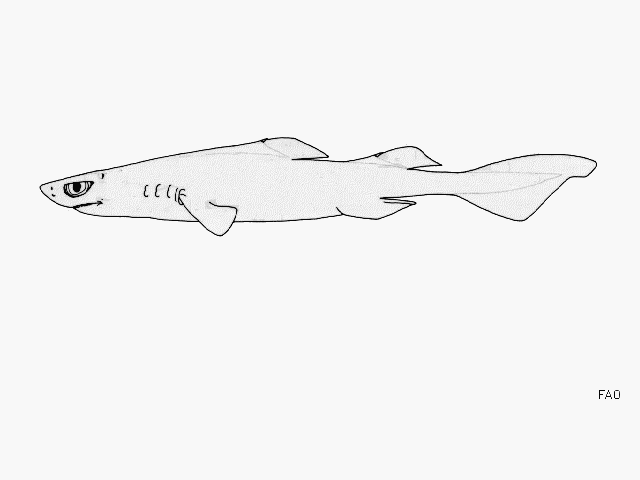
Species account
Summary
Aculeola nigra is a small deep-water shark of the family Etmopteridae, in the order Squaliformes [1]. It is known from Peru to central Chile [2], and was described in 1959 from a specimen trawled off Concón, on the central Chilean coast [3]. Its global category on the IUCN Red List is Near Threatened [4].
Etymology
De Buen described the genus Aculeola and the species Aculeola nigra in 1959, in a note on the fauna of the pre-abyssal zone off Valparaíso, where he described in all 2 new genera, a family of rays and 7 new species [3]. The type specimen was a female trawled 12 miles off Concón, at a depth of 60 fathoms [3].
Identification and similar species
It is a soft-bodied, loosely built shark with a short snout that swells at the sides around the nostrils, large round eyes and wide spiracles [3]. The mouth is wide, with thin, unfolded lips; the teeth are small, equal in both jaws and single-pointed, set in roughly 3 or 4 longitudinal rows [3].
Each dorsal fin carries a small spine that barely projects; the tail stalk is square in section and has no notch on its upper side, and the caudal fin has a broad margin, no basal lobe and an apical lobe that is hardly visible [3]. The pectoral fins are short and rounded, and when laid against the flank they do not reach the level where the first dorsal begins [3].
In central-northern Chile the females examined measured 16.5 to 67 cm in total length and the males 17.5 to 53.9 cm; females therefore reach a larger size [2].
Similar species
- Centroscyllium granulatum: De Buen treated it under the name Centroscyllium granulosus: it resembles Aculeola nigra in shape and in having a spine on both dorsal fins, but its teeth are small, numerous and 3-pointed, whereas those of Aculeola nigra have a single point [3].
- Centroscyllium nigrum: It shares the trawl catches of central-northern Chile with Aculeola nigra and is smaller: its females examined reached 51.4 cm, against 67 cm in Aculeola nigra [2].
Distribution and habitat
It is known from the eastern Pacific, from Peru to central Chile [2]. The updated checklist of chondrichthyans of the Peruvian sea, which spans 3° to 18° S, includes it in the family Etmopteridae alongside Centroscyllium nigrum, supported by two earlier works, from 2001 and 2009 [5].
The type specimen was trawled at a depth of 60 fathoms, and De Buen noted that the species was taken within the continental shelf, in areas that trawlers visit routinely, although from its shape and colour he expected to find it in the pre-abyssal zone as well [3]. The 269 specimens studied in 2006 between 24° and 34° S were obtained with trawl nets at depths of 276 to 623 m [2].
Biology
It is a lecithotrophic live-bearer: the embryo feeds only on the yolk of the oocytes the mother produces [2]. The oocytes sit at the edge of the ovary, the type called external or carcharhinid, and the testes are of the diametric type [2].
Among 142 females and 127 males examined, half the individuals were already mature at 38 cm total length in males and at 39 cm in females; females with embryos appeared from about 40 cm [2]. These sizes are smaller than the 42 cm and 50 cm attributed to a 1984 catalogue, cited in that same study [2].
Between September and November, 22 females with embryos were found, 15 % of the females examined, with an average of 10.9 embryos per female; larger females tended to carry more, though the relationship was moderate [2]. The embryos measured 2.3 to 17 cm, the yolk sac was fully absorbed from 13.5 cm on, and the size at birth was estimated at 16.75 cm [2].
The gonadosomatic index of males peaked in August; females with embryos were found between September and November, and in November and December females appeared at every stage of maturity, with more females that had just given birth [2]. The authors consider that this is probably the breeding season, but warn that sampling covered only June to December 2006 and that the study needs to continue for more years to define the cycle properly [2].
Conservation
Its global category on the IUCN Red List is Near Threatened [4].
The authors of the reproductive study recall that cartilaginous fishes grow slowly, mature late and have few young, especially those of deep water, so that they are vulnerable to exploitation and to changes in their habitat [2]. In central-northern Chile this species reaches the nets as bycatch of the crustacean trawl fishery [2].
Human relevance
The relationship with fishing recorded in the literature read is incidental capture: the specimens studied in 2006 in central-northern Chile came from the bycatch of the trawl fleets that fish for red squat lobster, yellow squat lobster and nylon shrimp [2].
Where to see it in Peru
References (5)
- Froese, R., Pauly, D. (2026). Aculeola nigra de Buen, 1959. World Register of Marine Species. https://www.marinespecies.org/aphia.php?p=taxdetails&id=279502 (accessed 2026-10-21)
- Gatica, C., Acuña, E. (2011). Biología reproductiva de los tiburones de profundidad Aculeola nigra De Buen, 1959, y Centroscyllium nigrum Garman, 1899 (Chondrichthyes: Etmopteridae), centro-norte de Chile. Gayana (Concepción), 1-16. doi:10.4067/s0717-65382011000100001 (accessed 2026-10-21)
- De Buen, F. (1959). Notas preliminares sobre la fauna marina preabismal de Chile, con descripción de una familia de rayas, dos géneros y siete especies nuevos. Boletín Museo Nacional de Historia Natural, 173-201. doi:10.54830/bmnhn.v27.1959.628 (accessed 2026-10-21)
- Ebert, D.A., Concha, F., Acuña, E. et al. (2019). Aculeola nigra: Ebert, D.A., Concha, F., Acuña, E., Herman, K. & Kyne, P.M. The IUCN Red List of Threatened Species 2020: e.T44653A124437350. doi:10.2305/IUCN.UK.2020-3.RLTS.T44653A124437350.en (accessed 2026-10-21)
- Cornejo, R., Vélez-Zuazo, X., González-Pestana, A. et al. (2015). An updated checklist of Chondrichthyes from the southeast Pacific off Peru. Check List, 1809. doi:10.15560/11.6.1809 (accessed 2026-10-21)