
Marine life guide of Peru · Scolopacidae
Spotted sandpiper
Actitis macularius Linnaeus, 1766
- Names in Peru
- Playero coleador
Species account
Summary
Actitis macularius is a shorebird of the family Scolopacidae described by Linnaeus in 1766 [1]. Of all North American sandpipers it breeds over the widest area, and it spends the boreal winter in a belt running from the southern United States to northern Argentina [2]. In Peru it is called «playero coleador» [3]. It is recognised by its constant tail-bobbing [4]. Its breeding life is unusual: females compete for territories and for males, often take more than one mate, and it is the male that incubates [2]. The IUCN Red List classifies it as Least Concern in its 2024 assessment [5].
Identification and similar species
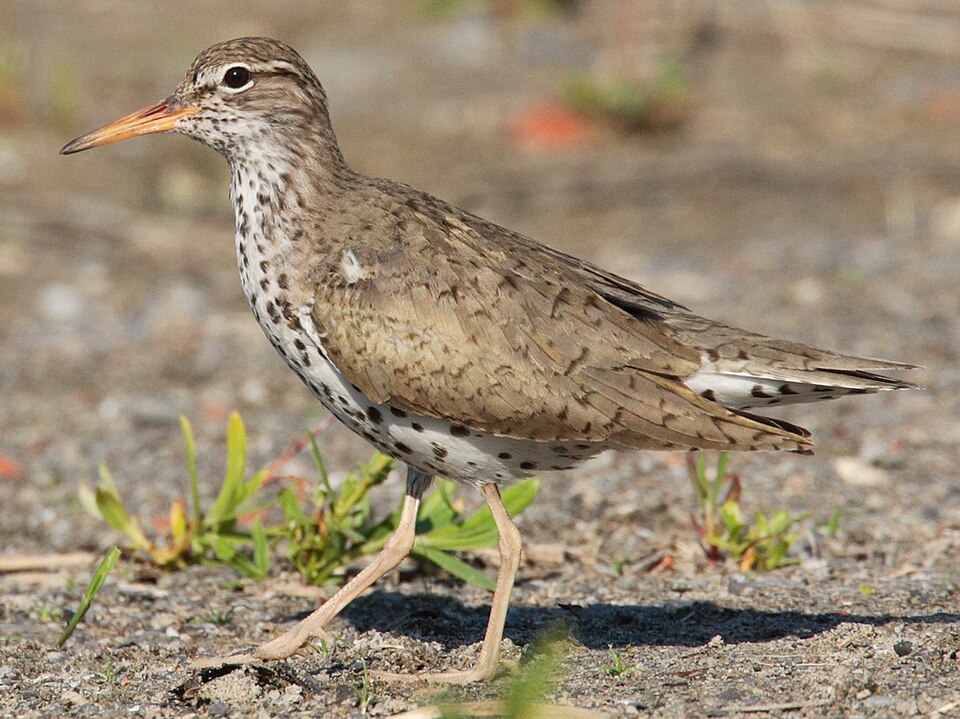
It is a small, elongated sandpiper, brown above and white below, with yellow legs and a medium-length bill that is black with an orange base [4]. Two habits give it away: it bobs its tail up and down all the time, whether feeding or standing still, and it flies in short, fast stretches [4].
In breeding plumage the white underside becomes covered with dark brown spots, each confined to a single feather; juveniles and adults outside the breeding season have none [2]. On Beaver Island, in Lake Michigan, 87 adults were caught between 2013 and 2015: the two sexes overlapped in spotting, but females carried fewer spots that were bigger, more irregular in shape and spread over more of the plumage, and the pattern of a given bird changed from one year to the next [2]. Males and females have wings, tails and tarsi of equal length, yet females weigh 20 to 25 % more [2].
Distribution and habitat
It breeds across most of North America, from the northern tree line down to the southern United States, and in autumn it heads south mainly over land [6]. Outside the breeding season it occupies much of northern South America, as far south as northern Argentina, as well as the Caribbean, Central America and a good part of southern North America [4].
In Peru it lives along the coast, on rocky shores, beaches, drainage ditches, shallow wetlands and grasslands that stay flooded all year; it is also common away from the coast, above all along the banks of small rivers, and it is one of the commonest Nearctic shorebirds among those wintering in the Amazon basin [4]. At the Caucato wetland, in Pisco, of 165 birds counted, 96 were on the lagoon shore and 47 over open water [7]. At the Poza de La Arenilla, in La Punta (Callao), it was the species that best characterised the shoreline zone in the counts of 2013 to 2015 [8].
Biology
Females reach the breeding grounds first and compete with one another for territories and for males [2]. A clutch usually holds 4 eggs, which the male incubates for 21 days before also taking charge of the chicks, and the female can lay another clutch in a second male's nest only 8 days later [2].
In a study lasting 17 years, on average 26 % of females were monogamous each season; older females were more often polyandrous and each age used tactics of its own: one-year-olds usually paired with one male after another, whereas 2-year-olds were mostly simultaneously polyandrous [9]. Females tended to stay on the territories where they or their mates had bred more often [9].
This role reversal is not due to females carrying more androgens than males: in wild populations they did not exceed them [10]. Before incubation males had more testosterone than females, but their level dropped about 25-fold as the nest went from 1 or 2 eggs to 3, when incubation begins; paired females had about 7 times more testosterone than females without a mate [11]. Prolactin rose in both sexes during the first days of incubation and in males kept rising afterwards, in line with their greater share of incubation [12].
In its sister species Actitis hypoleucos clutches shift from mostly sons early in the season to mostly daughters late on, but no such seasonal change in sex ratio was found in Actitis macularius [13]. Its diploid number is 2n = 92, with most pairs telocentric, according to the karyotype of 3 adult females collected at Bragança, in the state of Pará (Brazil) [14].
Ecology
It forages alone or in pairs at the water's edge, bobbing its tail all the while, and takes almost nothing but aquatic insects, especially fly larvae [4].
It hosts a varied fauna of parasitic worms. Of 12 birds collected in marine habitats of New Brunswick (Canada) during the August 2003 migration, every one was infected, carrying from 2 to 942 worms each and 11 species in all; the tapeworm Anomotaenia hypoleuci was the most frequent and is regarded as a specialist of this host [15]. In 70 birds from Belize, Texas and Montana 17 helminth species turned up, although each bird carried few, and the tapeworm Kowalewskiella cingulifera was the only one present at all 3 localities [16].
Conservation
Its global category is Least Concern [5]. The atlas of Peruvian shorebirds gives an estimated hemispheric population of about 660,000 birds, 2.7 % of them in Peru, and describes its trend as stable or increasing [4]. In the fauna list of the management plan of the Los Manglares de Tumbes National Sanctuary it carries no national category [3].
In North America the contamination reaching its eggs has been measured. In 2004, on the upper Hudson River (New York), eggs held a geometric mean of 9.1 µg of PCBs per gram of fresh weight, against 0.6 on two rivers that flow into the Hudson; 7 of 35 eggs went above 20 µg/g, the estimated threshold for poorer hatching in tree swallows and some raptors, although the study could not link those loads to nest success [17]. Downstream of coal mines on the Elk River (British Columbia), selenium in its eggs averaged 2.2 µg/g against 1.2 at reference sites; hatching dropped slightly, but productivity stayed above the regional average [18].
At the Caucato wetland, in Pisco, vehicle noise, people and domestic animals disturbed the birds, which became alert, moved about or took flight within the wetland [7].
Where to see it in Peru
The coastal census of February 2010 [4] estimated about 18,035 birds in Peru (95 % confidence interval: ± 1,386): 556 in the south, 11,029 in the centre and 6,451 in the north; the sites holding most were the Manglares de Tumbes (1,660), Tumbes Bay (1,002), the El Tubo wetlands (547) and Faclo Grande (374) [4]. It is on the fauna list of the Los Manglares de Tumbes National Sanctuary, in its 2023 management plan [3].
On the central coast it has been counted in wetlands and on beaches. It appears in the 2013 to 2015 counts at the Poza de La Arenilla, in La Punta (Callao) [8]. At the Caucato wetland, in Pisco, 165 birds were tallied in counts from 2017 to 2019, none of them in the months of April to July [7]. On the seashore of San Andrés, also in Pisco and next to the northern end of the Paracas National Reserve, the censuses of January 2023 and December 2024 totalled 39 and 4 birds respectively, on sandy, pebbly and rocky beaches [19].
References (19)
- WoRMS Editorial Board (2026). Actitis macularius Linnaeus, 1766. World Register of Marine Species. https://www.marinespecies.org/aphia.php?p=taxdetails&id=159081 (accessed 2026-10-20)
- Blizard, M., Pruett-Jones, S. (2017). Plumage pattern dimorphism in a shorebird exhibiting sex-role reversal (Actitis macularius). The Auk, 363-376. doi:10.1642/AUK-16-96.1 (accessed 2026-10-20)
- Servicio Nacional de Áreas Naturales Protegidas por el Estado (2023). Plan Maestro del Santuario Nacional Los Manglares de Tumbes 2023-2027. SERNANP, RP N.° 064-2023-SERNANP, 140. https://cdn.www.gob.pe/uploads/document/file/4137567/RESOLUCION%20PRESIDENCIAL%20N%20064-2023-SERNANP.pdf.pdf (accessed 2026-10-20)
- Senner, N.R., Angulo Pratolongo, F. (2014). Atlas de las aves playeras del Perú. Sitios importantes para su conservación. Ministerio del Ambiente y CORBIDI, Lima, 96. https://sinia.minam.gob.pe//sites/default/files/archivos/public/docs/Atlas-de-las-Aves-Playeras-del-Per%C3%BA-FINAL-WEB.compressed.pdf (accessed 2026-10-20)
- BirdLife International (2024). Actitis macularius: BirdLife International. The IUCN Red List of Threatened Species 2024: e.T22693277A262691229. doi:10.2305/IUCN.UK.2024-2.RLTS.T22693277A262691229.en (accessed 2026-10-20)
- Diniz, C.G., Magalhães, N.G.M., Sousa, A.A. et al. (2016). Microglia and neurons in the hippocampus of migratory sandpipers. Brazilian Journal of Medical and Biological Research, e5005. doi:10.1590/1414-431X20155005 (accessed 2026-10-20)
- Pisconte Vilca, J.A., Anchante Aparcana, J.C., Aparcana Mendoza, M.A. et al. (2020). Variación de la abundancia y diversidad de las aves migratorias en el humedal de Caucato, Pisco Perú. Ñawparisun - Revista de Investigación Científica, 103-110. doi:10.47190/nric.v3i1.132 (accessed 2026-10-20)
- Cotillo, A., Podestá, J., Segura-Cobeña, E. et al. (2018). Distribución espacial de las aves playeras limícolas para once zonas descritas en el humedal costero Poza de La Arenilla - La Punta, Callao. The Biologist (Lima), 119-137. doi:10.24039/rtb2018161226 (accessed 2026-10-20)
- Oring, L.W., Reed, J.M., Alberico, J.A.R. (1994). Mate acquisition tactics in polyandrous spotted sandpipers (Actitis macularia): the role of age and experience. Behavioral Ecology, 9-16. doi:10.1093/beheco/5.1.9 (accessed 2026-10-20)
- Rissman, E.F., Wingfield, J.C. (1984). Hormonal correlates of polyandry in the spotted sandpiper, Actitis macularia. General and Comparative Endocrinology, 401-405. doi:10.1016/0016-6480(84)90082-0 (accessed 2026-10-20)
- Fivizzani, A.J., Oring, L.W. (1986). Plasma Steroid Hormones in Relation to Behavioral Sex Role Reversal in the Spotted Sandpiper, Actitis Macularia. Biology of Reproduction, 1195-1201. doi:10.1095/biolreprod35.5.1195 (accessed 2026-10-20)
- Oring, L.W., Fivizzani, A.J., El Halawani, M.E. et al. (1986). Seasonal changes in prolactin and luteinizing hormone in the polyandrous spotted sandpiper, Actitis macularia. General and Comparative Endocrinology, 394-403. doi:10.1016/0016-6480(86)90049-3 (accessed 2026-10-20)
- Andersson, M., Wallander, J., Oring, L. et al. (2003). Adaptive seasonal trend in brood sex ratio: test in two sister species with contrasting breeding systems. Journal of Evolutionary Biology, 510-515. doi:10.1046/j.1420-9101.2003.00533.x (accessed 2026-10-20)
- Pinheiro, M.L.S., Nagamachi, C.Y., Ribas, T.F.A. et al. (2021). Chromosomal painting of the sandpiper (Actitis macularius) detects several fissions for the Scolopacidae family (Charadriiformes). BMC Ecology and Evolution, 8. doi:10.1186/s12862-020-01737-x (accessed 2026-10-20)
- Didyk, A.S., Canaris, A.G., Kinsella, J.M. (2007). Intestinal Helminths of the Spotted Sandpiper, Actitis macularius (L.), During Fall Migration in New Brunswick, Canada, with a Checklist of Helminths Reported from this Host. Comparative Parasitology, 359-363. doi:10.1654/4280.1 (accessed 2026-10-20)
- Canaris, A.G., Kinsella, J.M., Didyk, A.S. (2009). Helminth Parasites of Spotted Sandpipers, Actitis macularius (Charadriiformes), From Belize, Texas, and Montana. Journal of Parasitology, 1542-1544. doi:10.1645/GE-2141.1 (accessed 2026-10-20)
- Custer, T.W., Custer, C.M., Gray, B.R. (2009). Polychlorinated biphenyls, dioxins, furans, and organochlorine pesticides in spotted sandpiper eggs from the upper Hudson River basin, New York. Ecotoxicology, 391-404. doi:10.1007/s10646-009-0425-z (accessed 2026-10-20)
- Harding, L.E., Graham, M., Paton, D. (2005). Accumulation of Selenium and Lack of Severe Effects on Productivity of American Dippers (Cinclus mexicanus) and Spotted Sandpipers (Actitis macularia). Archives of Environmental Contamination and Toxicology, 414-423. doi:10.1007/s00244-004-0004-5 (accessed 2026-10-20)
- Pulido-Capurro, V. (2025). Las aves de la orilla marina de San Andrés, Pisco, Ica. The Biologist (Lima), 55-70. doi:10.62430/rtb20252311926 (accessed 2026-10-20)