
Bivalves · Spondylidae
Spondylus limbatus
Spondylus limbatus G. B. Sowerby II, 1847
Spanish: Ostra grande
- Names in Peru
- Ostra grande
- Peruvian Register of Marine Species
- Listed in PeRMS (IMARPE)
Species account
Summary
Spondylus limbatus is a bivalve of the family Spondylidae described by G. B. Sowerby II in 1847; the name Spondylus calcifer is one of its synonyms [1]. It is the largest of the 4 Spondylus species of the Panamic Province: its shell reaches 25 cm in length and, after the larval stage, it fixes itself to rock or other hard substrates by almost the whole right valve [2]. The management plan of the Reserva Nacional Mar Tropical de Grau calls it «ostra grande» and includes it among the highly threatened rocky-reef species [3]. The same plan warns that its populations in northern Peru have been almost entirely removed by divers [3].
Identification and similar species
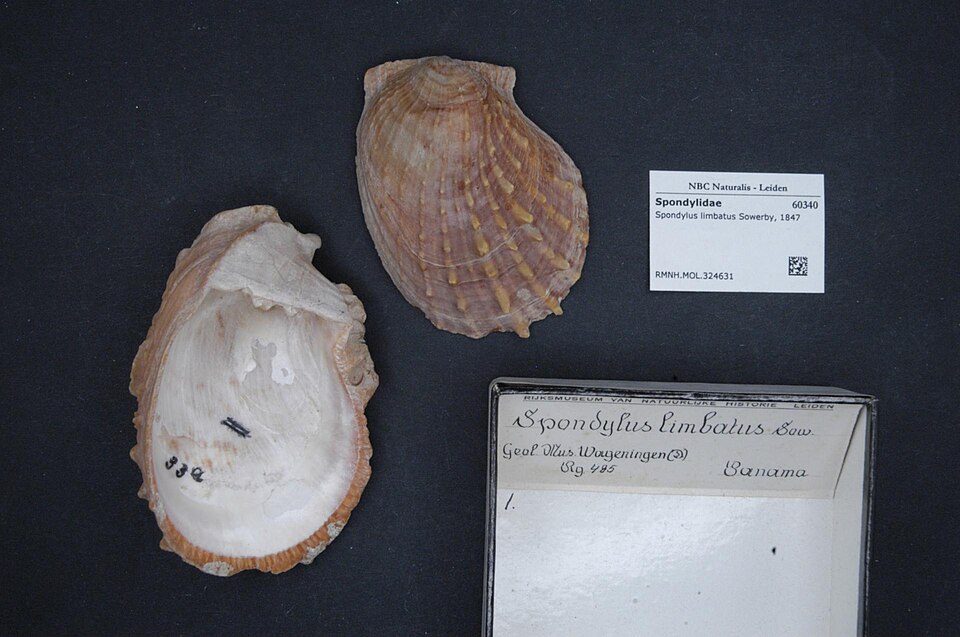
Shell shape is highly variable, from irregularly rounded to plainly misshapen. The outside carries strong radial ribs with short spines, spatulate or pointed, which can shrink until they vanish, and the right valve shows concentric lamellae around the area by which it is fixed to the rock, which can be broad [2]. The hinge teeth are thick and sturdy, brown in the left valve and white in the right; the adductor muscle scar ranges from faint to strongly marked and the ventral edge bears fine, numerous crenulations [2].
Colour shows mainly on the broad inner margin of the shell and runs from purple to orange [2]. In a reference collection of 180 specimens, purple dominated in about 67 % of the shells (121), orange appeared in 27.8 % (50) and reddish brown in 5 % (9); some shells had one orange valve and one purple valve [2]. Measured on the 174 left valves in that collection, height ranged from 48.8 to 222.3 mm, with a mean of 136 mm [2].
Similar species
- Spondylus crassisquama: Orange or reddish specimens of Spondylus limbatus can be mistaken for this species; in Spondylus limbatus the hinge teeth are usually larger, thicker and brown, the adductor scar is more deeply impressed, the attachment area of the right valve can be broad and the margin bears fine crenulations, while a dark, intense purple is typical of Spondylus limbatus [2].
Distribution and habitat
It lives in the Panamic Province, which runs from the Pacific coast of the Baja California peninsula, Mexico, to northern Peru [2]. An archaeological study places the southern limit of the species, under the name Spondylus calcifer, at Cabo Blanco in Peru [4]. A reference collection published in 2026 gathered 180 specimens from 72 localities in 8 countries; the only Peruvian locality was a rocky shoal at Punta Sal, Tumbes, with 2 specimens [2].
It occupies warm-water rocky and coral reefs, from the lower intertidal zone down to about 55 m [2]. Of the specimens with a known depth, most came from between 2 and 20 m and about 80 % from less than 12 m, although those figures come from what fishers reported [2]. On the coast of Guatemala, a straight plain of sandy beaches and soft bottoms, fishers said they had never seen it, nor was it found in bays with heavy river discharge, such as Bahía San Miguel in Panama; for the authors, this confirms that it needs hard bottoms away from the direct influence of rivers [2].
Biology
In a laboratory culture using adults from the Gulf of California, males and females spawned after 10 °C thermal shocks; oocytes averaged 56 µm, and a female 110.5 mm high released 28.95 million oocytes against 71.76 million from one of 180 mm; trochophore larvae appeared after 7 h and D-larvae after 17 h, and by 2 weeks they were pediveligers, so under those conditions settlement would begin at the earliest about 15 days after fertilisation [5]. In the mature ovary, oocytes that have completed vitellogenesis measure 60 to 70 µm [6].
The breeding calendar changes with latitude. At Ayangue, on the coast of Ecuador, it reproduces all year round, with a maximum from October to December, when the water is cooler and chlorophyll is higher, and each individual produces 2.9 to 35 million eggs [7]. At Agua Verde, in the Gulf of California, sampling in 2009 found gonads active between March and September, and most spawning took place in July and August [8].
In that same Agua Verde area, shells measured 82 to 167 mm and readings of shell sections gave ages of 1 to 14 years; the von Bertalanffy model, which described growth best, estimated an asymptotic height of 142.7 mm and a growth constant k of 0.47 [8]. According to genetic and spatial analyses, its larvae may disperse more than 100 km from where they were fertilised [2].
Ecology
Most specimens in the 2026 collection were fixed to rock, from large boulders and slabs to cobbles; 4 were cemented onto other shells, 3 of them of Spondylus, and in one case a live individual was growing on another live one [2]. The 3 specimens fishers found loose carried a small attachment mark on the right valve, a sign that they had come away from their substrate [2]. At Mulegé, Mexico, fishers return the shells to the sea the same day so that the organisms attached to them, sometimes juvenile Spondylus, keep growing, and the authors suggest the practice could partly help exploited populations [2].
At 6 representative fishing banks in the Gulf of California, density differed between banks and fell steadily from north to south; where density was low, sizes varied less [9]. In Ecuador, by contrast, observed densities would already be below the thresholds other broadcast-spawning invertebrates need to reproduce; since a shortage of mates is the main cause of Allee effects in such species, the lack of synchrony in spawning makes that risk weigh even more [7].
Conservation
In Peru, the management plan of the Reserva Nacional Mar Tropical de Grau includes the «ostra grande» among the rocky-reef species highly threatened by poor spearfishing practices and other fishing gear [3]. The same plan notes that, after regaining value in jewellery in recent decades, its populations in northern Peru have been almost entirely removed by divers and that urgent conservation action is needed [3].
The plan's rules of use forbid taking it anywhere in the Arrecifes de Punta Sal sector [3]. The same ban applies throughout the Cabo Blanco – El Ñuro sector [3]. Among its priority research lines is a baseline of the commercially valuable reef invertebrates, Spondylus included, down to 30 m, carried out with transect censuses and photographs, without taking samples, because of their low density [3].
Outside Peru, the species is under special protection in Mexico [6]. In October 2009 Ecuador announced a ban on fishing Spondylus calcifer and Spondylus princeps [7]. Today a permanent ban, with some exceptions, is in force in Mexico and Ecuador, while in El Salvador, Nicaragua and Costa Rica local commercial fishing is allowed; fishers in Jalisco, El Salvador and Ecuador recall that before the 1990s it was more abundant in waters shallower than 5 to 10 m [2]. A regional review attributes a steep fall in natural populations to exploitation for crafts, jewellery and gastronomy, which led to fishing restrictions [10].
Human relevance
Together with Spondylus crassisquama, it was used by various pre-Hispanic cultures as a ritual offering and to make ornaments [2]. In present-day Peru, Spondylus shells occur at the great majority of major Andean archaeological sites, from the preceramic to Inca times; the peoples of the north coast obtained them through exchange with those of the north-Andean coast, and the Chimú and Lambayeque depicted divers collecting them on friezes at Chan Chan and at Huaca Las Balsas, Túcume [4]. The reserve's management plan recalls that historical value and notes that in recent decades the shell has again become prized in jewellery [3].
Today it is collected by breath-hold diving, with surface-supplied air or with scuba; since the right valve stays welded to the rock, divers usually cut the adductor muscle and take only the left valve [2]. As a rule only that muscle is eaten, and rarely the mantle; for coastal communities it supplements the diet rather than being a main resource, and the shells are used as decoration or as raw material for jewellery [2]. A regional review sums up its current value for crafts, jewellery, fisheries and gastronomy in the eastern Pacific [10].
Where to see it in Peru
In the reference collection published in 2026, gathered mostly in 2022 and 2023, the only Peruvian provenance was a rocky shoal at Punta Sal, Tumbes, which yielded 2 specimens [2]. The 2026 management plan warns that in northern Peru the species has been almost entirely removed by divers [3]. In the reserve, taking it is forbidden in the Arrecifes de Punta Sal sector [3] and in the Cabo Blanco – El Ñuro sector [3].
References (10)
- MolluscaBase eds. (2026). Spondylus limbatus G. B. Sowerby II, 1847. World Register of Marine Species. https://www.marinespecies.org/aphia.php?p=taxdetails&id=207886 (accessed 2026-10-20)
- Cotom-Nimatuj, J.A., Michel-Morfín, J.E., Bassey-Fallas, G. et al. (2026). New records and ecological insights of Spondylus limbatus (Bivalvia, Spondylidae) from the Panamic Province. Biodiversity Data Journal, e180522. doi:10.3897/bdj.14.e180522 (accessed 2026-10-20)
- Servicio Nacional de Áreas Naturales Protegidas por el Estado (2026). Plan Maestro de la Reserva Nacional Mar Tropical de Grau 2026–2031. Anexo de la Resolución de Presidencia Ejecutiva N.° 000052-2026-SERNANP/PE. https://cdn.www.gob.pe/uploads/document/file/9468842/7752998-5-pm_2026-2031_rnmtg-f-f-f-f.pdf (accessed 2026-10-20)
- Jaramillo Arango, A. (2017). Comunión e interexistencia. El Spondylus spp. En la costa norte del Perú durante el Intermedio Tardío (800-1450 d.C). Antípoda. Revista de Antropología y Arqueología, 77-97. doi:10.7440/antipoda28.2017.04 (accessed 2026-10-20)
- Soria, G., Tordecillas-Guillen, J., Cudney-Bueno, R. et al. (2010). Spawning Induction, Fecundity Estimation, and Larval Culture of Spondylus calcifer (Carpenter, 1857) (Bivalvia: Spondylidae). Journal of Shellfish Research, 143-149. doi:10.2983/035.029.0108 (accessed 2026-10-20)
- Camacho-Mondragón, M.A., Villalejo-Fuerte, M., Ceballos-Vázquez, B.P. et al. (2019). Ultraestructura del Ovocito Maduro y en Reabsorción de Spondylus limbatus G. B. Sowerby II, 1847 (= S. calcifer ) (Bivalvia: Spondylidae). International Journal of Morphology, 694-700. doi:10.4067/s0717-95022019000200694 (accessed 2026-10-20)
- Mackensen, A.K., Brey, T., Sonnenholzner, S. (2011). The Fate of Spondylus Stocks (Bivalvia: Spondylidae) in Ecuador: Is Recovery Likely?. Journal of Shellfish Research, 115-121. doi:10.2983/035.030.0117 (accessed 2026-10-20)
- Villalejo-Fuerte, M., Ruiz Domínguez, M., Cota Hernández, G.G. et al. (2023). Parameters of the Spondylus limbatus GB Sowerby II, 1847, population in the Central-West Gulf of California, Mexico. Invertebrate Reproduction & Development, 26-36. doi:10.1080/07924259.2023.2172363 (accessed 2026-10-20)
- Villalejo-Fuerte, M., Borges Souza, J., Arellano-Martínez, M. et al. (2020). The density of the bivalve Spondylus limbatus in Agua Verde-Tembabiche Gulf of California, Mexico. Latin American Journal of Aquatic Research, 162-166. doi:10.3856/vol48-issue1-fulltext-2141 (accessed 2026-10-20)
- Lodeiros, C., Soria, G., Valentich-Scott, P. et al. (2016). Spondylids of Eastern Pacific Ocean. Journal of Shellfish Research, 279-293. doi:10.2983/035.035.0203 (accessed 2026-10-20)
More pictures
Photo: a6475 · CC BY-SA 4.0 · GBIF (iNaturalist research-grade observations) Photo: Bennett Grappone · CC BY 4.0 · GBIF (iNaturalist research-grade observations)
If you come across it
Protected or threatened species. Watch it without touching, feeding, chasing or taking it, and keep the recommended viewing distances.species threatened by extraction — SERNANP (2026). Plan Maestro de la Reserva Nacional Mar Tropical de Grau 2026–2031. RPE N.° 000052-2026-SERNANP, p. 55 of the PDF
Related species
From the same genus (Spondylus).

Names and sources
In Spanish
- Ostra grande — Peru; SERNANP (2026). Plan Maestro de la Reserva Nacional Mar Tropical de Grau 2026–2031. RPE N.° 000052-2026-SERNANP, p. 55 of the PDF · main name
Learn more
Conservation status: no data (IUCN). Taxonomy: PeRMS / WoRMS (CC BY 4.0).