
Bony fishes · Gobiesocidae
Mateo almarante
Sicyases sanguineus Müller & Troschel, 1843
- Peruvian Register of Marine Species
- Listed in PeRMS (IMARPE)
Species account
Summary
Identification and similar species
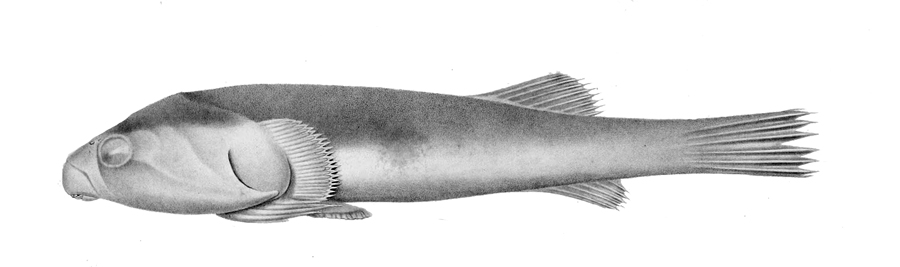
It is a fish that clings with its ventral sucker to vertical faces of large rocks exposed to the surf [1]. Young, half-grown and adult fish differ in how long they keep the air held in their gill cavities out of water, so behaviour changes with age [1].
The genus has a second species in Chilean waters, Sicyases hildebrandi, which belongs to the Juan Fernández archipelago. It is told apart from the mainland Sicyases sanguineus by the number of anal-fin rays, head length, maximum body width, the breadth of the sucker's hind edge and skin texture, rough or smooth [4].
Distribution and habitat
It occurs from Salaverry, in Peru, to Punta Arenas, in Chile [3]. It lives attached to rocks of the rocky intertidal; it is found on large exposed rocks splashed by the cold, heavy surf of Chile and southern Peru, and it seldom turns up in isolated pools, bays or estuaries [1],[3]. It avoids rocks that dry out beyond the spray zone and climbs to higher rocks when the tide comes up [1].
Its position changes with size: individuals under 15 cm in total length often occupy the highest points of the intertidal, whereas those over 23 cm are seldom seen out of the water in the lower intertidal and were collected in the subtidal by divers [5]. At Juan Fernández the genus is represented by a different species, Sicyases hildebrandi, not by this one [4].
Biology
It tolerates emersion: it can survive out of water provided it is spared severe drying or heat, and its evaporative water loss is low [2]. On leaving the water it gulps air, seals its gill cavities and often turns head-down; it breathes using the air held in those cavities [1]. It leaves the water in greater numbers during calm periods [1].
Larvae hatch at more than 3 mm, near the first quarter and the full moon, and in the first 25 days grow 0.14 mm per day [6]. Before settlement the larva's head flattens and the body keeps a hydrodynamic shape [7].
Ecology
Individuals under 15 cm eat intertidal animals and algae, and those over 23 cm feed mostly on benthic animals of the lower intertidal and the subtidal; the authors note that the species may influence community structure in some areas of the rocky intertidal and shallow subtidal of central Chile [5].
It hosts parasites. In Lima, of 99 fish examined, 79 (79.8 %) carried at least one parasite and 6 parasite species were found, among them the copepod Acanthochondria sicyases, which infects the gills and gill chamber [3]. In central Chile, 154 fish yielded 11 parasite species, and beyond 20 cm in length a marked rise in parasite abundance and richness was seen, together with a diet change and a move from the intertidal to the subtidal [8].
Where to see it in Peru
This account cites no specific Peruvian site where to look for it: the only Peruvian study cited obtained 99 specimens in August and September 2009 at the Chorrillos fishing terminal, in Lima, and gives Salaverry as the species' northern limit [3]. Adults leave the water more often in remote areas little altered by people, and the species seeks rocks splashed by the surf [1].
References (8)
- Ebeling, A.W., Bernal, P.A., Zuleta, A. (1970). Emersion of the amphibious Chilean clingfish, Sicyases sanguineus. The Biological Bulletin, 139: 115-137. doi:10.2307/1540131 (accessed 2026-10-25)
- Gordon, M.S., Fischer, S., Tarifeño, E. (1970). Aspects of the Physiology of Terrestrial Life in Amphibious Fishes: II. The Chilean Clingfish, Sicyases Sanguineus. Journal of Experimental Biology, 53: 559-572. doi:10.1242/jeb.53.3.559 (accessed 2026-10-25)
- Iannacone, J., Alvariño, L. (2011). Aspectos cuantitativos de los parásitos del pejesapo Sicyases sanguineus (Müller & Troshel, 1843) (Perciformes: Gobiesocidae) de la zona costera de Chorrillos, Lima, Perú. Neotropical Helminthology, 5: 56-72. doi:10.24039/rnh2011511036 (accessed 2026-10-25)
- Vera S., R., Pequeño R., G. (2001). Comparación de caracteres merísticos y morfométricos entre peces del género Sicyases del archipiélago de Juan Fernández, Valparaíso y Valdivia (Osteichthyes: Gobiesocidae). Investigaciones Marinas, 29. doi:10.4067/s0717-71782001000200001 (accessed 2026-10-25)
- Cancino, J.M., Castilla, J.C. (1988). Emersion behaviour and foraging ecology of the common Chilean clingfish Sicyases sanguineus (Pisces: Gobiesocidae). Journal of Natural History, 22: 249-261. doi:10.1080/00222938800770191 (accessed 2026-10-25)
- Contreras, J.E., Landaeta, M.F., Plaza, G. (2013). The contrasting hatching patterns and larval growth of two sympatric clingfishes inferred by otolith microstructure analysis. Marine and Freshwater Research, 64: 157-167. doi:10.1071/mf12232 (accessed 2026-10-25)
- Bernal-Durán, V., Jahnsen-Guzmán, N., Landaeta, M.F. (2017). Sharing morphospaces: early ontogenetic shape changes in two clingfish larvae (Pisces: Gobiesocidae) from the south-east Pacific Ocean. Journal of Fish Biology, 91: 1510-1516. doi:10.1111/jfb.13451 (accessed 2026-10-25)
- Muñoz, G., Zamora, L.N. (2011). Ontogenetic Variation in Parasite infracommunities of the Clingfish Sicyases sanguineus (Pisces: Gobiesocidae). Journal of Parasitology. doi:10.1645/ge-2445.1 (accessed 2026-10-25)
More pictures
Where it has been recorded
- Filled: scientific records, or confirmed by a curator
- Hatched: isolated record
- Dotted outline: no scientific records and no curator's confirmation (an ORKA sighting is not drawn here)
- Cold central sea
Scientific records (1 record)
- Cold southern sea
Scientific records (6 records)
From openly licensed OBIS and GBIF records (CC0 or CC BY). How each list is built.
Related species
From the same family.
Names and sources
In English
- Mateo almarante — Wikidata
Learn more
Conservation status: no data (IUCN). Taxonomy: PeRMS / WoRMS (CC BY 4.0).