
Bony fishes · Carangidae
Mexican lookdown
Selene brevoortii (Gill, 1863)
Spanish: Radio
- Names in Peru
- Radio · Jorobado
- Peruvian Register of Marine Species
- Listed in PeRMS (IMARPE)

Species account
Summary
Selene brevoortii is a fish of the family Carangidae, with a deep, strongly compressed body, living in coastal waters of the tropical eastern Pacific [1],[2]. In Peru it is recorded under the names radio and jorobado [2]. It has been reported from southern California to northern Chile, and one source places it between 2 and 165 m depth [3]. It is of minor fishery interest [2], and its global IUCN Red List category is Least Concern [4].
Etymology
Gill described the species in 1863 as Argyriosus brevoortii; the current valid name is Selene brevoortii [1]. Selene is the Greek word for the moon, and the epithet commemorates James Carson Brevoort (1818–1887), an American collector of coins and rare books [2]. Unaccepted synonyms include Vomer brevoortii and Argyreiosus pacificus, the latter by Lockington, 1877 [1].
Identification and similar species
The body is short, deep and strongly compressed, and scaleless; the lateral-line scutes are very weak and poorly differentiated [2]. The dorsal fin has 8 isolated spines, 1 further spine and 20 to 23 soft rays, and the lower limb of the first gill arch carries 29 to 34 gill rakers [2]. In adults the front lobes of the second dorsal and the anal fin are very long, whereas in juveniles it is the front dorsal spines that are drawn out [2].
Adults are golden or silvery with metallic blue sheen; juveniles are yellowish with dark transverse bars that are faint and broken [2]. The maximum recorded length is 38 cm fork length, and a common size is 25 cm [2]; another source gives up to 42 cm total length [3]. In 57 fish bought from fishers in Mazatlán the mean total length was 23.5 cm [5].
Distribution and habitat
It is a marine, benthopelagic species of the eastern Pacific. FishBase places it from the southern tip of Baja California, Mexico, to Ecuador, between 1 and 50 m depth [2]. A 2021 fish checklist extends the range from Seal Beach, southern California, to northern Chile, including the Gulf of California, with depths of 2 to 165 m, and lists it in coastal waters, bays and estuaries [3].
In Peru, during the 2017 coastal El Niño, it was observed at the landing sites of Pisco, at 13.5° S, an occurrence the authors regard as unusual; temperatures above 26 °C and a salinity above 35.1 were measured at that time [6]. The authors state that the species is frequent in northern Peru and propose that those warm and somewhat saltier waters would have favoured its displacement southward [6].
Biology
Adults form small schools close to the bottom in shallow coastal waters [2]. Its prey includes juvenile cephalopods, prawns, bristle worms and little fishes, and the estimated trophic level is 3.8 [2].
FishBase gives no length at maturity, and no reproduction study was found in the sources reviewed [2]. The length-weight relationship estimated there has an exponent of 2.81, with total length in centimetres [2].
Ecology
A study of 874 fish of 10 carangid species from the southeastern Gulf of California found 8 metazoan parasite species in Selene brevoortii, and it was the first description of this species' parasite community [7]. The communities of the Selene species were very similar to each other, with a similarity above 65 %, which the authors link to similar ecological habits [7].
Among its parasites is a gill copepod, Caligus selenecola, described from fish bought from fishers in Mazatlán and examined between June and November 2021; it occurred in 9 of 57 fish examined, a prevalence of 15 % [5].
Conservation
Human relevance
Where to see it in Peru
References (7)
- WoRMS Editorial Board (2026). Selene brevoortii (Gill, 1863). World Register of Marine Species. https://www.marinespecies.org/aphia.php?p=taxdetails&id=273283 (accessed 2026-10-25)
- Froese, R., Pauly, D. (2026). Selene brevoortii, Hairfin lookdown. FishBase. https://www.fishbase.se/summary/1956 (accessed 2026-10-25)
- Love, M.S., Bizzarro, J.J., Cornthwaite, A.M. et al. (2021). Checklist of marine and estuarine fishes from the Alaska–Yukon Border, Beaufort Sea, to Cabo San Lucas, Mexico. Zootaxa, 1-285. doi:10.11646/zootaxa.5053.1.1 (accessed 2026-10-25)
- Smith-Vaniz, B., Robertson, R., Dominici-Arosemena, A. et al. (2008). Selene brevoortii: Smith-Vaniz, B, Robertson, R., Dominici-Arosemena, A. & Molina, H. The IUCN Red List of Threatened Species 2010: e.T183636A8148902. doi:10.2305/iucn.uk.2010-3.rlts.t183636a8148902.en (accessed 2026-10-25)
- Morales-Serna, F.N., Yáñez-Rivera, B., Gómez, S. (2024). Caligus selenecola sp. nov. (Siphonostomatoida, Caligidae) parasitic on the hairfin lookdown Selene brevoortii (Gill) from the Gulf of California, Mexico, with some comments on Caritus tolii Rangnekar, 1984. ZooKeys, 43-68. doi:10.3897/zookeys.1209.120812 (accessed 2026-10-25)
- Donayre-Salazar, S., Higaki Moyano, K.O., Roque-Sánchez, M.A. et al. (2022). Especies de Carangidae inusuales durante el Niño costero 2017 en el litoral de Pisco, sur del Perú. Revista Peruana de Biología, e21280. doi:10.15381/rpb.v29i1.21280 (accessed 2026-10-25)
- Osuna-Cabanillas, J.M., Marín-Enríquez, E., Martínez-Falcón, A.P. et al. (2024). Low similarity between parasite communities of ten sympatric carangid species. Parasitology International, 102885. doi:10.1016/j.parint.2024.102885 (accessed 2026-10-25)
More pictures
Where it has been recorded
- Filled: scientific records, or confirmed by a curator
- Hatched: isolated record
- Dotted outline: no scientific records and no curator's confirmation (an ORKA sighting is not drawn here)
- Tropical northern sea
Scientific records (2 records)
- Tropical–cold transition zone
Scientific records (4 records)
- Cold central sea
Scientific records (1 record)
From openly licensed OBIS and GBIF records (CC0 or CC BY). How each list is built.
Related species
From the same genus (Selene) and from the same family (Carangidae).

Pacific moonfish
Selene peruviana
IUCN status: LC · Least Concern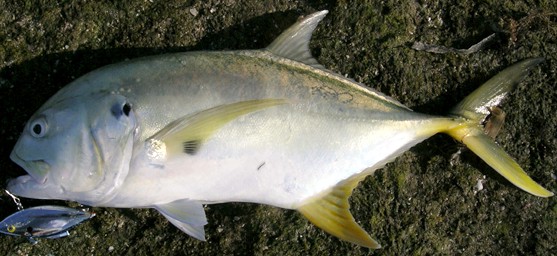
Pacific crevalle jack
Caranx caninus
IUCN status: LC · Least Concern
Jack
Caranx hippos
IUCN status: LC · Least Concern
Pacific bumper
Chloroscombrus orqueta
IUCN status: LC · Least Concern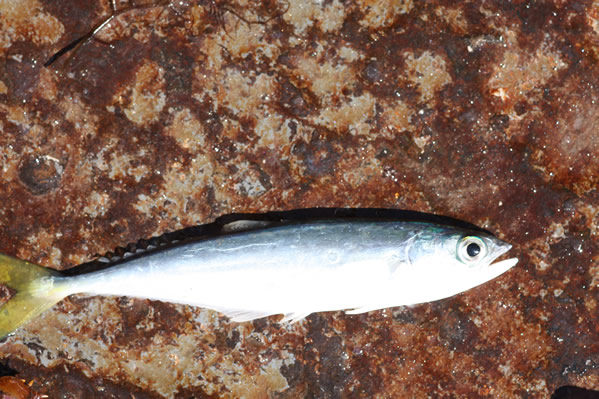
Shortjaw leatherjack
Oligoplites refulgens
IUCN status: LC · Least Concern
Bigeye scad
Selar crumenophthalmus
IUCN status: LC · Least Concern
Paloma pompano
Trachinotus paitensis
IUCN status: LC · Least Concern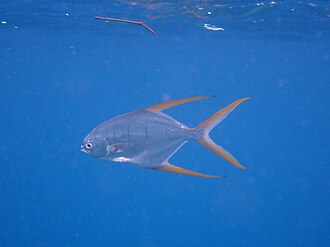
Gafftopsail pompano
Trachinotus rhodopus
IUCN status: LC · Least Concern
Names and sources
In Spanish
- Radio — Peru; fishbase; Wikidata · main name
- Antena — Wikidata
- Cara Caballa — Wikidata
- Carita — Wikidata
- Carita Jorobada — Wikidata
- Espejuelo — Wikidata
- Jorobado — Peru; fishbase; Wikidata
- Jorobado Antena — Wikidata
- Jorobado Mexicano — Wikidata; WoRMS
In English
- Mexican lookdown — WoRMS; Wikidata
- Airfin Lookdown — Wikidata
- Hairfin Lookdown — Wikidata
Classification
Learn more
Conservation status: Least Concern (IUCN Red List, according to Wikidata). Taxonomy: PeRMS / WoRMS (CC BY 4.0).