
Sea snails · Lottiidae
Scurria zebrina
Scurria zebrina (Lesson, 1831)
- Peruvian Register of Marine Species
- Listed in PeRMS (IMARPE)
Species account
Summary
Scurria zebrina is a limpet of the family Lottiidae, in the order Nacellida [1]. It lives on wave-exposed rocky intertidal shores of the Chilean coast, from about 31° S to at least 42° S, and among the patellogastropods endemic to Chile and Peru it has the most restricted geographic range [2]. Its shells measure 6 to 30 mm according to one taxonomic revision and its median in the field is around 3 cm [2],[3]. The taxonomic revision treats it as absent from the Peruvian coast and warns that juveniles of Scurria viridula can be mistaken for it, especially in Peruvian material [2].
Etymology
Lesson described it as Patella zebrina; the World Register of Marine Species gives the year 1831 and the revision by Espoz and colleagues cites 1830 [1],[2]. The literature has since placed it in Scurria, in Patelloidea and in Collisella, and Collisella aconcaguina (Ramírez, 1974) is among its synonyms [2]. Molecular analysis of the 16S region groups it with Scurria viridula in a clade with 100 % resolution, and the two differ at 48 positions across 724 sequenced base pairs [2].
Identification and similar species
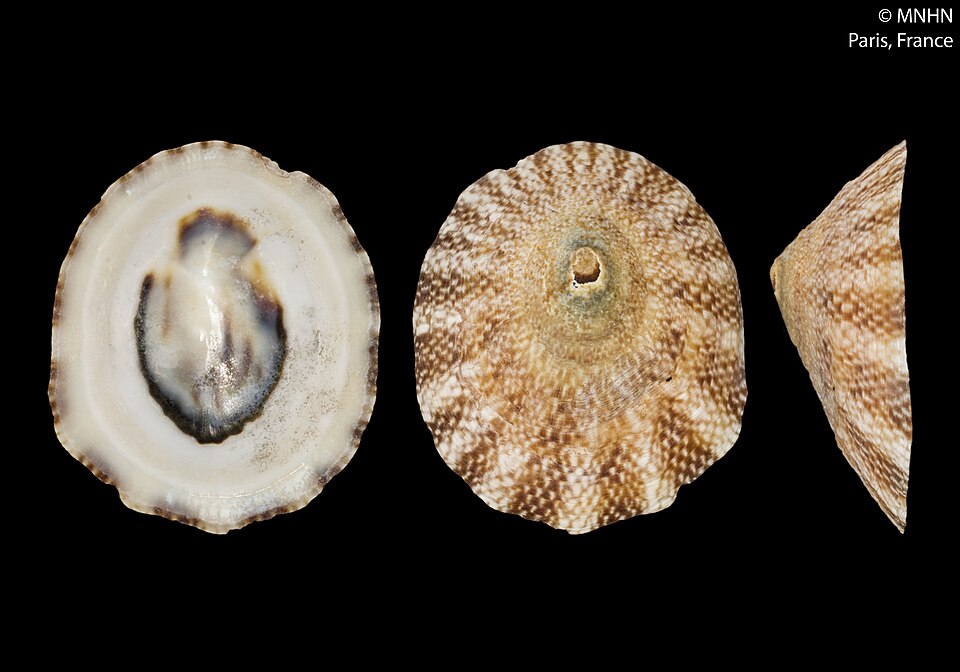
The shell is large, thick, conical and high, and is one of the least variable in the genus Scurria [2]. Outside it is yellowish brown, with softly coloured ribs marked by dark triangles, brown to black, arranged in bands from the apex towards the margin; inside it is yellowish white and the margin has brown and white bands [2]. Large individuals often have eroded shells, and the mantle tentacles, of variable size, form 2 rows [2].
In the taxonomic description the size ranges from 6 to 30 mm, but in field surveys in north-central Chile the median shell length was 2.7 to 3.1 cm, the largest individuals reached 5.8 cm and the smallest measured between 1.27 and 1.33 cm [2],[3]. The authors of the second study note that adults of this species and of Scurria viridula have relatively similar morphology, which makes field identification difficult [3].
Similar species
- Scurria viridula: Juveniles of Scurria viridula can be mistaken for Scurria zebrina, probably because of the triangles described on the shell, but their shell is thinner and more fragile and carries a thin green layer at the margin, visibly different from the rest; in Scurria zebrina that layer is brown and as thick as the others [2].
Distribution and habitat
The revision by Espoz and colleagues places its distribution from Caleta Derrumbe, in Chile (31° S), to Chepu, on Chiloé Island (42° S), and does not rule out that it goes farther south; with 1221 km of linear coast, it is the endemic Chile and Peru patellogastropod with the most restricted range [2]. In surveys from 1998 to 2011 at 10 sites in north-central Chile it did not appear north of 30° S, and it overlapped with Scurria viridula along only about 250 km of coast [3]. It coincides with the equatorial limit of Mazzaella laminarioides and of the bull kelp Durvillaea antarctica [3].
It lives on wave-exposed rock in the upper and middle intertidal and reaches its largest size on vertical walls; on platforms less than 45° steep it is limited to juveniles or to adults from southern Chile, and now and then it turns up in depressions of the rock [2]. In north-central Chile it was found between 1.0 and 2.5 m above mean low water level, and a later study describes it as a mid-intertidal species [3],[4].
Biology
In the laboratory, individuals from Talcaruca (30.48° S), Quintay (33.29° S) and Calfuco (39.75° S) were compared, with 14, 20 and 17 specimens respectively; they were acclimated for 14 days at 14 °C and at 20 °C and fed algae of the genus Ulva [4]. The species has 2 genetic groups, which explain 5.7 % of total genetic variation, and Calfuco belongs to a different one from Talcaruca and Quintay [4].
Oxygen consumption depended mostly on body weight and also on temperature: at Talcaruca it was higher at 14 °C than at 20 °C, whereas heart rate at that site was lower at 14 °C than at 20 °C [4]. In comparisons between sites there were no significant differences in either trait, and the authors found no latitudinal pattern in the physiology of the Scurria species they studied [4].
Ecology
Densities vary widely among sites: in north-central Chile they ranged from 0.087 individuals per 900 cm² at Guanaqueros to 5.083 individuals per 900 cm² at Limarí [3]. It is often seen resting under the canopy of Mazzaella laminarioides, and at Limarí its abundance correlated positively with that alga [3].
At a scale of a few centimetres, individuals tend to cluster at Limarí and at Huentelauquén, and they tend to stay apart from those of Scurria viridula, which may allow both species to live together in the zone where they overlap [3]. Faced with the predator Heliaster helianthus, a sea star, it moves slowly towards a depression in the rock and clamps on, or, if there is no depression, it increases the force with which it sticks to the rock [2].
Where to see it in Peru
The literature reviewed does not record it in Peru: the revision of the intertidal patellogastropods of Chile and Peru states that it is absent from the Peruvian coast, and surveys from 1998 to 2011 in north-central Chile did not find it north of 30° S [2],[3]. Those surveys did not cover Peru; the taxonomic revision explains that juveniles of Scurria viridula can be mistaken for it, especially on the Peruvian coast [2]. To see it you have to go to the exposed mid-intertidal rocks of Chile, from about 30° S southwards [3],[2].
References (4)
- WoRMS Editorial Board (2026). Scurria zebrina (R. P. Lesson, 1831). World Register of Marine Species. https://www.marinespecies.org/aphia.php?p=taxdetails&id=456651 (accessed 2026-10-25)
- Espoz, C., Lindberg, D. R., Castilla, J. C. et al. (2004). Los patelogastrópodos intermareales de Chile y Perú. Revista chilena de historia natural, 257-283. doi:10.4067/s0716-078x2004000200006 (accessed 2026-10-25)
- Aguilera, M. A., Valdivia, N., Broitman, B. R. (2013). Spatial niche differentiation and coexistence at the edge: co-occurrence distribution patterns in Scurria limpets. Marine Ecology Progress Series, 185-198. doi:10.3354/meps10293 (accessed 2026-10-25)
- Saenz-Agudelo, P., Nespolo, R. F., Broitman, B. R. et al. (2025). Context-Dependent Physiological Responses in Scurria Limpets Are Not Associated With Latitudinal Gradients or Biogeographic Breaks Across the South-Eastern Pacific. Ecology and Evolution, e72250. doi:10.1002/ece3.72250 (accessed 2026-10-25)
More pictures
Where it has been recorded
- Filled: scientific records, or confirmed by a curator
- Hatched: isolated record
- Dotted outline: no scientific records and no curator's confirmation (an ORKA sighting is not drawn here)
- Cold southern sea
Scientific records (16 records)
From openly licensed OBIS and GBIF records (CC0 or CC BY). How each list is built.
Related species
From the same genus (Scurria) and from the same family (Lottiidae).

Scurria araucana
IUCN status: Not evaluated
Scurria ceciliana
IUCN status: Not evaluated
Scurria plana
IUCN status: Not evaluated
Scurria scurra
IUCN status: Not evaluated
Scurria variabilis
IUCN status: Not evaluated
Scurria viridula
IUCN status: Not evaluatedLottia orbignyi
IUCN status: Not evaluated
Lottia mesoleuca
IUCN status: Not evaluated
Names and sources
Classification
Learn more
Conservation status: no data (IUCN). Taxonomy: PeRMS / WoRMS (CC BY 4.0).