
Bony fishes · Sciaenidae
Sciaena callaensis
Sciaena callaensis Hildebrand, 1946
- Peruvian Register of Marine Species
- Listed in PeRMS (IMARPE)
Species account
Summary
Identification and similar species
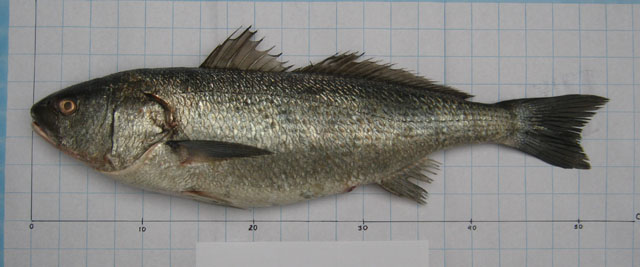
Its body is moderately elongate and compressed, with a moderately high back and a rather strongly convex nape [1]. The snout is long and conical and juts out ahead of the mouth, which is large, slightly oblique and opens underneath, with the lower jaw shorter than the upper; the lips, maxilla and chin bear papillae [1]. In the two specimens of the original description, the dorsal fin has 10 spines followed by 1 spine and 21 to 23 soft rays, the anal fin 2 spines and 9 rays, the pectoral fin 18 rays, and there are 56 to 57 scales in a lateral series [1].
The pectoral fin is long, reaching past the tip of the pelvic fin by more than one eye diameter, and the tail fin is distinctly crescent-shaped [1]. The old preserved specimens are greyish above with bluish metallic reflections and pale silvery below; dark streaks run along the rows of scales, the pectoral axil is black, and all fins except the pelvics are more or less dusky [1].
The type specimen measures 340 mm in total length (270 mm to the base of the tail fin) and the other specimen 230 mm (185 mm) [1]. The larger specimen, designated as the type, is number 36934 of the United States National Museum (U.S.N.M.) [1].
Similar species
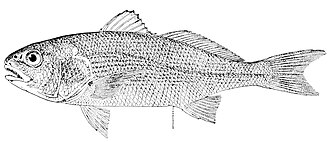
- Sciaena deliciosa: It is very similar and differs mainly in its teeth: in Sciaena callaensis those of the upper jaw form a narrower band with an outer row of large, close-set teeth, and those of the lower jaw sit in 2 main rows, the inner one with enlarged teeth, whereas in Sciaena deliciosa they form broad bands; it also has a straight or slightly concave profile above the eyes, a slightly longer maxilla, somewhat fewer scales and a longer pectoral fin, although the paratype overlaps slightly with Sciaena deliciosa in everything except the teeth and the maxilla [1].
Distribution and habitat
Ecology
In Peru it has been recorded as a host of larval stages (metacestodes) of tapeworms of the family Diphyllobothriidae: larvae of Adenocephalus pacificus on the peritoneum and the surface of the stomach, reported by Tantaleán in 1975, and larvae of Diphyllobothrium sp. on the peritoneum, the stomach surface and the body cavity, reported by Escalante in 1983 [4].
Conservation
Its global category on the IUCN Red List is Critically Endangered [3].
Its identity calls for caution: Hildebrand himself noted that it is very close to Sciaena deliciosa and that the small specimen overlaps slightly with it in every character except the teeth and the length of the maxilla [1]. Even so, WoRMS keeps it as an accepted name [2].
Health, toxicological and chemical relevance
Not medical advice. For a sting, a poisoning or an allergy, seek medical care.
Adenocephalus pacificus, one of the tapeworms whose larvae have been found in this species [4], is the main cause of diphyllobothriosis in South America, a zoonosis people catch by eating fish [5]. A molecular study of plerocercoid larvae in 9 commercially fished species from Peru examined 6999 fish, 6 of them Sciaena callaensis; the combined prevalence across all species was 2.61 % [5].
Human relevance
That same 2024 study included it among the 9 commercially important Peruvian fishes that it analysed [5].
Where to see it in Peru
References (5)
- Hildebrand, S.F. (1946). A descriptive catalog of the shore fishes of Peru. Bulletin of the United States National Museum, 1-530. doi:10.5479/si.03629236.189.1 (accessed 2026-10-20)
- WoRMS Editorial Board (2026). Sciaena callaensis Hildebrand, 1946. World Register of Marine Species. https://www.marinespecies.org/aphia.php?p=taxdetails&id=273789 (accessed 2026-10-20)
- Chao, L., Bearez, P., Williams, J. (2020). Sciaena callaensis: Chao, L., Bearez, P. & Williams, J. The IUCN Red List of Threatened Species 2020: e.T154864A131075850. doi:10.2305/IUCN.UK.2020-2.RLTS.T154864A131075850.en (accessed 2026-10-20)
- Alves, P.V., de Chambrier, A., Scholz, T. et al. (2017). Annotated checklist of fish cestodes from South America. ZooKeys, 1-205. doi:10.3897/zookeys.650.10982 (accessed 2026-10-20)
- Mondragón-Martínez, A., Marroquin-Vilchez, D., Martínez-Rojas, R. et al. (2024). Molecular identification and prevalence of plerocercoid larvae (Cestoda: Diphyllobothriidae) in some commercial fish species from Peru. Parasitology Research. doi:10.1007/s00436-024-08267-1 (accessed 2026-10-20)
More pictures
If you come across it
Protected or threatened species. Watch it without touching, feeding, chasing or taking it, and keep the recommended viewing distances.
Where it has been recorded
- Filled: scientific records, or confirmed by a curator
- Hatched: isolated record
- Dotted outline: no scientific records and no curator's confirmation (an ORKA sighting is not drawn here)
- Tropical–cold transition zone
Isolated record (1 record)
- Cold central sea
Scientific records (4 records)
From openly licensed OBIS and GBIF records (CC0 or CC BY). How each list is built.
Related species
From the same genus (Sciaena) and from the same family (Sciaenidae).
Sciaena deliciosa
IUCN status: LC · Least ConcernBluestreak drum
Elattarchus archidium
IUCN status: LC · Least Concern
Corvina drum
Cilus gilberti
IUCN status: DD · Data DeficientPeruvian weakfish
Cynoscion analis
IUCN status: LC · Least ConcernBigeye corvina
Isopisthus remifer
IUCN status: LC · Least Concern
Shining drum
Larimus effulgens
IUCN status: LC · Least Concern- No openly licensed image yet
Pacific drum
Larimus pacificus
IUCN status: LC · Least Concern Snakehead kingcroaker
Menticirrhus ophicephalus
IUCN status: LC · Least Concern
Names and sources
Classification
Learn more
Conservation status: Critically Endangered (IUCN Red List, according to Wikidata). Taxonomy: PeRMS / WoRMS (CC BY 4.0).