
Bony fishes · Labridae
Loosetooth parrotfish
Nicholsina denticulata (Evermann & Radcliffe, 1917)
Spanish: Pococho beriquete
- Peruvian Register of Marine Species
- Listed in PeRMS (IMARPE)

Species account
Summary
Nicholsina denticulata is a small parrotfish of the tropical eastern Pacific; the current taxonomic register places it in the family Labridae [1]. It lives at depths of 1 to 11 m, mostly on rocky coasts with macroalgae, and reaches about 32.0 cm in total length [2]. In Peru it is known from Lobos de Afuera, Lobos de Tierra, Don Martín and North Chincha islands [3]. The IUCN lists it as Least Concern [4].
Etymology
The genus name honours J.T. Nichols, a curator of ichthyology at the American Museum of Natural History [2].
Nicholsina was established in 1915 as a subgenus of Cryptotomus, and was later treated as a genus by Schultz (1958) [3]. The species was described in 1917 under the name Xenoscarus denticulatus [3].
Identification and similar species
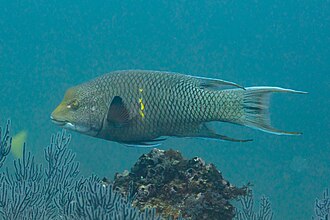
A fresh specimen caught in northern Chile was very dark brown, with red at the rear base of the pectoral fin; the branchiostegal membrane, the underside of the chin and the isthmus were reddish brown [3]. The membrane of the tail fin was red and its rays a dark brown that contrasted with it; no conspicuous stripes or borders were seen, nor radial lines around the eyes [3].
The same specimen had IX dorsal spines and 10 soft rays, III anal spines and 9 anal rays, 12 pectoral rays, 27 pored scales on the lateral line and 22 large cycloid scales in a lengthwise series [3]. A narrow free fold crosses the isthmus; the teeth of the lower jaw form a fused plate, while those of the upper jaw are conical, free and in a single row [3]. That individual measured 282 mm in total length [3], and the largest size recorded for the species is 32.0 cm [2].
Similar species
- Nicholsina usta: It lives in the Atlantic, not the eastern Pacific; Nicholsina denticulata is told apart from it by its typically dark colour pattern [3].
Distribution and habitat
The species belongs to the eastern Pacific, from the Gulf of California to Ecuador and northern Peru, and it includes the Galápagos Islands [2]. Its northern limit in the Gulf of California is Guaymas, where its juvenile phase was described under another name, Xenoscarus hubbsii [3]. A specimen caught near Iquique, at 20°12'S, pushed the known southern limit into northern Chile and was the first record of the family Scaridae for the continental Chilean coast [3].
It is a marine reef-associated fish that lives at 1 to 11 m and is abundant in shallow coastal areas, above all on rocky coasts with macroalgae [2]. The Iquique specimen was speared at 10 m over a rocky bottom [3].
Biology
It scrapes or breaks off pieces of reef to digest the algae growing in them, or feeds directly on algae; it can be solitary or form loose schools [2]. FishBase gives it a trophic level of 2.0, estimated from its food items [2].
FishBase estimates a medium resilience for the species, with a minimum population doubling time of 1.4 to 4.4 years [2].
Conservation
Health, toxicological and chemical relevance
Not medical advice. For a sting, a poisoning or an allergy, seek medical care.
FishBase rates it as harmless to humans [2].
Human relevance
FishBase classes it as a minor commercial fishery species and gives it a high price category [2].
Where to see it in Peru
The literature records it in Peru at Lobos de Afuera, Lobos de Tierra, Don Martín and North Chincha islands; the data date from 1917 and 1946 [3].
References (4)
- WoRMS Editorial Board (2026). Nicholsina denticulata (Evermann & Radcliffe, 1917). World Register of Marine Species. https://www.marinespecies.org/aphia.php?p=taxdetails&id=276038 (accessed 2026-10-25)
- Froese, R., Pauly, D. (2026). Nicholsina denticulata, Loosetooth parrotfish. FishBase. https://www.fishbase.se/summary/Nicholsina-denticulata.html (accessed 2026-10-25)
- Sielfeld, W. (2013). New data on Nicholsina denticulata (Evermann and Radcliffe, 1917) (Scaridae, Labroidei) in southeastern Pacific. Latin American Journal of Aquatic Research, 163-165. doi:10.3856/vol41-issue1-fulltext-13 (accessed 2026-10-25)
- IUCN (2007). Nicholsina denticulata: Allen, G., Robertson, R., Rivera, R., Edgar, G., Merlen, G., Zapata, F., Barraza, E. & Rocha, L.A. The IUCN Red List of Threatened Species. doi:10.2305/iucn.uk.2012.rlts.t183813a17894922.en (accessed 2026-10-25)
More pictures
Where it has been recorded
- Filled: scientific records, or confirmed by a curator
- Hatched: isolated record
- Dotted outline: no scientific records and no curator's confirmation (an ORKA sighting is not drawn here)
- Tropical northern sea
Scientific records (6 records)
- Cold central sea
Scientific records (12 records)
- Cold southern sea
Scientific records (2 records)
From openly licensed OBIS and GBIF records (CC0 or CC BY). How each list is built.
Related species
From the same family.
Mexican hogfish
Bodianus diplotaenia
IUCN status: LC · Least ConcernBrown hogfish
Bodianus eclancheri
IUCN status: LC · Least ConcernProtected in Peru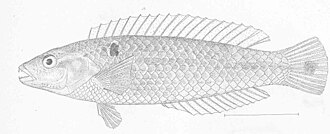
Chameleon wrasse
Halichoeres dispilus
IUCN status: LC · Least ConcernBumphead parrotfish
Scarus perrico
IUCN status: LC · Least ConcernProtected in PeruBanded wrasse
Halichoeres notospilus
IUCN status: LC · Least ConcernCortez rainbow wrasse
Thalassoma lucasanum
IUCN status: LC · Least Concern- No openly licensed image yet
Bodianus darwini
IUCN status: Not evaluated - No openly licensed image yet
Blackspot wrasse
Decodon melasma
IUCN status: LC · Least Concern
Names and sources
In Spanish
- Pococho beriquete — WoRMS; Wikidata · main name
- Loro Pez Loro de Diente Flojo — Wikidata
In English
- Loosetooth parrotfish — WoRMS; Wikidata
Classification
Learn more
Conservation status: Least Concern (IUCN Red List, according to Wikidata). Taxonomy: PeRMS / WoRMS (CC BY 4.0).