
Bony fishes · Mugilidae
White mullet
Mugil curema Valenciennes, 1836
Spanish: Lisa plateada
- Names in Peru
- Lisa plateada
- Peruvian Register of Marine Species
- Not in PeRMS: recorded by OBIS, or by ORKA at our dive sites

Species account
Summary
Identification and similar species
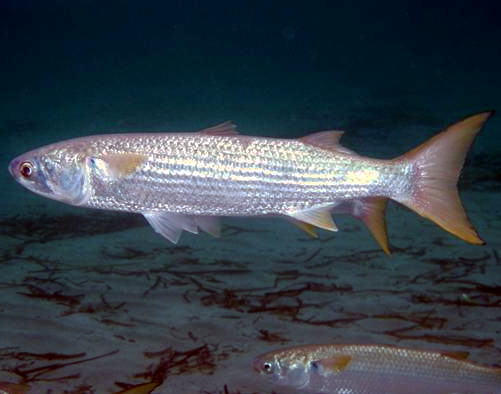
It is described as a thick-bodied mullet, round in section, with a wide head, a level interorbital space and an adipose eyelid, well developed, that hides much of the pupil [4].
The external characters of mullets are highly conserved, and molecular analyses have shown they do not suffice to separate every species [2]. In the Gulf of Mexico, the shape of the ctenii on the scales was used to tell Mugil hospes from Mugil curema [5].
Using recent specimens from Ecuador and Peru, Britzke and colleagues redescribed Mugil setosus and discussed whether Mugil curema truly occurs in the Pacific Ocean [6].
Similar species
- Mugil setosus: By its redescription, the tip of the pelvic fin reaches beyond the vertical of the base of the third dorsal spine, the pectoral fin has ii+13–14 rays and the anterodorsal tip of the second dorsal fin is uniformly dark [6].
Distribution and habitat
FishBase gives the eastern Pacific range as the Gulf of California to Chile, and for the species as a whole marine, brackish and fresh water, usually between 0 and 20 m depth [4]. That figure lumps the whole complex, and whether the name Mugil curema truly occurs in the Pacific is under discussion [6].
The Pacific lineage, called Mugil sp. O, was identified molecularly in specimens collected in Ecuador [2].
Biology
The Pacific lineage has 46 chromosomes, 2 of them metacentric and 44 subtelocentric or acrocentric, a karyotype unlike that of Mugil incilis, which has 48, of Mugil curema in the strict sense, with 28, and of Mugil margaritae, with 24 [2].
Reproductive data exist only for Atlantic populations. In the Paciência River estuary, in Maranhão (Brazil), 942 fish were measured during 2021, with a mean total length of 20.44 cm; size at first maturity was 19.04 cm and reproductive activity peaked in May and July [7]. That population belongs to the Atlantic, where the name keeps its original sense, so its figures cannot simply be carried over to Peru [2].
Ecology
Otoliths of 163 fish from Mexico, Venezuela and Brazil, analysed through their strontium-calcium ratio, indicated that 87.1 % moved from the estuary towards the sea or hypersaline environments, and that 11.1 % showed marine-water signals from early ages [8].
Those results fit a fish that uses estuaries, lagoons and rivers together with the open coast, and in which juveniles predominate in estuarine areas that serve as nurseries [7]. For the authors of the otolith study, its sustainable use depends on conserving the estuaries and the corridors that join them with lagoons, rivers, mangroves and the sea [8].
Conservation
References (8)
- WoRMS Editorial Board (2026). Mugil curema Valenciennes, 1836. World Register of Marine Species. https://www.marinespecies.org/aphia.php?p=taxdetails&id=159416 (accessed 2026-10-25)
- Nirchio, M., Oliveira, C., Siccha-Ramirez, Z.R. et al. (2017). The Mugil curema species complex (Pisces, Mugilidae): a new karyotype for the Pacific white mullet mitochondrial lineage. Comparative Cytogenetics. doi:10.3897/compcytogen.v11i2.11579 (accessed 2026-10-25)
- IUCN (2018). Mugil curema: Castro, M.G., Vieira, J.P., Albieri, R.J., Mendonca, E., Villwock de Miranda, L., Fadré, N.N., Brick Peres, M., Padovani-Ferreira, B., da Silva, F.M.S., Rodrigues, A.M.T. & Chao, L. The IUCN Red List of Threatened Species. doi:10.2305/IUCN.UK.2019-2.RLTS.T190168A82660284.EN (accessed 2026-10-25)
- Froese, R., Pauly, D. (2026). Mugil curema Valenciennes, 1836. FishBase. https://www.fishbase.se/summary/Mugil-curema.html (accessed 2026-10-25)
- Ibáñez, A.L., González-Castro, M., Pacheco-Almanzar, E. (2011). First record of Mugil hospes in the Gulf of Mexico and its identification from Mugil curema using ctenii. Journal of Fish Biology. doi:10.1111/j.1095-8649.2010.02863.x (accessed 2026-10-25)
- Britzke, R., Menezes, N.A., Nirchio, M. (2019). Redescription of Mugil setosus Gilbert 1892 with comments on the occurrence of Mugil curema Valenciennes 1836 in the Pacific Ocean (Teleostei: Perciformes: Mugilidae). Zootaxa. doi:10.11646/zootaxa.4671.3.5 (accessed 2026-10-25)
- Figueiredo, M.B., Melo, M.L.F., Fernandes, C.A.F. et al. (2026). Aspects of the biology of Mugil curema (Osteichthyes, Mugilidae) in the Amazon coast, Brazil. Brazilian Journal of Biology. doi:10.1590/1519-6984.299258 (accessed 2026-10-25)
- Avigliano, E., Ibañez, A., Fabré, N. et al. (2021). Unravelling the complex habitat use of the white mullet, Mugil curema, in several coastal environments from Neotropical Pacific and Atlantic waters. Aquatic Conservation: Marine and Freshwater Ecosystems. doi:10.1002/aqc.3486 (accessed 2026-10-25)
More pictures
Where it has been recorded
- Filled: scientific records, or confirmed by a curator
- Hatched: isolated record
- Dotted outline: no scientific records and no curator's confirmation (an ORKA sighting is not drawn here)
- Tropical northern sea
Scientific records (20 records)
- Tropical–cold transition zone
Scientific records (18 records)
- Cold central sea
Scientific records (8 records)
- Cold southern sea
Scientific records (1 record)
From openly licensed OBIS and GBIF records (CC0 or CC BY). How each list is built.
Related species
From the same genus (Mugil) and from the same family (Mugilidae).
Names and sources
In Spanish
- Lisa plateada — Peru; fishbase; Wikidata · main name
- Anchoa blanca — Wikidata
- Anchoeta — Wikidata
- Anchoveta — Wikidata
- Capiton — Wikidata
- Chango — Wikidata
- Chapiton — Wikidata
- Galupe — Wikidata
- Isa Criolla — Wikidata
- Jarea — Wikidata
- Lebrancha — Wikidata
- Lebranche — Wikidata
- Lisa — Wikidata
- Lisa blanca — Wikidata; WoRMS
- Lisa Criolla — Wikidata
- Lisa curema — Wikidata
- Liseta — Wikidata
- Liseta Plateada — Wikidata
- Liza Curema — Wikidata
- Mujol — Wikidata
- Plateado — Wikidata
In English
- White mullet — WoRMS; Wikidata
- Blue-black mullet — WoRMS
- Blueback Mullet — Wikidata
- Curema Mullet — Wikidata
- Josea — Wikidata
- Mollit — Wikidata
- Mulet — Wikidata
- Mullet — Wikidata
Learn more
Conservation status: Least Concern (IUCN Red List, according to Wikidata). Taxonomy: PeRMS / WoRMS (CC BY 4.0).