
Bony fishes · Sciaenidae
Pacific drum
Larimus pacificus Jordan & Bollman, 1890
Spanish: Bereche
- Names in Peru
- Bereche
- Peruvian Register of Marine Species
- Listed in PeRMS (IMARPE)
Species account
Summary
Larimus pacificus is a fish of the family Sciaenidae, the drums and croakers [1]. It lives in tropical coastal waters of the eastern Pacific, from Mexico to Peru, and does not exceed 32.0 cm total length [2]. In Tumbes it is called «bereche» and ranked among the most landed species of that region's small-scale fishery [3]. Its global category on the IUCN Red List is Least Concern [4].
Identification and similar species
The body is moderately short and not very deep, with a slightly arched back; the mouth is large and oblique, and the rear end of the upper jaw reaches past the middle of the eye [2]. The snout bears 3 pores, there are 20 to 21 gill rakers on the lower limb of the first gill arch, the pectoral fins have 16 to 17 rays and the scales are ctenoid [2].
It is grey to silvery brown, darker on the back, with distinct black stripes along the scale rows of the flanks; the fins are pale or greyish [2]. The common length is 18.0 cm and the maximum recorded is 32.0 cm total length [2].
Distribution and habitat
It occurs in the tropical eastern Pacific, from Mexico to Peru, roughly between 24° N and 18° S [2]. It lives in neritic and pelagic coastal waters at depths of 29 to 50 m, and the database describes it as an uncommon species [2].
In northern Peru it turned up in the catches of the small-scale shrimp trawl fishery between Cabo Blanco and Máncora, in the Piura region, with nets working at 6.5 to 65 m depth and less than 5 miles from the coast [5].
Ecology
It feeds mainly on planktonic crustaceans, and the database gives it a trophic level of 4.5 with a margin of ±0.7 [2].
In the small-scale shrimp trawl fishery of northern Peru it was one of the most abundant bycatch species: it made up 5.7 % of the catch weight, with a catch per hour of trawling of 4.7 kg, the fifth highest among all species [5].
Conservation
Its global category on the IUCN Red List is Least Concern, according to the 2020 assessment [4].
In the shrimp trawl fishery of northern Peru it is discarded: the authors state that, because of its size or a lack of consumer acceptance in Peru, it was not retained, although it is sold or eaten elsewhere [5].
Human relevance
FishBase classes it as a minor commercial fishery resource and considers it harmless to people [2].
In Tumbes, the small-scale fishery between 1996 and 2010 rested on 20 species, and the most representative was the bereche, at 12.4 % of landings, according to a thesis that cites a 2010 report [3]. By contrast, in the small-scale shrimp trawl fishery of Piura it was discarded in 2019 and 2020 [5].
Where to see it in Peru
References (5)
- WoRMS Editorial Board (2026). Larimus pacificus Jordan & Bollman, 1890. World Register of Marine Species. https://www.marinespecies.org/aphia.php?p=taxdetails&id=276131 (accessed 2026-10-25)
- Froese, R., Pauly, D. (2026). Larimus pacificus, Pacific drum. FishBase. https://www.fishbase.se/summary/Larimus-pacificus.html (accessed 2026-10-25)
- Arevalo Aguirre, Y.J. (2018). Influencia de la temperatura y la cepa bacteriana en la calidad bromatológica del ensilado biológico obtenido con residuos de carajito (Diplectrum conceptione) y volador (Chelidonichthys obscurus). Tesis de Ingeniería Agroindustrial, Universidad Nacional de Tumbes, 19. https://repositorio.untumbes.edu.pe/server/api/core/bitstreams/4d16e5c2-894e-4cfd-aa05-879b1f2370ec/content (accessed 2026-10-25)
- Chao, L., Espinosa-Perez, H., Bearez, P. (2020). Larimus pacificus: Chao, L., Espinosa-Perez, H. & Bearez, P. The IUCN Red List of Threatened Species. doi:10.2305/iucn.uk.2020-2.rlts.t183380a131015357.en (accessed 2026-10-25)
- Mendo, J., Mendo, T., Gil-Kodaka, P. et al. (2022). Bycatch and discards in the artisanal shrimp trawl fishery in Northern Peru. PLOS ONE, e0268128. doi:10.1371/journal.pone.0268128 (accessed 2026-10-25)
Where it has been recorded
- Filled: scientific records, or confirmed by a curator
- Hatched: isolated record
- Dotted outline: no scientific records and no curator's confirmation (an ORKA sighting is not drawn here)
- Tropical–cold transition zone
Scientific records (13 records)
- Cold central sea
Scientific records (6 records)
From openly licensed OBIS and GBIF records (CC0 or CC BY). How each list is built.
Related species
From the same genus (Larimus) and from the same family (Sciaenidae).
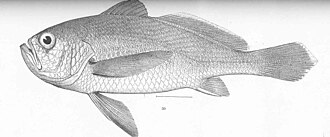
Shining drum
Larimus effulgens
IUCN status: LC · Least Concern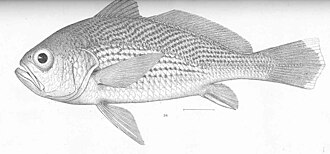
Steeplined drum
Larimus acclivis
IUCN status: LC · Least Concern- No openly licensed image yet
Silver drum
Larimus argenteus
IUCN status: LC · Least Concern Bluestreak drum
Elattarchus archidium
IUCN status: LC · Least Concern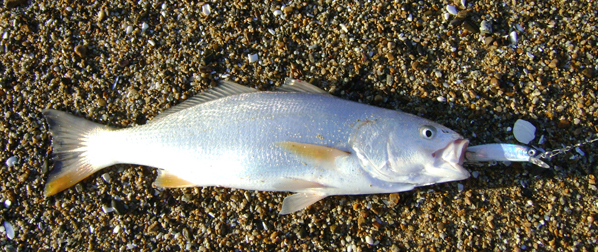
Corvina drum
Cilus gilberti
IUCN status: DD · Data DeficientPeruvian weakfish
Cynoscion analis
IUCN status: LC · Least ConcernBigeye corvina
Isopisthus remifer
IUCN status: LC · Least ConcernSnakehead kingcroaker
Menticirrhus ophicephalus
IUCN status: LC · Least Concern
Names and sources
In Spanish
- Bereche — Peru; SERNANP (2023). Plan Maestro del Santuario Nacional Los Manglares de Tumbes 2023-2027. RP N.° 064-2023-SERNANP, p. 26 of the PDF · main name
- Bombache cajeto — Wikidata
- Boquinete del Pacífico — Wikidata; WoRMS
- Cajero — Wikidata
- Cajeta — Wikidata
- Corvineta tambor — Wikidata
In English
- Pacific drum — WoRMS; Wikidata
Classification
Learn more
Conservation status: Least Concern (IUCN Red List, according to Wikidata). Taxonomy: PeRMS / WoRMS (CC BY 4.0).