
Bony fishes · Labrisomidae
Porehead blenny
Labrisomus multiporosus Hubbs, 1953
Spanish: Trambollo
- Names in Peru
- Trambollo
- Peruvian Register of Marine Species
- Listed in PeRMS (IMARPE)
Species account
Summary
Labrisomus multiporosus is a small fish of the family Labrisomidae, described by Clark Hubbs in 1953 from specimens taken at Acapulco, Mexico [1],[2]. It lives on shallow rocky bottoms of the tropical eastern Pacific, and the original study recorded it in Peru from Paita to the Lobos islands [1]. Its global IUCN Red List category is Least Concern [3].
Etymology
Hubbs built the epithet multiporosus from the Latin words multus (many) and porus (pore), for the numerous lateral-line pores on the head [1].
Identification and similar species
It has 17 to 19 dorsal spines and 11 to 13 dorsal soft rays, 17 to 18 anal soft rays and 65 to 69 scales along the lateral line [1].
The colour pattern has four distinct dark bars on the body, with fainter bars between them; the head is mottled and bears a doubled dark stripe from the eye to the corner of the preopercle, and a faint ocellus lies between the second and third dorsal spines [1].
The feature behind its name is the great number of lateral-line pores piercing the head, covering a share of the head surface among the largest in the genus; it also has a broad patch of palatine teeth [1]. It has been measured at up to 18 cm total length, although about 10 cm is typical [4].
Other characters in the original description are 2 upper and 7 lower gill rakers, a row of 5 or 6 large teeth on the vomer and a comb of nuchal cirri whose width is 3.6 % or more of standard length [1].
Similar species
- Labrisomus xantusi: The two are very similar and overlap in part of the Gulf of California; Hubbs separates them by the width of each comb of nuchal cirri and because Labrisomus xantusi has fewer lateral-line pores on the head; Labrisomus multiporosus is the more common species on the southern coasts, where Labrisomus xantusi is rare, Labrisomus multiporosus is the more common species on the southern coasts [1].
- Labrisomus nuchipinnis: Labrisomus multiporosus has a more extensive patch of palatine teeth, lacks the dark ocellus-like mark on the opercle and has wider nuchal cirri [1].
Distribution and habitat
According to the original description, the species ranges from Turtle Bay, Baja California, to Lobos de Afuera Island, Peru; in the Gulf of California it reaches north to Punta Peñasco [1]. Later sources give the eastern Pacific as far as Peru, including the Galápagos Islands [4].
It is a reef-associated species recorded between 0 and 5 m deep [4]. Where it overlaps with Labrisomus xantusi, specimens of Labrisomus multiporosus appear more frequent on rocks next to sandy beaches [1].
Biology
The postlarvae of Labrisomus multiporosus are pelagic and have been collected at night under lights in the tropical eastern Pacific, including far south of the area where Labrisomus xantusi lives [1].
Hubbs links this long pelagic phase to the presence of the genus far from its centre of origin in Central America, and reports that in another species of the genus postlarvae were taken between 15 April and 9 June; for Labrisomus multiporosus he gives only parallel evidence, scattered geographically [1].
Ecology
Labrisomus multiporosus and Labrisomus xantusi can share a site: near Mazatlán, 54 of 65 fish of the two species in a sample were Labrisomus multiporosus, whereas at Guaymas it was 22 of 137 once one collection from a sandy bottom with scattered rocks was excluded [1].
Specimens from Panama, Ecuador, Peru and the Galápagos have on average slightly more soft rays (dorsal and anal combined, average 29.50) than those from Mexico (29.05), a difference Hubbs considers of marginal significance and not enough to separate another species [1].
Conservation
The IUCN assesses Labrisomus multiporosus globally as Least Concern [3].
Where to see it in Peru
In Peru, the specimens Hubbs examined (collected before 1953) came from Paita, from a point 9.5 miles south of Zorritos Light and from Lobos de Tierra and Lobos de Afuera islands [1].
A recent DNA-barcoding study of rocky-reef fishes of northern Peru, sampled by scuba at Isla Foca, between Cabo Blanco and Los Órganos and at Punta Sal, includes this species among those sequenced, but does not say at which of those sites it was obtained [5].
References (5)
- Hubbs, C. (1953). Revision of the Eastern Pacific fishes of the clinid genus Labrisomus. Zoologica: Scientific Contributions of the New York Zoological Society 38, 113-136. doi:10.5962/p.184712 (accessed 2026-10-25)
- WoRMS Editorial Board (2026). Labrisomus multiporosus Hubbs, 1953. World Register of Marine Species. https://www.marinespecies.org/aphia.php?p=taxdetails&id=281258 (accessed 2026-10-25)
- Hastings, P. (2007). Labrisomus multiporosus: Hastings, P. The IUCN Red List of Threatened Species 2010: e.T183854A8188944. doi:10.2305/iucn.uk.2010-3.rlts.t183854a8188944.en (accessed 2026-10-25)
- Froese, R., Pauly, D. (2026). Labrisomus multiporosus, Porehead blenny. FishBase (facts only; CC BY-NC). https://www.fishbase.se/summary/8295 (accessed 2026-10-25)
- Zavala, E., Britzke, R., Siccha-Ramírez, Z. et al. (2025). DNA barcoding of marine rocky reef fishes from northern Peru suggests a parapatric speciation in the Tropical Eastern Pacific. Ecology and Evolution 15, e70125. doi:10.1002/ece3.70125 (accessed 2026-10-25)
More pictures
Where it has been recorded
- Filled: scientific records, or confirmed by a curator
- Hatched: isolated record
- Dotted outline: no scientific records and no curator's confirmation (an ORKA sighting is not drawn here)
- Tropical northern sea
Scientific records (6 records)
- Tropical–cold transition zone
Scientific records (2 records)
- Cold central sea
Scientific records (4 records)
From openly licensed OBIS and GBIF records (CC0 or CC BY). How each list is built.
Related species
From the same genus (Labrisomus) and from the same family (Labrisomidae).
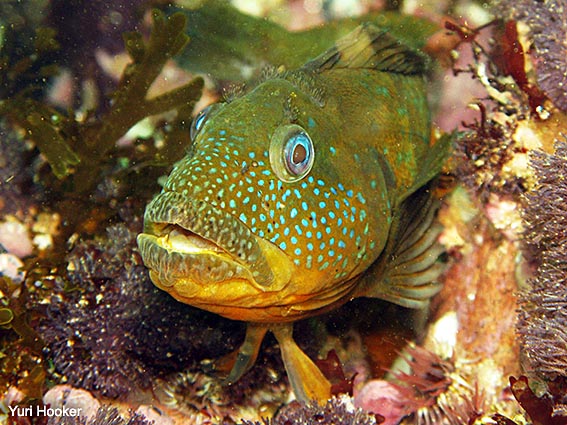
Chalapo Clinid
Labrisomus philippii
IUCN status: LC · Least Concern- No openly licensed image yet
Labrisomus pomaspilus
IUCN status: DD · Data Deficient 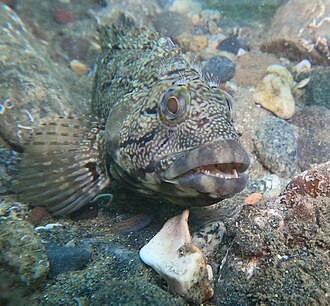
Largemouth blenny
Labrisomus xanti
IUCN status: LC · Least Concern
Auchenionchus crinitus
IUCN status: LC · Least Concern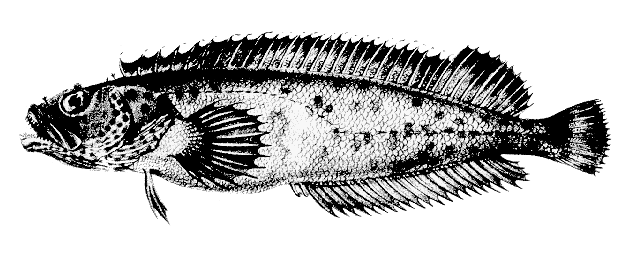
Auchenionchus microcirrhis
IUCN status: LC · Least Concern
Throatspotted blenny
Malacoctenus tetranemus
IUCN status: LC · Least Concern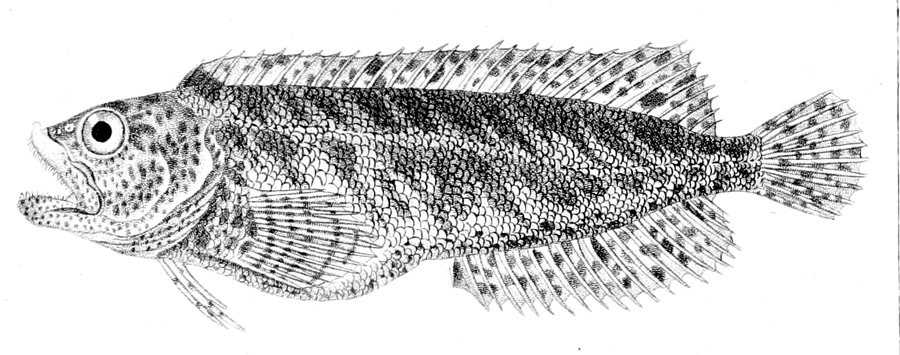
Auchenionchus variolosus
IUCN status: LC · Least Concern- No openly licensed image yet
Topgallant blenny
Paraclinus altivelis
IUCN status: DD · Data Deficient
Names and sources
In Spanish
- Trambollo — Peru; fishbase · main name
- Blenia Porosa — Wikidata
- Curiche — Wikidata
- Trambollo Cabeza Porosa — Wikidata; WoRMS
- Trambollo Curiche — Wikidata
In English
- Porehead blenny — WoRMS; Wikidata
- Curiche Clinid — Wikidata
Classification
Learn more
Conservation status: Least Concern (IUCN Red List, according to Wikidata). Taxonomy: PeRMS / WoRMS (CC BY 4.0).