
Sharks, rays and chimaeras · Dasyatidae
Hypanus dipterurus
Hypanus dipterurus (Jordan & Gilbert, 1880)
Spanish: Batea
- Names in Peru
- Batea · Batana
- Peruvian Register of Marine Species
- Listed in PeRMS (IMARPE)
Species account
Summary
Hypanus dipterurus is a stingray of the family Dasyatidae, in the order Myliobatiformes [1]. It ranges along the eastern Pacific from southern California to northern Chile, and in Peru it is one of the rays most often landed by small-scale fishers: between 1997 and 2015 it made up 5.9 % of batoid landings [2],[3]. In Peru it is called «batea» or «batana» [4]. The IUCN Red List classifies it as Vulnerable [5].
Etymology
Jordan and Gilbert described it in May 1880 as Dasybatis dipterurus, from specimens taken in San Diego Bay, California [6]. In October of the same year Garman described Trygon brevis from specimens collected at Paita, Piura, in 1872 during the Hassler Expedition; in 1913 Garman himself merged the two species under his own name, and the priority of Jordan and Gilbert's name was not recognised until 1998 [6]. In 2016 a revision of the family Dasyatidae revived the genus Hypanus, which had been treated as a synonym of Dasyatis, and the species was moved into it [7],[1].
A 2026 preprint, not yet peer reviewed, argues that the southeast Pacific populations are a separate species and gives them back the name Hypanus brevis, on the basis of genetic differences and a few proportions of the disc and of the space between the nostrils [6]. For now the World Register of Marine Species keeps Hypanus dipterurus as the accepted name [1].
Identification and similar species
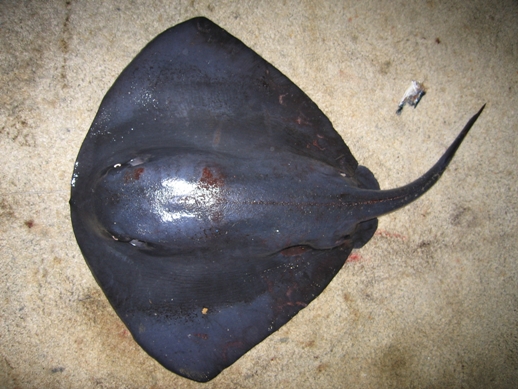
It is a ray with a diamond-shaped disc. According to the description of Peruvian specimens in the 2026 preprint, the disc is slightly wider than long, the snout is pointed but short, the front edges of the disc are almost straight, and the floor of the mouth bears 5 papillae in one transverse row [6]. The whip-like tail carries a long, slender spine and a short skin fold underneath; juveniles have a smooth back, while adults have a few scattered denticles along the midline and on the shoulders [6].
The back is brown, dark brown or olive-brown, without spots, turning slightly reddish towards the edges; the belly is white with the rear edges of the pectoral and pelvic fins brown, and in juveniles the back is slightly more violet [6]. The largest known Peruvian specimen, incomplete, measured about 900 mm in disc width, and a 690 mm male caught at Chorrillos in 1999 weighed 13.8 kg [6]. FishBase lists a maximum disc width of 167 cm [4].
Similar species
Distribution and habitat
It lives in the eastern Pacific from southern California to Peru and has been reported from the Galapagos Islands; it is a bottom-dwelling fish recorded between 10 and 355 m deep [4]. Until recently its known southern limit was San Andrés, on Peru's central coast; anglers' photos shared on social media and historical data confirmed it in southern Peru and northern Chile, more than 1250 km further south, and a distribution model predicts it could live along much of the Peruvian and Chilean coasts [2].
Off Peru it is fished mostly very close to shore: between 2015 and 2024, 32 % of catches came from within the first nautical mile and another 44 % from between 1 and 5 miles, and much of the rest comes from around the Lobos de Afuera Islands, probably still on the continental shelf [6].
Biology
It is viviparous: embryos first live on their yolk and later on a nourishing uterine fluid secreted by the mother [4].
In western Mexico, where it is a regular catch of small-scale fisheries, females mature at a median disc width of 57.3 cm and males at 46.5 cm [9]. Its vertebrae lay down one pair of bands per year, and the oldest estimated ages were 28 years in females and 19 in males; it grows very slowly, the slowest rate then measured in rays of its order [9].
A demographic model for the Bahía Magdalena population in Mexico estimated a generation time of 14.9 to 16.5 years and unfished population growth of only 5 to 6 % per year, falling to about 1 % under low fishing mortality; that growth depends most on the survival of juveniles and adults [10].
These figures come from northern hemisphere populations. Research on rays in Peru is scarce: between 1978 and 2022 only 25 studies on Peruvian batoids were published, and the most studied were other species [3].
Ecology
At Espíritu Santo Island, in the Bay of La Paz (Mexico), 473 stomachs showed that it eats invertebrates living buried in the sediment or on top of it, above all clams of the genus Solemya and the mantis shrimp Nannosquilla raymanningi [11]. There it specialises in bivalves, polychaete worms and mantis shrimps and acts as a secondary consumer and mesopredator; older females ate more polychaetes in the cold season and younger ones more mantis shrimps and bivalves in the warm season [11].
In the upper Gulf of California 48 prey species were found in its diet, with the snail Mitrella dorma the most important, and a strategy that combines specialist and generalist prey [12].
In Peru, new monogenean worms have been described from its gills using rays caught off Lima and off Puerto Pizarro, Tumbes; by 2020 there were 5 monogenean species described from this ray [13],[14].
Conservation
The IUCN Red List classifies Hypanus dipterurus as Vulnerable in its 2020 global assessment [5]. According to the 2026 preprint, that category is due mainly to intense and largely unmanaged fishing across most of its range [6].
In Peru it has no management measures of its own: the few fishery rules for rays concern other species and the genera Mobula and Myliobatis, and even those are not fully enforced [3]. Its landings fell by an average of 11.5 % per year between 1997 and 2006, with no clear trend between 2007 and 2015, and the authors warn that the decline may have begun before IMARPE recorded rays species by species [3].
Its low growth potential leaves it little resilience to fishing, and fishing effort with no limits or monitoring can deplete or collapse local populations [10]. The 2026 preprint found a single COI haplotype in every specimen from northern and central Peru, which could point to a bottleneck and raises concern about its genetic diversity [6].
Health, toxicological and chemical relevance
Not medical advice. For a sting, a poisoning or an allergy, seek medical care.
Its tail carries a long, slender spine [6]. Stingray wounds happen because the spine pierces the skin and then releases venom; a study of the tissue covering this species' spine found a mixture of proteins that was toxic to a line of human cervical cancer cells grown in the laboratory and broke down gelatin, although it did not destroy red blood cells [15].
Human relevance
In Peru it is among the 4 most landed groups of rays: between 1997 and 2015 it made up 5.9 % of batoid landings, was caught mainly with gillnets (68.3 %) and secondly with purse seines (18.6 %), and its landings peaked in the austral summer [3]. A single site on the central coast, San Andrés, accounted for 41.1 % of its landings [3].
Between 2015 and 2024 IMARPE recorded about 46.2 tonnes of batea a year, worth about 62,000 dollars annually; 78 % was caught with gillnets and most was landed in the north (44 %) and the south (37 %) of the country [6]. According to the same work, «batea» is the commercial name in wide use in Peru [6].
Where to see it in Peru
The literature on Peru knows it mainly from fishery landings: between 1997 and 2015 its main landing site was San Andrés, on the central coast [3]. Specimens studied between 2017 and 2026 came from San José beach in Lambayeque, from La Libertad, from waters off Redondo beach in Miraflores (Lima) and from Pisco in Ica, and between 2015 and 2024 it was also fished around the Lobos de Afuera Islands [6]. For studies of its parasites, specimens were obtained at Puerto Pizarro, Tumbes [14].
References (15)
- WoRMS Editorial Board (2026). Hypanus dipterurus (Jordan & Gilbert, 1880). World Register of Marine Species. https://www.marinespecies.org/aphia.php?p=taxdetails&id=1042857 (accessed 2026-10-20)
- Almendras, D., Villafaña, J.A., Bustamante, C. et al. (2024). New evidence confirms the presence of the diamond stingray Hypanus dipterurus (Jordan & Gilbert 1880) in Chile and extends its southern range. Journal of Fish Biology, 1245-1250. doi:10.1111/jfb.16039 (accessed 2026-10-20)
- González-Pestana, A., Velez-Zuazo, X., Alfaro-Shigueto, J. et al. (2023). Batoid fishery in Peru (1950-2015): Magnitude, management and data needs. Revista de Biología Marina y Oceanografía, 217-233. doi:10.22370/rbmo.2022.57.Especial.3729 (accessed 2026-10-20)
- Froese, R., Pauly, D. (2026). Hypanus dipterurus (Jordan & Gilbert, 1880), Diamond stingray. FishBase. https://www.fishbase.se/summary/Hypanus-dipterurus.html (accessed 2026-10-20)
- Pollom, R., Bizzarro, J., Burgos-Vázquez, M.I. et al. (2020). Hypanus dipterurus: Pollom, R., Bizzarro, J., Burgos-Vázquez, M.I., Cevallos, A., Velez-Zuazo, X., Avalos, C., Espinoza, M., González, A., Herman, K., Mejía-Falla, P.A., Navia, A.F., Pérez Jiménez, J.C. & Sosa-Nishizaki, O. The IUCN Red List of Threatened Species 2020: e.T60152A80677563. doi:10.2305/IUCN.UK.2020-3.RLTS.T60152A80677563.en (accessed 2026-10-20)
- Marín, A., Zavalaga, F., Gozzer-Wuest, R. et al. (2026). Hypanus brevis: a newly resurrected Eastern South Pacific stingray lineage revealed by integrative taxonomy. bioRxiv (preprint). doi:10.64898/2026.02.25.708098 (accessed 2026-10-20)
- Last, P.R., Naylor, G.J.P., Manjaji-Matsumoto, B.M. (2016). A revised classification of the family Dasyatidae (Chondrichthyes: Myliobatiformes) based on new morphological and molecular insights. Zootaxa, 345-368. doi:10.11646/zootaxa.4139.3.2 (accessed 2026-10-20)
- Cornejo, R., Vélez-Zuazo, X., González-Pestana, A. et al. (2015). An updated checklist of Chondrichthyes from the southeast Pacific off Peru. Check List, 1809. doi:10.15560/11.6.1809 (accessed 2026-10-20)
- Smith, W.D., Cailliet, G.M., Melendez, E.M. (2007). Maturity and growth characteristics of a commercially exploited stingray, Dasyatis dipterura. Marine and Freshwater Research, 54-66. doi:10.1071/MF06083 (accessed 2026-10-20)
- Smith, W.D., Cailliet, G.M., Cortés, E. (2008). Demography and elasticity of the diamond stingray, Dasyatis dipterura: parameter uncertainty and resilience to fishing pressure. Marine and Freshwater Research, 575-586. doi:10.1071/MF07020 (accessed 2026-10-20)
- Restrepo-Gómez, D.C., Cruz-Escalona, V.H., Peterson, M.S. et al. (2020). Effects of age, maturity stage, sex and seasonality on the feeding strategies of the diamond stingray (Hypanus dipterurus) in the southern Gulf of California. Marine and Freshwater Research, 469-480. doi:10.1071/MF20165 (accessed 2026-10-20)
- Simental-Anguiano, M.D.R., Torres-Rojas, Y.E., Galván-Magaña, F. et al. (2022). Importance of Shellfish in the Diet of Two Ray Species (Rhinoptera steindachneri and Hypanus dipterurus) in the Upper Gulf of California. Journal of Shellfish Research. doi:10.2983/035.041.0215 (accessed 2026-10-20)
- Chero, J.D., Cruces, C.L., Sáez, G. et al. (2020). A new species of Heterocotyle (Monogenea: Monocotylidae), a gill parasite of the diamond stingray Hypanus dipterurus (Myliobatiformes: Dasyatidae) from the Peruvian coastal zone. Acta Parasitologica, 474-481. doi:10.2478/s11686-020-00183-5 (accessed 2026-10-20)
- Chero, J.D., Cruces, C.L., Sáez, G. et al. (2021). A new species of Loimopapillosum Hargis, 1955 (Monogenea: Monocotylidae) parasitizing Hypanus dipterurus (Myliobatiformes: Dasyatidae) off the Pacific coast of South America, and its phylogenetic relationships. Journal of Helminthology, e37. doi:10.1017/S0022149X21000262 (accessed 2026-10-20)
- Marrón-Grijalba, E., Cardona-Félix, C.S., Cruz-Escalona, V.H. et al. (2020). Biochemical characterization and in vitro biological activities of the epithelial cell extracts from Hypanus dipterurus spine. Toxicon, 129-135. doi:10.1016/j.toxicon.2020.08.032 (accessed 2026-10-20)
More pictures
If you come across it
Protected or threatened species. Watch it without touching, feeding, chasing or taking it, and keep the recommended viewing distances.
Where it has been recorded
- Filled: scientific records, or confirmed by a curator
- Hatched: isolated record
- Dotted outline: no scientific records and no curator's confirmation (an ORKA sighting is not drawn here)
- Cold central sea
Scientific records (9 records)
- Cold southern sea
Scientific records (1 record)
From openly licensed OBIS and GBIF records (CC0 or CC BY). How each list is built.
Related species
From the same genus (Hypanus) and from the same family (Dasyatidae).
Names and sources
In Spanish
- Batea — Peru; fishbase · main name
- Batana — Peru; fishbase
Classification
Learn more
Conservation status: Vulnerable (IUCN Red List, according to Wikidata). Taxonomy: PeRMS / WoRMS (CC BY 4.0).