
Sharks, rays and chimaeras · Heterodontidae
Peruvian horn shark
Heterodontus quoyi (Fréminville, 1840)
Spanish: Suño
- Names in Peru
- Suño · Tiburón gato
- Peruvian Register of Marine Species
- Listed in PeRMS (IMARPE)
Species account
Summary
In the order Heterodontiformes and family Heterodontidae, Heterodontus quoyi belongs to the bullhead sharks [1]. It is a small, mostly nocturnal, egg-laying species that lives over rocky bottoms and reefs along the coasts and islands of Peru and in the Galapagos Islands; in Peru it is known as suño [2]. It appears in the updated checklist of Peruvian chondrichthyans [3]. Its global IUCN Red List category is Least Concern [4].
Etymology
Fréminville described it in 1840 as Cestracion quoyi, from an adult male of about 475 mm kept at the National Museum of Natural History in Paris, with the Galapagos Islands as type locality [2]. In 1917, Evermann and Radcliffe described Gyropleurodus peruanus from a gravid adult female of 565 mm total length caught at Lobos de Tierra Island, Peru; the FAO catalogue now treats it as a synonym [2]. The FAO gives its Spanish name as «dormilón de Galápagos» [2].
Identification and similar species
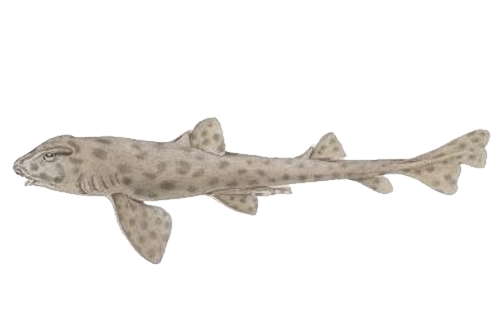
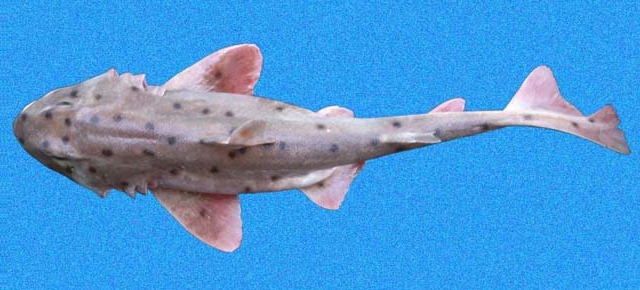
It has two dorsal fins, each with a spine, and an anal fin. The body is light grey or brown above, with large black spots and without a dark harness pattern; hatchlings have a colour pattern similar to the adults [2]. The first dorsal fin begins behind the pectoral-fin bases, level with their inner margins, and this is the feature the FAO key uses to separate it from the species of the genus in which that fin begins over the pectoral-fin bases [2].
The ridges above the eyes are low and the space between them is only very slightly concave. In adults the front teeth have one cusp with a pair of smaller cusplets, and the rear molar-like teeth are strongly keeled. The trunk denticles are fairly large and rough. Adults mature between 48 and 61 cm, and the largest known size is 61 cm [2].
In a sample of 4 adults landed in Lambayeque, the skin denticles differed between the back, belly, flank and first dorsal fin in density, crown size and shape, and in the number of ridges and cusps; the study suggests these differences could help taxonomy [5]. The FAO catalogue notes that Peruvian specimens with this dorsal-fin origin include 2 forms that might be 2 species, although its author does not separate them because of the small amount of material examined [2].
Distribution and habitat
It lives in the eastern Pacific, along the coasts and islands of Peru and in the Galapagos Islands [2]. The updated checklist of Peruvian chondrichthyans includes it [3].
It is a shark of coastal continental and insular waters, staying on the bottom at moderate depths. It inhabits rocky and coral reefs, and it has been seen resting on ledges of vertical rock walls between 16 and 30 m deep; the FAO catalogue considers it little known but apparently common [2]. At family level, bullhead sharks favour water warmer than 21 °C and most live in water shallower than 100 m [2].
Biology
It is a poorly studied, mostly nocturnal species, and it lays eggs [2]. An egg case possibly from this species measured about 11 cm, and an apparently newly hatched male measured 17 cm; egg-case identification is uncertain, and they might resemble those of Heterodontus francisci, with thin spiral flanges of 5 turns [2].
The 565 mm gravid female used to describe Gyropleurodus peruanus was caught at Lobos de Tierra Island, in Peru [2]. For the rest of the family it is known that bullhead sharks are sluggish, that at least some species rest by day in crevices and caves, that their eggs can take more than 5 months to hatch and that the young hatch at more than 14 cm [2].
Ecology
It feeds on crabs, and marine algae have sometimes been found in its stomach [2]. One individual was taken from the stomach of a tiger shark, which indicates that it can be prey for larger sharks [2].
Across the whole family, the diet rests on bottom invertebrates: sea urchins are a favourite food, and they also eat shrimp, other crustaceans, snails, oysters, polychaete worms and, more rarely, small fish [2].
Conservation
Its global IUCN Red List category is Least Concern, according to the 2020 assessment [4]. The FAO catalogue states that it is not a commercial species and is presumably caught as discarded bycatch in other fisheries [2].
For bullhead sharks in general, the FAO points out that fishing and habitat destruction in heavily exploited tropical waters, such as those of the tropical eastern Pacific, could cause conservation problems, and that at least 2 species of the family may be declining from fishing pressure, without saying which [2].
Human relevance
The FAO considers it a non-commercial species [2]. Even so, the 4 adults in the denticle study were obtained at the Santa Rosa fishing terminal in Lambayeque [5]. Divers see it often in the Galapagos [2].
The family is described as harmless but able to bite if provoked; divers have often harassed these sharks, and at least one species is prized for jewellery made from its fin spines [2].
References (5)
- WoRMS Editorial Board (2026). Heterodontus quoyi (Fréminville, 1840). World Register of Marine Species. https://www.marinespecies.org/aphia.php?p=taxdetails&id=276700 (accessed 2026-10-25)
- Compagno, L.J.V. (2002). FAO species catalogue for fishery purposes No. 1. Sharks of the world. An annotated and illustrated catalogue of shark species known to date. Volume 2. Bullhead, mackerel and carpet sharks (Heterodontiformes, Lamniformes and Orectolobiformes). FAO Species Catalogue for Fishery Purposes No. 1, Vol. 2. FAO, Rome. https://www.fao.org/4/x9293e/x9293e00.htm (accessed 2026-10-25)
- Cornejo, R., Vélez-Zuazo, X., González-Pestana, A. et al. (2015). An updated checklist of Chondrichthyes from the southeast Pacific off Peru. Check List, 1809. doi:10.15560/11.6.1809 (accessed 2026-10-25)
- Kyne, P.M., Charvet, P., Areano, E.M. et al. (2020). Heterodontus quoyi: Kyne, P.M., Charvet, P., Areano, E.M., Cevallos, A., Espinoza, M., González, A., Herman, K., Mejía-Falla, P.A., Morales-Saldaña, J.M., Navia, A.F. & Velez-Zuazo, X. The IUCN Red List of Threatened Species 2020: e.T44579A124433617. doi:10.2305/IUCN.UK.2020-3.RLTS.T44579A124433617.en (accessed 2026-10-25)
- Kanagusuku, K. (2022). Morfología de los dentículos dérmicos del Tiburón dormilón de Galápagos Heterodontus quoyi (Elasmobranchii: Heterodontidae), una especie del Pacífico sudoriental. Revista de Biología Marina y Oceanografía. doi:10.22370/rbmo.2022.57.especial.3337 (accessed 2026-10-25)
More pictures
Where it has been recorded
- Filled: scientific records, or confirmed by a curator
- Hatched: isolated record
- Dotted outline: no scientific records and no curator's confirmation (an ORKA sighting is not drawn here)
- Tropical–cold transition zone
Scientific records (2 records)
- Cold central sea
Scientific records (5 records)
From openly licensed OBIS and GBIF records (CC0 or CC BY). How each list is built.
Related species
From the same genus (Heterodontus).

Names and sources
In Spanish
- Suño — Peru; fishbase; WoRMS · main name
- Dormilón de Galápagos — WoRMS
- Gato — Wikidata; WoRMS
- Suno — Wikidata
- Tamborín — WoRMS
- Tiburón — WoRMS
- Tiburón gato — Peru; fishbase
- Tiburón Gato De Galápagos — Wikidata
- Tiburón Tamborín — Wikidata
In English
- Peruvian horn shark — WoRMS; Wikidata
- Galapagos Bullhead Shark — Wikidata; WoRMS
- Galapagos horn shark — WoRMS
Learn more
Conservation status: Least Concern (IUCN Red List, according to Wikidata). Taxonomy: PeRMS / WoRMS (CC BY 4.0).