
Bony fishes · Kyphosidae
Girella laevifrons
Girella laevifrons (Tschudi, 1846)
- Peruvian Register of Marine Species
- Listed in PeRMS (IMARPE)
Species account
Summary
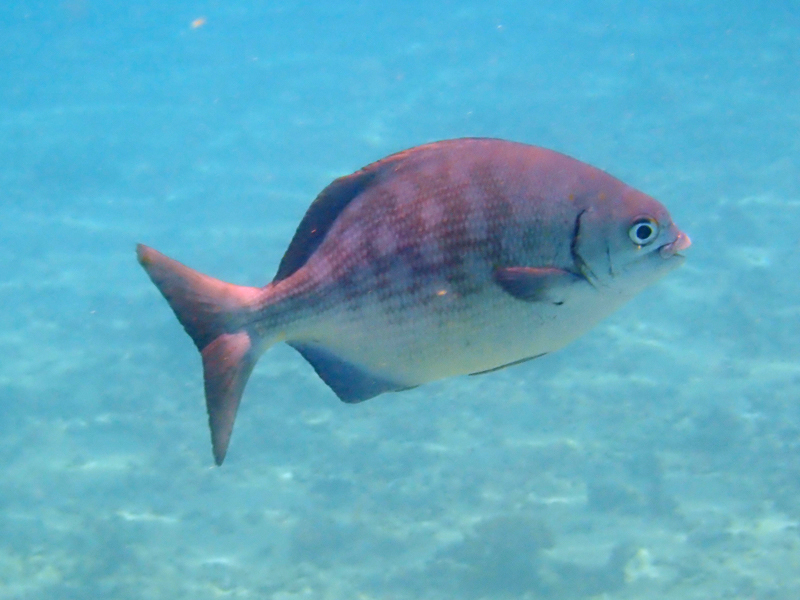
Girella laevifrons is a marine fish of the southeastern Pacific that, according to FishBase, lives in Peru and Chile and reaches 38.3 cm in total length [1]. WoRMS accepts it as a valid species, described by Tschudi in 1846 and now placed in the family Girellidae, although the Peruvian and Chilean studies cited here treat it in Kyphosidae [2],[3]. On the Peruvian coast it is found from the Guañape Islands, at 8° S, to Tacna [3]. It is a fish of shallow rocky areas with omnivorous habits, and its culture has been tested in Peru [3].
Distribution and habitat
In Peru it has been recorded from the Guañape Islands (8° S) to Tacna, and in Chile it is a fish well represented in the shallow rocky intertidal zones of the north and centre of the coast [3]. FishBase summarises its range as the southeastern Pacific, Peru and Chile [1].
Authors of a study of this species in Chile note that adults live in subtidal waters, and the juveniles were studied in the intertidal zone [4]. In Peru, 120 juveniles of 1 to 9 g were captured in October 2018 at San Bernardino beach, in Casma (Áncash), at 9° S [3].
Biology
In a study of several populations along the Chilean coast, juveniles from the south had the highest metabolic rate and condition factor, which the authors interpret as a physiological response to cold, linked to their later move to subtidal waters [4].
In captivity, Peruvian juveniles of 1.35 g and 0.99 g were kept for 92 days at a mean temperature of 21 °C (between 17 and 25 °C) and a salinity of 35; survival was 100 % and the specific growth rate ranged from 1.16 to 1.27 % per day [3]. Weight gain was 190 to 225 % and the final mean weight was a little over 3 g, slower growth than that of Graus nigra in another study [3].
Ecology
It is described as an omnivorous fish [3], although the work on Peruvian fingerlings attributes herbivorous habits to it [5]. According to Chilean studies summarised in that work, the green alga Ulva appears in 46.3 % of stomachs (frequency of occurrence), and another study places it at between 12.36 and 18.26 % of the diet, with an assimilation rate of 75 % [5].
In a 30-day trial with 120 fingerlings of 0.458 g, the best weight gain (112 %) came with 30 % Ulva lactuca meal in the diet, compared with levels of 15 and 45 % and a control without algae [5],[3].
Conservation
According to FishBase (Red List version 2025-2), the species has not been assessed globally [1].
Human relevance
Its flesh is white and firm, and the authors of the 2024 study regard it as an important resource for artisanal fishers, based on a personal communication cited in that work [3]. In Peru it is being evaluated as a candidate for mariculture because of its low trophic level diet, and the 2019 trial with fingerlings reached 50 % survival with the best diet [3]. In 2024, another trial reached 100 % survival in juveniles of 1.35 g and 0.99 g [3].
Where to see it in Peru
The Peruvian literature consulted places the species from the Guañape Islands to Tacna and associates it with shallow rocky zones; the juveniles studied in 2018 were captured at San Bernardino beach, in Casma [3].
References (5)
- Froese, R., Pauly, D. (2026). Girella laevifrons. FishBase. https://www.fishbase.se/summary/Girella-laevifrons.html (accessed 2026-10-25)
- Froese, R., Pauly, D. (2026). Girella laevifrons (Tschudi, 1846). World Register of Marine Species. https://www.marinespecies.org/aphia.php?p=taxdetails&id=314470 (accessed 2026-10-25)
- Cruz-Castellón, C., Vásquez-Quispesivana, W., Guerrero-Jiménez, C. et al. (2024). Cultivation of sea chub Girella laevifrons (Perciformes: Kiphosidae) juveniles on the central coast of Peru. Revista de Biología Marina y Oceanografía. doi:10.22370/rbmo.2024.59.2.4817 (accessed 2026-10-25)
- Pulgar, J., Ojeda, F.P., Bozinovic, F. (2006). Intraspecific geographic and seasonal physiological variability in an intertidal fish, Girella laevifrons, along a climatic gradient. Journal of Fish Biology. doi:10.1111/j.0022-1112.2006.00979.x (accessed 2026-10-25)
- Cruz, C.A. (2019). Una dieta a base de harina de Ulva lactuca mejora el crecimiento de alevines de bauncos Girella laevifrons (Pisces: Kyphosidae). Scientia Agropecuaria. doi:10.17268/sci.agropecu.2019.02.04 (accessed 2026-10-25)
More pictures
Where it has been recorded
- Filled: scientific records, or confirmed by a curator
- Hatched: isolated record
- Dotted outline: no scientific records and no curator's confirmation (an ORKA sighting is not drawn here)
- Tropical–cold transition zone
Scientific records (2 records)
- Cold central sea
Scientific records (3 records)
- Cold southern sea
Scientific records (5 records)
From openly licensed OBIS and GBIF records (CC0 or CC BY). How each list is built.
Related species
From the same family.


Names and sources
Classification
Learn more
Conservation status: no data (IUCN). Taxonomy: PeRMS / WoRMS (CC BY 4.0).