
Crabs, lobsters and shrimps · Varunidae
Cyclograpsus cinereus
Cyclograpsus cinereus Dana, 1851
- Peruvian Register of Marine Species
- Listed in PeRMS (IMARPE)
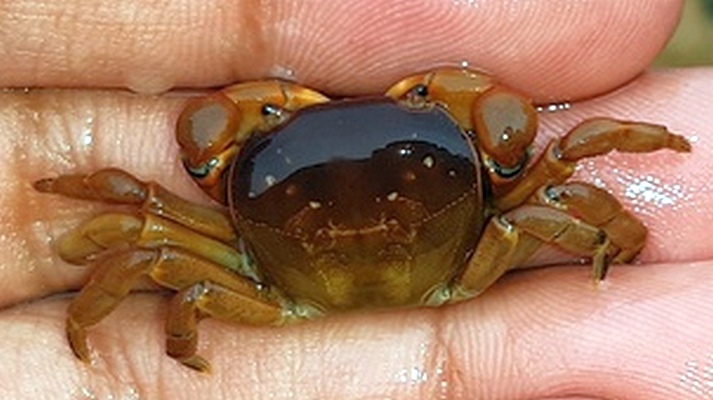
Species account
Summary
Cyclograpsus cinereus Dana, 1851 is a marine crab of the family Varunidae, accepted under that name in the World Register of Marine Species [1]. It lives in the upper part of the intertidal zone on the south-eastern Pacific coast, and its northern limit reported in the literature is Ancón, in Peru [2]. The authors of a study in Antofagasta list it among the most abundant species on the rocky shores of Chile [3].
Distribution and habitat
According to the survey cited by Costlow and Fagetti, adults occur from Ancón, in Peru, to Calbuco, in Chile, and there is also one isolated locality outside that range, in Panama [2]. Adults live in the upper level of the intertidal zone, under stones, in coarse sand [2].
In later studies, the Chilean populations have been described as belonging to the supratidal zone, with constant cycles of immersion and emersion [4]. In Antofagasta bay (23°27′ S) the species was counted in quadrats on rocky shores during the spring and summer of 2018 to 2020, at six sites, four urban and two inside a protected area [3].
Biology
At Montemar, on the central Chilean coast, ovigerous females were observed all year round except February. The main spawning period ran from July to November, when more than 60% of the population carried eggs and the water temperature rose from 12 °C to 14 °C [2].
The larva completes its development in 5 zoeal stages and 1 megalopa. The first zoea has a gibbose dorsal spine, and the following zoeae bear lateral spines on the carapace. Reared in the laboratory at 25 °C, larvae took on average 30 days to reach the first crab at a salinity of 30 ppt and 34.2 days at 35 ppt; at 20 °C they took 45.7 and 47.7 days respectively [2].
Survival to the crab stage was 38% to 45% at 20 °C, and only 2% to 10% at 25 °C. At 30 °C all larvae died within the first 2 days after hatching. A salinity between 30 and 35 ppt did not appreciably change the duration of development [2].
In 6 populations along 19° of latitude of the Chilean coast, female size, egg number and egg size, and reproductive output differed among localities following a clinal pattern [5].
Ecology
In Antofagasta bay the individuals showed an aggregated distribution in 15 sampling events and a uniform one in 4. No significant density differences were found between the sites of the urban zone and those of the protected zone [3].
Because it lives in the supratidal zone, with constant cycles of immersion and emersion, the crab retains CO2, mainly in the branchial cavity. In 6 Chilean populations exposed to air in the laboratory, those from low latitudes, subject to higher air temperatures, showed greater variation in haemolymph pH, more calcium, and less chloride and activity of the enzyme LDH [4].
The species breathes oxygen from both air and water, like an amphibious crab. In 5 populations spread over 2000 km, in almost all of them the ratio of aerial to aquatic metabolism was close to 1, and the metabolic rate was higher at low latitudes [6].
Where to see it in Peru
A 1967 paper places Cyclograpsus cinereus in Peru only as far as Ancón, the northern limit of its range according to the literature it cites; no more recent presence data for the Peruvian coast are given here. According to that paper, the adults' habitat is the upper part of the intertidal zone, under stones on coarse sand [2].
References (6)
- DecaNet eds. (2026). Cyclograpsus cinereus Dana, 1851. World Register of Marine Species. https://www.marinespecies.org/aphia.php?p=taxdetails&id=444708 (accessed 2026-10-25)
- Costlow, J.D., Fagetti, E. (1967). The Larval Development of the Crab, Cyclograpsus cinereus Dana, under Laboratory Conditions. Pacific Science 21(2), 166-177. doi:10.5281/zenodo.16388896 (accessed 2026-10-25)
- Rios-Escalante, P., Esse, C., Retamal, M. et al. (2022). Spatial Distribution of Cyclograpsus cinereus Dana 1851 on the Rocky Shores of Antofagasta (23°27′ S, Chile). Diversity, 418. doi:10.3390/d14060418 (accessed 2026-10-25)
- Lagos, N., Cáceres, C., Lardies, M. (2013). Geographic variation in acid–base balance of the intertidal crustacean Cyclograpsus cinereus (Decapoda, Grapsidae) during air exposure. Journal of the Marine Biological Association of the United Kingdom, 159-165. doi:10.1017/s0025315413001264 (accessed 2026-10-25)
- Lardies, M., Arias, M., Bacigalupe, L. (2010). Phenotypic covariance matrix in life-history traits along a latitudinal gradient: a study case in a geographically widespread crab on the coast of Chile. Marine Ecology Progress Series, 179-187. doi:10.3354/meps08694 (accessed 2026-10-25)
- Lardies, M., Muñoz, J., Paschke, K. et al. (2010). Latitudinal variation in the aerial/aquatic ratio of oxygen consumption of a supratidal high rocky-shore crab. Marine Ecology, 42-51. doi:10.1111/j.1439-0485.2010.00408.x (accessed 2026-10-25)
More pictures
Where it has been recorded
- Filled: scientific records, or confirmed by a curator
- Hatched: isolated record
- Dotted outline: no scientific records and no curator's confirmation (an ORKA sighting is not drawn here)
- Cold central sea
Scientific records (4 records)
- Cold southern sea
Scientific records (4 records)
From openly licensed OBIS and GBIF records (CC0 or CC BY). How each list is built.
Related species
From the same family.
Names and sources
Classification
Learn more
Conservation status: no data (IUCN). Taxonomy: PeRMS / WoRMS (CC BY 4.0).