
Sea snails · Calyptraeidae
Crucibulum scutellatum
Crucibulum scutellatum (W. Wood, 1828)
- Peruvian Register of Marine Species
- Listed in PeRMS (IMARPE)

Species account
Summary
Crucibulum scutellatum (W. Wood, 1828) is a marine snail of the family Calyptraeidae, an accepted name in the World Register of Marine Species [1]. Calyptraeids are sedentary snails that filter-feed and live attached to hard substrates [2]. A review of the family in Peru recorded it from Tumbes to Ica, on rocky infralittoral bottoms, with a recorded length of 67.0 mm [3].
Identification and similar species
The shell is a low cone with a subcentral apex. Its sculpture has thick, scaly radial ribs, sometimes interlaced with concentric sculpture, that project at the margin as heavy spines; the colour is brownish and the septum is white [3]. The review gives a length of 67.0 mm [3].
The cup-shaped septum, attached at the centre of the shell, sets Crucibulum apart from Calyptraea, whose septum is an inclined plane tracing a loose spiral [2]. Species of Crucibulum generally have spiny, ridged or rugose sculpture and keep a slight curve at the apex [2]. Because shells are plastic and often conform to the substrate, many species are hard to identify from the shell alone [2].
Similar species
Distribution and habitat
The world register accepts Crucibulum scutellatum as the valid name and bases it on Patella scutellata W. Wood, 1828 [1]. The Peruvian review gives it from Punta Piaxtla, in Sinaloa (Mexico), to Ecuador, and south to Pimentel, in Lambayeque (Peru) [3].
The Peruvian collections examined in that review amounted to 23 lots and 72 specimens, and their habitat is the rocky infralittoral [3]. The review was based on 1237 calyptraeid specimens from along the Peruvian coast, collected by hand in the intertidal zone and the rocky sublittoral [3].
Biology
Within the family, all calyptraeids are protandrous hermaphrodites: they start as males and change to females as they grow, and males may attach to the shells of females in stacks of decreasing size [2]. The early stages are always brooded between the female's neck, propodium and the substrate [2].
For Crucibulum scutellatum, Collin's compilation of modes of development classifies it as planktotrophic and without nurse eggs [4]. Those data come from Panama and Costa Rica, near 8° N, and not from Peru [4].
Ecology
The anatomy of calyptraeids is dominated by modifications of the gill and the mantle cavity for filter feeding [2]. They are found attached to hard substrates such as rocks, shells and human-made objects, especially glass bottles [2].
In Crucibulum, the mantle cavity and the style sac curve backwards around a plug of connective tissue that fills the cup-shaped septum [2]. In the eastern Pacific, upwelling areas are associated with calyptraeid abundances of up to hundreds per m2 and with species of large body size [2].
Where to see it in Peru
References (4)
- WoRMS Editorial Board (2026). Crucibulum scutellatum (W. Wood, 1828). World Register of Marine Species. https://www.marinespecies.org/aphia.php?p=taxdetails&id=532688 (accessed 2026-10-25)
- Collin, R. (2019). Calyptraeidae from the northeast Pacific (Gastropoda: Caenogastropoda). Zoosymposia, 107-130. doi:10.11646/zoosymposia.13.1.12 (accessed 2026-10-25)
- Paredes, C., Cardoso, F. (2006). La Familia Calyptraeidae en el Perú (Gastropoda: Caenogastropoda). Revista Peruana de Biología, 177-184. doi:10.15381/rpb.v13i3.2335 (accessed 2026-10-25)
- Collin, R. (2003). Worldwide patterns in mode of development in calyptraeid gastropods. Marine Ecology Progress Series, 103-122. doi:10.3354/meps247103 (accessed 2026-10-25)
More pictures
Where it has been recorded
- Filled: scientific records, or confirmed by a curator
- Hatched: isolated record
- Dotted outline: no scientific records and no curator's confirmation (an ORKA sighting is not drawn here)
- Tropical northern sea
Scientific records (7 records)
- Tropical–cold transition zone
Scientific records (1 record)
- Cold central sea
Isolated record (1 record)
- Cold southern sea
Scientific records (2 records)
From openly licensed OBIS and GBIF records (CC0 or CC BY). How each list is built.
Related species
From the same genus (Crucibulum) and from the same family (Calyptraeidae).

Crucibulum lignarium
IUCN status: Not evaluated
Spiny cup-and-saucer
Crucibulum spinosum
IUCN status: Not evaluatedCrucibulum personatum
IUCN status: Not evaluatedCrucibulum monticulus
IUCN status: Not evaluatedCrucibulum pectinatum
IUCN status: Not evaluated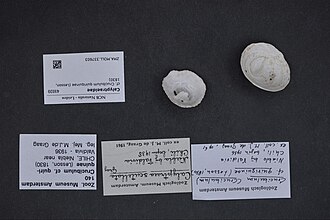
Crucibulum quiriquinae
IUCN status: Not evaluated
Bostrycapulus aculeatus
IUCN status: Not evaluatedBostrycapulus calyptraeiformis
IUCN status: Not evaluated
Names and sources
Classification
Learn more
Conservation status: no data (IUCN). Taxonomy: PeRMS / WoRMS (CC BY 4.0).