
Bony fishes · Sciaenidae
Corvina drum
Cilus gilberti (Abbott, 1899)
Spanish: Corvina
- Names in Peru
- Corvina · Ceviche · Corvina pampera · Corvinilla · Gringa · Seviche
- Peruvian Register of Marine Species
- Listed in PeRMS (IMARPE)
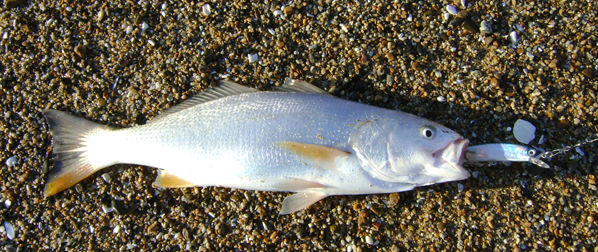
Species account
Summary
Cilus gilberti is a fish of the drum family (Sciaenidae) native to the southeastern Pacific, with records in Peru and Chile [1]. It lives over soft bottoms in the coastal zone and is a resource for artisanal fisheries [2]. It eats small crustaceans and fishes such as anchoveta, and as of 2000 little was known of its basic biology [2]. The IUCN lists it as Data Deficient (DD) [3].
Identification and similar species
The species was described as Sciaena gilberti in 1899 and is now accepted in the genus Cilus; Cilus montti, described in 1900, is a synonym [4].
Until 1985 it was treated as two different species [5]: juveniles were known as corvinilla (Sciaena gilberti) and adults as corvina (Cilus montti) [2].
Among 827 specimens measured off Talcahuano, Chile, total length ranged from 25 to 106 cm and weight from 299 g to 17 kg [2]. Another source gives a maximum length of 92 cm and has no recorded size at maturity [1].
Distribution and habitat
It is endemic to the southeastern Pacific. In Chilean waters it is recorded in the north at Arica (18°20'S) and in the south at Chiloé (43°06'S), associated with soft bottoms of the coastal zone over the continental shelf [2]. FishBase places it in Peru and Chile, between latitudes 6°S and 37°S [1].
It is a neritic fish of sandy or muddy bottoms [5]. In southern Peru, in 2016, specimens were caught in a rocky and sandy zone on the beaches of Punta Colorada and Punta Mesa, near Sama (Tacna), 50 m from the low-tide line [6].
Biology
Of the 827 specimens analysed off Talcahuano between August 1994 and July 1995, 56.6 % were female, 35.2 % male and 8.2 % could not be sexed because the gonad was still incipient; almost all fish under 35 cm were immature or of undetermined sex [2]. FishBase has no recorded size at maturity [1].
In captivity, 21 wild fish caught in 2016 in Tacna all survived (100 %) through the 7 months of conditioning, in water of 15.3 to 19.7 °C and with dissolved oxygen of 5.65 to 8.09 mg/l [6]. They fasted for 23 to 31 days before starting to eat; they first accepted fresh crustaceans (Emerita analoga) and frozen anchoveta and bonito, and later a formulated feed [6].
Ecology
Although at least 24 prey types turned up in the stomachs, the diet is concentrated on a few: by the index of relative importance, anchoveta Engraulis ringens and mysids each contributed about 49 % of the total [2]. Fish under 36 cm ate mostly crustaceans, whereas in fish over 60 cm fishes weighed as much as crustaceans [2]. In winter the main crustacean became the euphausiid Euphausia mucronata, at 52 % of the index [2].
In 86 corvinas studied off Talcahuano in 1983 and 1998, 26 taxa of metazoan parasites were recorded, and every host was parasitised [5].
Conservation
Its global IUCN Red List category is Data Deficient (DD), according to the 2020 assessment [3]. In Chile it was already noted in 2000 that there was almost no information on basic aspects of its biology despite fishery interest [2].
The authors of a 2019 Peruvian study report that corvina populations have declined and that the El Niño phenomenon affects them [6]. FishBase estimates its vulnerability to fishing at 51 out of 100 [1].
Human relevance
It is an important resource for artisanal fisheries in Chile, whose catches go to human consumption [2]. FishBase rates it a highly regarded table fish in South America and a commercial fishery species [1].
The swim bladder of drums is sought to make colapez [6]. In Tacna, the Morro Sama Aquaculture Centre (FONDEPES) caught wild corvinas in 2016 to build a broodstock, the basis of a first captive culture [6].
Where to see it in Peru
The only Peruvian study consulted for this account documents catches on the Sama coast (Tacna), between Punta Colorada and Punta Mesa, over three outings in 2016, 50 m from the low-tide line [6]. That study describes no diving observations [6].
The 21 fish of that study were taken to the Morro Sama Aquaculture Centre, a FONDEPES facility [6].
References (6)
- Froese, R., Pauly, D. (2026). Cilus gilberti, Corvina drum. FishBase. https://www.fishbase.se/summary/Cilus-gilberti (accessed 2026-10-25)
- Chong, J., Cortés, N., Bustos, R. (2024). Hábitos alimentarios de la Corvina Cilus gilberti (ABBOTT, 1889) (PISCES: SCIAENIDAE) frente a la costa de Talcahuano. Biología Pesquera 28 (2000), 29-35. doi:10.21703/0067-8767.2000.28.2609 (accessed 2026-10-25)
- Chao, L., Robertson, R., Bearez, P. (2020). Cilus gilberti: Chao, L., Robertson, R. & Bearez, P. The IUCN Red List of Threatened Species 2020: e.T183478A130860318. doi:10.2305/IUCN.UK.2020-2.RLTS.T183478A130860318.en (accessed 2026-10-25)
- WoRMS Editorial Board (2026). Cilus gilberti (Abbott, 1899). World Register of Marine Species. https://www.marinespecies.org/aphia.php?p=taxdetails&id=280187 (accessed 2026-10-25)
- Garcías, F., Mendoza, R., George-Nascimento, M. (2001). Variación entre años de las infracomunidades de parásitos metazoos de la corvina Cilus gilberti (Pisces: Sciaenidae) en Chile. Revista Chilena de Historia Natural 74, 833-840. doi:10.4067/s0716-078x2001000400010 (accessed 2026-10-25)
- Espinoza Ramos, L., Contreras Mamani, Z. (2019). CAPTURA Y ACONDICIONAMIENTO DE REPRODUCTORES DE CORVINA Cilus gilberti EN EL CENTRO DE ACUICULTURA MORRO SAMA - TACNA, PERÚ. Ciencia & Desarrollo 22, 43-49. doi:10.33326/26176033.2018.22.744 (accessed 2026-10-25)
More pictures
Where it has been recorded
- Filled: scientific records, or confirmed by a curator
- Hatched: isolated record
- Dotted outline: no scientific records and no curator's confirmation (an ORKA sighting is not drawn here)
- Cold central sea
Scientific records (3 records)
From openly licensed OBIS and GBIF records (CC0 or CC BY). How each list is built.
Related species
From the same family.
Bluestreak drum
Elattarchus archidium
IUCN status: LC · Least ConcernPeruvian weakfish
Cynoscion analis
IUCN status: LC · Least ConcernBigeye corvina
Isopisthus remifer
IUCN status: LC · Least Concern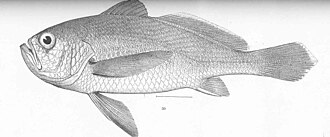
Shining drum
Larimus effulgens
IUCN status: LC · Least Concern- No openly licensed image yet
Pacific drum
Larimus pacificus
IUCN status: LC · Least Concern Snakehead kingcroaker
Menticirrhus ophicephalus
IUCN status: LC · Least Concern- No openly licensed image yet
Paita kingfish
Menticirrhus paitensis
IUCN status: LC · Least Concern 
California corbina
Menticirrhus undulatus
IUCN status: DD · Data Deficient
Names and sources
In Spanish
- Corvina — Peru; SERNANP (2023). Plan Maestro del Santuario Nacional Los Manglares de Tumbes 2023-2027. RP N.° 064-2023-SERNANP, p. 26 of the PDF; fishbase · main name
- Ceviche — Peru; fishbase
- Corvina pampera — Peru; fishbase; Wikidata
- Corvinilla — Peru; fishbase; Wikidata
- Gringa — Peru; fishbase; Wikidata
- Seviche — Peru; fishbase
In English
- Corvina drum — Wikidata
Classification
Learn more
Conservation status: Data Deficient (IUCN Red List, according to Wikidata). Taxonomy: PeRMS / WoRMS (CC BY 4.0).