
Bivalves · Veneridae
Chionopsis amathusia
Chionopsis amathusia (R. A. Philippi, 1844)
- Peruvian Register of Marine Species
- Listed in PeRMS (IMARPE)

Species account
Summary
Chionopsis amathusia is a venerid clam that R. A. Philippi described in 1844 under the name Venus amathusia [1]. It lives in the tropical eastern Pacific, from the Gulf of California to the far north of Peru, and the annotated checklist of Peruvian bivalves places it on sandy bottoms from the intertidal zone down to 73 m [2]. Its shell is ovate-triangular and convex, and well-preserved specimens have an elaborate sculpture [3].
Identification and similar species
Olsson describes an ovate-triangular, convex shell with full, prominent umbones, a somewhat longer posterior side and an anterior margin deeply excavated beneath a wide, heart-shaped lunule; size varies, but it seldom exceeds 58 mm [3]. The sculpture is made of numerous raised concentric lamellae tilted backwards, and both the lower face of those lamellae and the spaces between them are engraved with fine radial cords [3]. The colour is usually a plain cream, sometimes a muddy brown, with the lunule and escutcheon deep brown [3].
The IMARPE guide to recognising commercial bivalves draws it as subtriangular, somewhat inflated and relatively thick, cream on the outside and white inside, with raised, spaced concentric ribs, small radial ribs and small spines alternating on the concentric grooves [4]. The same guide gives a maximum size of 74 mm of valve length [4].
Olsson treats Chionopsis as a full genus, set apart from Chione in the strict sense by thinner, more convex valves and a larger, deeper pallial sinus, with 3 cardinal teeth in each valve [3]. MolluscaBase accepts Chionopsis amathusia as the valid name and regards Chione jamaniana and Venus darwinii as unaccepted synonyms [1].
Similar species
- Chionopsis gnidia: According to Olsson, it is similar but larger and heavier, with the concentric lamellae more widely spaced [3].
Distribution and habitat
Olsson considers it a common and widely distributed species, ranging from the Gulf of California to northern Peru [3]. The annotated checklist by Paredes and colleagues records it from La Paz, Baja California, and the Gulf of California (Sonora, Mexico) to Punta Peña, Tumbes, Peru [2]. The IMARPE guide gives the same southern end, under the name Punta Peña Mala [4].
According to the annotated checklist, it lives on sandy bottoms, from the intertidal to the sublittoral zone, to a maximum of 73 m [2]. The IMARPE guide describes it on soft bottoms of the intertidal zone, down to 75 m depth [4]. The two sources differ slightly on the maximum depth [2],[4].
Human relevance
Where to see it in Peru
Olsson recorded the species in Peru at Tumbes, Zorritos, Boca Pan and Máncora, in a work published in 1961 [3]. The 2016 annotated checklist fixes its southern limit at Punta Peña, Tumbes [2]. Neither source says whether those places are hard to reach or restricted, or whether the species is seen while diving [3],[2].
References (4)
- MolluscaBase eds. (2026). Chionopsis amathusia (R. A. Philippi, 1844). World Register of Marine Species. https://www.marinespecies.org/aphia.php?p=taxdetails&id=507514 (accessed 2026-10-25)
- Paredes, C., Cardoso, F., Santamaría, J. et al. (2016). Lista anotada de los bivalvos marinos del Perú. Revista Peruana de Biología, 127-150. doi:10.15381/rpb.v23i2.12397 (accessed 2026-10-25)
- Olsson, A.A. (1961). Mollusks of the tropical eastern Pacific : particularly from the southern half of the Panamic-Pacific faunal province (Panama to Peru) ; Panamic-Pacific Pelecypoda. Paleontological Research Institution. doi:10.5962/bhl.title.6853 (accessed 2026-10-25)
- Instituto del Mar del Perú (2016). Guía ilustrada para reconocimiento de especies de moluscos bivalvos con valor comercial. Serie de Divulgación Científica, vol. 2, n.° 1. https://biblioteca.imarpe.gob.pe/opac_css/index.php?lvl=notice_display&id=24387 (accessed 2026-10-25)
More pictures
Where it has been recorded
- Filled: scientific records, or confirmed by a curator
- Hatched: isolated record
- Dotted outline: no scientific records and no curator's confirmation (an ORKA sighting is not drawn here)
- Tropical northern sea
Scientific records (5 records)
From openly licensed OBIS and GBIF records (CC0 or CC BY). How each list is built.
Related species
From the same genus (Chionopsis) and from the same family (Veneridae).
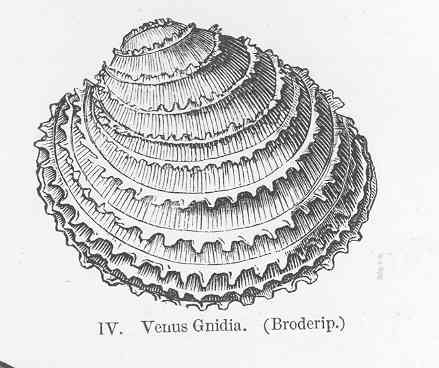
Chionopsis gnidia
IUCN status: Not evaluated- No openly licensed image yet
Chionopsis crenifera
IUCN status: Not evaluated Chionopsis ornatissima
IUCN status: Not evaluatedHysteroconcha lupanaria
IUCN status: Not evaluatedLamelliconcha concinna
IUCN status: Not evaluatedLeukoma columbiensis
IUCN status: Not evaluatedTivela byronensis
IUCN status: Not evaluatedAmeghinomya antiqua
IUCN status: Not evaluated
Names and sources
Classification
Learn more
Conservation status: no data (IUCN). Taxonomy: PeRMS / WoRMS (CC BY 4.0).