
Bony fishes · Ariidae
Tete sea catfish
Ariopsis seemanni (Günther, 1864)
Spanish: Bagre tete
- Peruvian Register of Marine Species
- Listed in PeRMS (IMARPE)

Species account
Summary
Ariopsis seemanni (Günther, 1864) is a sea catfish of the family Ariidae, accepted in WoRMS, that lives in coastal and brackish waters of the American Pacific; a study of its sounds describes it as common from Mexico to Peru [1],[2]. It reaches about 44.4 cm total length and sits at a middle trophic level [3].
Males brood the eggs in the mouth [3]. It is fished for food and, in Colombia, juveniles of 5 to 10 cm are sold as aquarium fish; the IUCN lists it as Least Concern (LC) [4],[5].
Identification and similar species
Among the sea catfishes of the eastern Pacific it differs from Ariopsis guatemalensis by its large eye, 36% to 63% of the distance between the eyes, against a small eye of about 25% in Ariopsis guatemalensis [6].
The lower tooth plate of Ariopsis seemanni is thin and split into two sections, whereas Ariopsis guatemalensis has its palate teeth in four patches and three pairs of barbels [6]. A species account is no substitute for a regional taxonomic key: the 2017 revision of the genus is the reference FishBase points to for the species [3].
Distribution and habitat
FishBase gives the species a latitude range of 24°N to 5°S [3]. A study of its sounds describes it as common in coastal marine and brackish waters of Central and South America, from Mexico to Peru [2].
It is demersal and can live in marine, brackish and fresh water, ascending medium and large rivers to at least 25 m above sea level [3]. In the Mexican Pacific it was caught as bycatch with seine nets in a shallow estuarine zone less than 3 m deep [6].
Biology
The recorded maximum is 44.4 cm total length and 912.3 g, and the estimated trophic level is 3.6 [3]. In a trial in Colombia, the wild females used averaged 263.6 g and 25.3 cm total length [4].
Males incubate the eggs in the oral cavity [3]. The oocytes of the females averaged 13.2 mm in diameter and, in the 15 females with oocytes in final maturation, the mean was about 30 per female, an apparently low fecundity that the authors relate to the care of eggs and larvae in the male's mouth [4].
The ovaries held oocytes at different stages of development, and in a captive hormone trial none of the 24 pairs spawned spontaneously [4]. Juveniles of about 7.2 cm reared on diets of 28% to 53% protein survived at over 75%, close to 95% on the 45% diet and to 75% on the 53% one [7].
Ecology
Individuals emit short constant-frequency sounds, with a median duration of 19.5 ms and a fundamental frequency of 148.3 to 249.8 Hz at 24.5 °C [2].
In the laboratory, 5 fish chose the arm of a Y-maze with a loudspeaker in 67% of the trials, which suggests the calls may help hold the group together; the authors consider it highly unlikely that they serve for acoustic obstacle detection [2].
Conservation
The IUCN globally classifies Ariopsis seemanni as Least Concern (LC) [5]. FishBase rates its vulnerability to fishing as low to moderate, with a score of 34 out of 100 [3].
In Colombia, the authors of a breeding trial note heavy fishing pressure over the last two decades on juveniles of 5 to 10 cm for the aquarium trade [4].
Human relevance
It is a commercial fish sold fresh or salted [3]. On the Colombian Pacific, adults longer than 25 cm are traditionally eaten in coastal communities [4].
Juveniles of 5 to 10 cm are sold as ornamental fish at home and abroad, acclimated to fresh water, and this trade is more profitable than selling adults for food [4],[7].
References (7)
- WoRMS Editorial Board (2026). Ariopsis seemanni (Günther, 1864). World Register of Marine Species. https://www.marinespecies.org/aphia.php?p=taxdetails&id=293653 (accessed 2026-10-25)
- Schmidtke, D., Schulz, J., Hartung, J. et al. (2013). Structure and Possible Functions of Constant-Frequency Calls in Ariopsis seemanni (Osteichthyes, Ariidae). PLoS ONE 8. doi:10.1371/journal.pone.0064864 (accessed 2026-10-25)
- Froese, R., Pauly, D. (2026). Ariopsis seemanni, Tete sea catfish. FishBase. https://www.fishbase.se/summary/Ariopsis-seemanni.html (accessed 2026-10-25)
- Espinel-Cárdenas, V.H., Rodríguez-Forero, A. (2019). Ensayo de reproducción inducida en Ariopsis seemanni. Orinoquia 23, 31-40. doi:10.22579/20112629.539 (accessed 2026-10-25)
- Cooke, R., Acero, A., Betancur, R. et al. (2007). Ariopsis seemanni: Cooke, R., Acero, A., Betancur, R., Rojas, P. & Cotto, A. The IUCN Red List of Threatened Species. doi:10.2305/IUCN.UK.2010-3.RLTS.T183818A8182512.en (accessed 2026-10-25)
- Guzmán-Morales, F., Ramos-Ávila, A.Y., Díaz-Santana-Iturrios, M. et al. (2023). Records of malformed sea catfishes (Ariopsis seemanni and Ariopsis guatemalensis) (Actinopterygii: Siluriformes: Ariidae) off San Blas (Mexican Pacific). Acta Ichthyologica et Piscatoria 53, 45-49. doi:10.3897/aiep.53.101350 (accessed 2026-10-25)
- Lamouroux-López, S.L. (2014). Efecto del nivel de proteína en el desempeño productivo de juveniles de tiburoncito Ariopsis seemanni. Orinoquia 18, 209-213. doi:10.22579/20112629.378 (accessed 2026-10-25)
More pictures
Where it has been recorded
- Filled: scientific records, or confirmed by a curator
- Hatched: isolated record
- Dotted outline: no scientific records and no curator's confirmation (an ORKA sighting is not drawn here)
- Tropical northern sea
Scientific records (7 records)
From openly licensed OBIS and GBIF records (CC0 or CC BY). How each list is built.
Related species
From the same family.
- No openly licensed image yet
Chihuil
Bagre panamensis
IUCN status: LC · Least Concern Long-barbeled sea catfish
Bagre pinnimaculatus
IUCN status: LC · Least Concern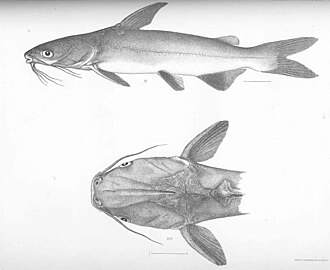
Box sea catfish
Cathorops multiradiatus
IUCN status: LC · Least ConcernPeruvian sea catfish
Galeichthys peruvianus
IUCN status: LC · Least Concern
Congo sea catfish
Cathorops fuerthii
IUCN status: DD · Data Deficient
Besudo sea catfish
Cathorops tuyra
IUCN status: DD · Data DeficientSculptured sea catfish
Notarius kessleri
IUCN status: LC · Least ConcernChilisea Catfish
Notarius troschelii
IUCN status: LC · Least Concern
Names and sources
In Spanish
- Bagre tete — WoRMS; Wikidata · main name
- Bagre Lisa — Wikidata
- Cuminate Negro — Wikidata
In English
- Tete sea catfish — WoRMS; Wikidata
Learn more
Conservation status: Least Concern (IUCN Red List, according to Wikidata). Taxonomy: PeRMS / WoRMS (CC BY 4.0).