
Bivalves · Anomiidae
Anomia peruviana
Anomia peruviana A. d'Orbigny, 1846
- Peruvian Register of Marine Species
- Listed in PeRMS (IMARPE)
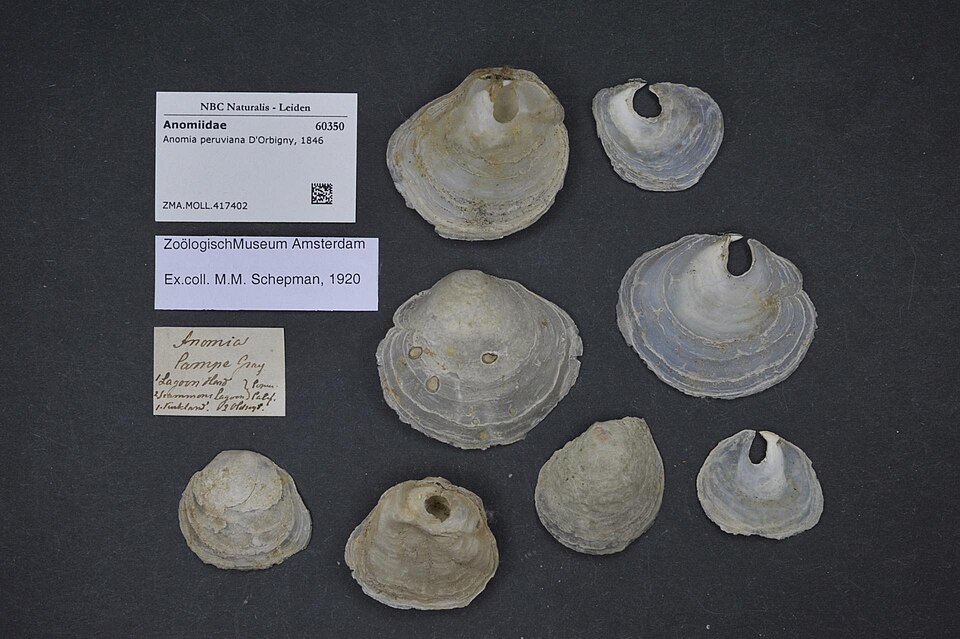
Species account
Summary
Anomia peruviana is a bivalve of the family Anomiidae, in the order Pectinida [1]. It is native to the eastern Pacific, with a range from southern California to Peru and the Galápagos Islands [2]. In Peru it appears in the country's annotated checklist of marine bivalves, with a record in Piura [3]. It is also known for having turned up in 2009 on the Atlantic side of the Panama Canal, and its describers suspect it was carried on the hulls of vessels [2].
Identification and similar species
The shell of this species has 3 muscle scars of similar size and a small to medium byssal opening (the foramen), and it can be white, yellow, orange or green [2]. In young animals that grew for 3 months on PVC plates in Panama, the maximum length was between 2 and 4 cm [2].
It closely resembles the Atlantic Anomia simplex, and the authors who studied its appearance in Panama note that nobody had tried to tell the two apart by shell shape, so identification by morphology leaves doubt [2]. What does separate them is DNA: in a fragment of the COI gene, the genetic distance between the two species was 0.175, whereas among Anomia peruviana specimens it was only 0.009 [2]. The authors therefore confirmed the identity of their specimens with genetic sequences [2].
Similar species
- Anomia simplex: The Atlantic Anomia simplex is nearly the same in shell shape and nobody had tried to separate them on that feature; the verified difference lies in the DNA [2].
Distribution and habitat
It is native to the eastern Pacific and extends from southern California to Peru and the Galápagos Islands; it occurs from the intertidal zone down to 110 m depth [2]. The checklist of Peruvian marine bivalves gives it for the intertidal and sublittoral down to 110 m, on rocky bottom, and gives, as its Peruvian locality, Bayóvar in Piura [3].
It had been recorded in old inventories of the Bay of Panama, on the Pacific side, but never on the Atlantic side of the country before December 2009, when it was found on settlement plates at the Shelter Bay marina in Limón Bay [2]. It kept appearing at that site in later surveys and by 2012 it was at other points of the Atlantic coast [2].
Biology
Very little is known about its reproduction: the authors of the Panama study state that there are no published data on its tolerance of low salinity or on its growth or reproduction, and that other species of the genus spawn in pulses and have plankton-feeding larvae that spend several weeks in the water column [2].
In a laboratory experiment, all 14 individuals kept in seawater survived, whereas of 16 exposed for 12 hours to freshwater from Gatún Lake, 25% survived [2]. The authors suggest that this result reflects the ability, as in other bivalves, to close the valves tightly under adverse conditions [2]. The individuals on the plates were at most 3 months old [2].
Ecology
It is a sessile organism that is often found in fouling communities and on ship hulls [2]. In the Panama study, PVC plates were hung below the low-tide level, left for 3 months, and whatever colonised them was identified; between 2008 and 2012, 482 plates were analysed at 5 Atlantic sites and 8 Pacific ones [2].
The species seems to have crossed the Panama Canal to the Atlantic attached to hulls, and the alternative hypothesis is that its larvae travelled in ballast water [2]. Of 11 individuals sequenced, 10 had a unique haplotype, which points to high genetic diversity and probably several introductions of at least 4 mitochondrial lineages [2]. In the 2025 phylogenetic revision of the family, the species enters with only one cox1 sequence (accession KF850703) and none of the other four genes used [4].
Human relevance
The checklist of Peruvian marine bivalves marks the species as commercial, without detailing the use [3]. Its best-documented practical importance is different: because it lives on vessel hulls and withstands some time in freshwater, it can travel between oceans; in the laboratory, 25% of individuals survived 12 hours in freshwater, the estimated maximum time of a Panama Canal transit [2].
Where to see it in Peru
The literature on Peru gives only one specific locality, Bayóvar in Piura, and describes the species on rocky bottoms from the intertidal down to 110 m, according to a checklist published in 2016, which does not say how or where to observe it. In Panama the young animals, 2 to 4 cm, turned up on plates hung in ports and marinas [2]; there are no data on seeing it while diving in Peru [3].
References (4)
- MolluscaBase eds. (2026). Anomia peruviana A. d'Orbigny, 1846. World Register of Marine Species. https://www.marinespecies.org/aphia.php?p=taxdetails&id=504259 (accessed 2026-10-25)
- Schlöder, C., Canning-Clode, J., Saltonstall, K. et al. (2013). The Pacific bivalve Anomia peruviana in the Atlantic: a recent invasion across the Panama Canal?. Aquatic Invasions, 443-448. doi:10.3391/ai.2013.8.4.08 (accessed 2026-10-25)
- Paredes, C., Cardoso, F., Santamaría, J. et al. (2016). Lista anotada de los bivalvos marinos del Perú. Revista Peruana de Biología, 127-150. doi:10.15381/rpb.v23i2.12397 (accessed 2026-10-25)
- Lin, Y.-T., Qiu, J.-W. (2025). Taxonomic Revision of Jingle Shells: Resurrecting and Reclassifying Species of Anomiidae (Bivalvia: Pectinida). Ecology and Evolution, e72372. doi:10.1002/ece3.72372 (accessed 2026-10-25)
More pictures
Where it has been recorded
- Filled: scientific records, or confirmed by a curator
- Hatched: isolated record
- Dotted outline: no scientific records and no curator's confirmation (an ORKA sighting is not drawn here)
- Tropical northern sea
Scientific records (6 records)
- Tropical–cold transition zone
Scientific records (9 records)
- Cold central sea
Isolated record (1 record)
From openly licensed OBIS and GBIF records (CC0 or CC BY). How each list is built.
Related species
From the same family.
Names and sources
Learn more
Conservation status: no data (IUCN). Taxonomy: PeRMS / WoRMS (CC BY 4.0).