
Bony fishes · Pomacentridae
Dusky seargent
Abudefduf concolor (Gill, 1862)
Spanish: Tono
- Peruvian Register of Marine Species
- Listed in PeRMS (IMARPE)
Species account
Summary
Abudefduf concolor is a fish of the family Pomacentridae, the damselfishes, native to the tropical eastern Pacific [1],[2]. Published records place it from the Gulf of California to Peru, including the Galápagos Islands [2]. It lives in the intertidal and upper subtidal zones on rocky reefs exposed to waves [3],[2]. Its global IUCN Red List category is Least Concern [4].
Identification and similar species
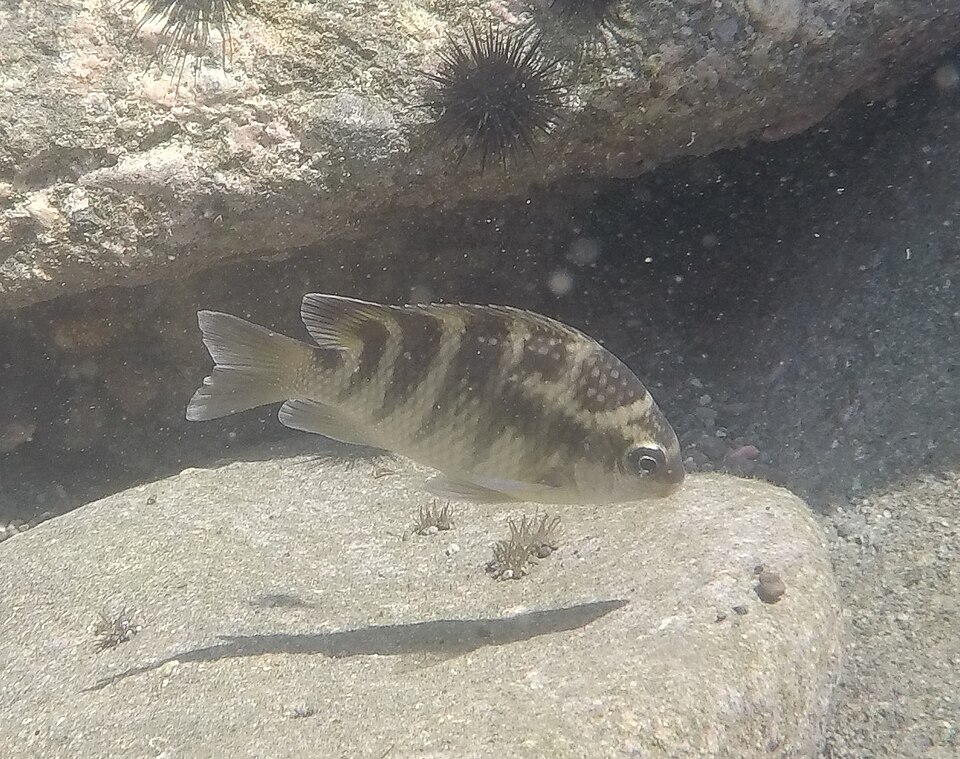
The body is short, deep and compressed from the sides, with 13 spines and 12 to 13 soft rays in the dorsal fin, and 2 spines and 10 to 12 soft rays in the anal fin [2].
The colour is dark brown, paler toward the belly, with 6 vertical bars on the flanks, each about as wide as the eye; the first starts high on the head and the sixth at the rear end of the dorsal-fin base [2]. The maximum recorded length is 19 cm total length, and a common size is 10 cm [2].
Similar species
- Abudefduf troschelii: Abudefduf troschelii also lives in the eastern Pacific, but belongs to the planktivorous group of Abudefduf, whereas Abudefduf concolor is among the species that feed mainly from the bottom [3].
Distribution and habitat
According to FishBase, the species ranges across the eastern Pacific from the lower Gulf of California to Peru, the Galápagos Islands included [2]. A checklist of Colombian Pacific fishes records specimens of the species held in museums of that country [5].
Adults live on rocky coastal reefs exposed to wave action, at depths of 0 to 12 m according to FishBase [2]. Observations made on both sides of the Isthmus of Panama indicate that this species and its Atlantic relative Abudefduf taurus live in the intertidal and upper subtidal zones, above the belts held by benthic damselfishes of the genera Microspathodon and Stegastes [3].
Biology
It is oviparous and forms distinct pairs when breeding. The eggs are demersal and stick to the substrate, and the male guards and aerates them [2].
FishBase describes it as omnivorous [2]. The phylogenetic analysis by Campbell and colleagues places it in a group of Abudefduf that feeds mainly from the bottom, separate from the group of planktivorous species [3].
Ecology
In the genus's family tree, Abudefduf concolor and the Atlantic fish Abudefduf taurus are considered a pair of twin species on either side of the Isthmus of Panama; the estimated time since their common ancestor is about 4.0 million years, with an interval of 3.5 to 5.5 million [3].
Among the 6 named species in the bottom-feeding groups of Abudefduf, only 2 are clearly local endemics according to Campbell and colleagues: this one and Abudefduf declivifrons, which occupy overlapping parts of the eastern Pacific [3]. Their phylogeographic analysis indicated no geographic subdivisions within the species in the eastern Pacific [3].
Conservation
Health, toxicological and chemical relevance
Not medical advice. For a sting, a poisoning or an allergy, seek medical care.
FishBase classes it as harmless to people [2].
Where to see it in Peru
A DNA barcoding study published in 2025 sampled rocky reef fishes by scuba diving in three areas of a marine national reserve in northern Peru: Isla Foca, the coast between Cabo Blanco and Los Órganos, and the Punta Sal reefs [6]. Abudefduf concolor appears among the species analysed in the results table of that work, although the text we reviewed does not say in which of the three areas it was obtained [6].
References (6)
- WoRMS Editorial Board (2026). Abudefduf concolor (Gill, 1862). World Register of Marine Species. https://www.marinespecies.org/aphia.php?p=taxdetails&id=273696 (accessed 2026-10-25)
- Froese, R., Pauly, D. (2026). Abudefduf concolor (Gill, 1862). FishBase. https://www.fishbase.se/summary/Abudefduf-concolor.html (accessed 2026-10-25)
- Campbell, M.A., Robertson, D.R., Vargas, M.I. et al. (2018). Multilocus molecular systematics of the circumtropical reef-fish genus Abudefduf (Pomacentridae): history, geography and ecology of speciation. PeerJ, e5357. doi:10.7717/peerj.5357 (accessed 2026-10-25)
- Allen, G., Robertson, R., Rivera, R. et al. (2007). Abudefduf concolor: Allen, G., Robertson, R., Rivera, R.,Edgar, G., Merlen, G., Zapata, F. & Barraza, E. The IUCN Red List of Threatened Species. doi:10.2305/iucn.uk.2010-3.rlts.t183483a8121204.en (accessed 2026-10-25)
- Tavera, J., Beltrán-León, B.S., Polanco F, A. et al. (2026). Voucher-verified checklist of Colombian Pacific marine fishes with emphasis on material deposited in Colombian museums. ZooKeys, 337-387. doi:10.3897/zookeys.1272.141461 (accessed 2026-10-25)
- Zavala, E., Britzke, R., Siccha-Ramírez, Z. et al. (2025). DNA barcoding of marine rocky reef fishes from northern Peru suggests a parapatric speciation in the Tropical Eastern Pacific. Ecology and Evolution, e70125. doi:10.1002/ece3.70125 (accessed 2026-10-25)
More pictures
Where it has been recorded
- Filled: scientific records, or confirmed by a curator
- Hatched: isolated record
- Dotted outline: no scientific records and no curator's confirmation (an ORKA sighting is not drawn here)
- Tropical northern sea
Scientific records (6 records)
- Tropical–cold transition zone
Scientific records (1 record)
- Cold central sea
Scientific records (1 record)
From openly licensed OBIS and GBIF records (CC0 or CC BY). How each list is built.
Related species
From the same genus (Abudefduf) and from the same family (Pomacentridae).

Panamic sergeant major
Abudefduf troschelii
IUCN status: LC · Least ConcernAzurina atrilobata
IUCN status: Not evaluatedAzurina intercrusma
IUCN status: Not evaluated
Valparaiso chromis
Chromis crusma
IUCN status: LC · Least Concern
Southern whitetail major
Stegastes beebei
IUCN status: LC · Least ConcernSilverstripe chromis
Chromis alta
IUCN status: LC · Least Concern
Coquito damsel
Nexilosus latifrons
IUCN status: LC · Least Concern
Acapulco damselfish
Stegastes acapulcoensis
IUCN status: LC · Least Concern
Names and sources
In Spanish
- Tono — Wikidata · main name
- Petaca rebozada — Wikidata
In English
- Dusky seargent — Wikidata
- Night sergeant — Wikidata
Classification
Learn more
Conservation status: Least Concern (IUCN Red List, according to Wikidata). Taxonomy: PeRMS / WoRMS (CC BY 4.0).