
Marine life guide of Peru · Labrisomidae
Chalapo Clinid
Labrisomus philippii (Steindachner, 1866)
- Names in Peru
- Trambollo · Trambollo boca amarilla
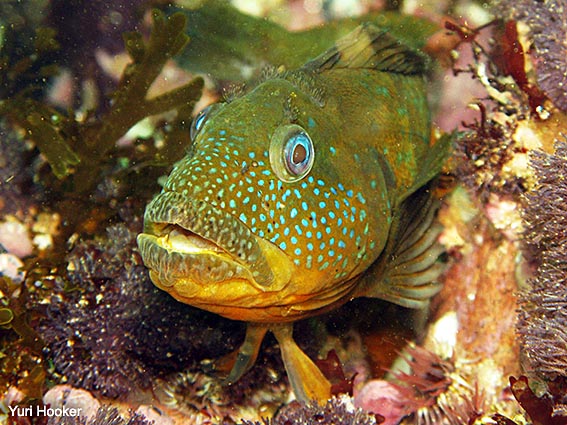
Species account
Summary
Labrisomus philippii is a fish of the family Labrisomidae, order Blenniiformes, described by Steindachner in 1866 [1]. In Peru it is called «trambollo» [2]. It lives on rocky bottoms in the intertidal and subtidal zones, and is known only from the coasts of Peru and Chile [2],[3]. It is a carnivore that feeds mostly on crustaceans [4]. On the IUCN Red List it is assessed as Least Concern [5].
Identification and similar species
Among the labrisomids of Chile it is the only one combining 19 to 20 spines and 11 to 13 soft rays in the dorsal fin, 68 to 74 scales along the lateral line and unbranched caudal-fin rays [6]. It also has 14 to 16 rays in each pectoral fin, usually 15, and 2 spines and 18 to 20 rays in the anal fin; the first dorsal spine is short, as long as the opercle [6].
The largest size recorded in FishBase is 36.9 cm total length [7]. In 1958, Springer regarded it as the most primitive member of its genus, chiefly because of its large size, its more developed dentition, the traits of its lateral line and its pectoral ray count [6].
It has received other scientific names that are now synonyms: Clinus philippii, the name under which Steindachner described it in 1866; Clinus fortidentatus, described by Cope in 1877 from a specimen from Callao Bay whose holotype appears to be lost; and Clinus chilensis, by Sauvage, from 1883 [6].
Similar species
- Auchenionchus microcirrhis: Species of Auchenionchus have branched caudal-fin rays, 56 to 64 lateral-line scales, 13 or 14 pectoral rays and a pelvic fin with 1 spine and 3 rays; Labrisomus philippii has unbranched caudal rays and 68 to 74 lateral-line scales [6].
- Calliclinus geniguttatus: Species of Calliclinus have branched caudal-fin rays, only 40 to 48 lateral-line scales, a pelvic fin with 1 spine and 4 rays and, with rare exceptions, 3 nuchal patches; Labrisomus philippii has unbranched caudal rays and 68 to 74 lateral-line scales [6].
Distribution and habitat
It is endemic to the coast of Peru and Chile, recorded from Paita in northern Peru to Coquimbo in Chile [3]. The key to Chilean labrisomids gives it the same range, from northern Peru to Coquimbo [6].
It occupies rocky bottoms, in both the intertidal and the subtidal zone [2]. It is described as a shallow-water fish, down to about 5 to 6 m [3]. In northern Chile, however, it was caught with gillnets set between 5 and 15 m deep at two localities on exposed coast: 14 specimens at Caleta Errázuriz and only 1 at Carrizal Bajo, further south [4]. At Pisagua and Sarmenia, also in northern Chile, its nests lay at 2 m depth [8].
Biology
The 124 specimens studied at Chorrillos, Lima, in 2008 averaged 19.1 cm total length, ranging from 10 to 24.5 cm; 64 were females and 60 males [2]. Another sample of 29 specimens from the same place, taken in October and November 2012, measured 13 to 26 cm, with 19 females and 10 males [3]. On the northern Chilean coast, between Mejillones del Norte and Punta Urco, 6 specimens speared in 1998 and 1999 measured 26 to 35 cm and weighed 277 to 635 g [9].
Care of the spawn falls to the male. In northern Chile the eggs form a mass stuck only onto patches of red algae, away from the crevices where the adult shelters, and the male spends about 90 % of its time beside it, defending it from fish and crustaceans and keeping it clean [8].
The eggs are spheroid, 1.09 to 1.23 mm across, and carry filaments arising from a basal pole [8]. Larvae reared in the laboratory hatched at about 5.06 mm long, with a working mouth and a rounded yolk sac; they have 35 myomeres and spines on the preopercle, and grew 0.28 mm per day [8].
Ecology
At Caleta Errázuriz, in northern Chile, 13 stomachs of adults caught between July 1996 and November 1997 showed a diet made almost entirely of crustaceans: crabs made up 74.23 % of the food weight and shrimps 15.50 %, while algae were very scarce [4]. It was therefore grouped with the carnivorous fishes of that assemblage, alongside species such as Cheilodactylus variegatus and Paralabrax humeralis [4].
Other studies describe it as a generalist carnivore that eats mainly invertebrates, among them annelids and crustaceans [2],[3]. In turn, it is prey of the marine otter Lontra felina [2].
Its parasites have been studied in detail in Lima. Of the 124 fish examined in 2008, 77 carried at least one parasite; 8 different parasites were found, 5 of them internal, and the commonest were the trematodes Zoogonus rubellus, in 32.2 % of the fish, and Prosorhynchoides rioplatensis, in 30.6 % [2]. Against data from 1988 at the same place, the prevalence of Zoogonus rubellus fell from 74 % to 32.2 % [2].
In the 2012 sample 8 helminths turned up, among them trematodes, a cestode, a nematode and acanthocephalans, and 5 of the 29 fish had none; the trematodes Lecithochirium macrorchis and Zoogonus dextrocirrus ranked highest [3]. Three of those species were recorded for the first time in this fish and in Peru [3].
Some of its parasites are larval stages that finish their cycle in other animals: the acanthocephalan Corynosoma australe in the sea lion Otaria byronia, and the nematode Proleptus in sharks and rays. The authors infer from this that the fish is part of the diet of those predators [2].
Conservation
Its global category on the IUCN Red List is Least Concern [5].
In San Jorge Bay, Antofagasta, Chile, the health of fish caught by free diving was compared between a site with heavy human activity, with 26 fish, and a site with little, with 33 [10]. Fish from the first site had a higher hepatosomatic index and condition factor and more liver damage: vacuolar degeneration in 62 % of fish against 30 %, and steatosis in 23 % against 17 %; the authors suggest those lesions may be due to the bay's pollution by heavy metals [10].
Its abundance in Peru has been reported to have risen after the 1997-1998 El Niño [2].
Human relevance
It reaches the markets of Lima: the specimens used in the parasite studies were bought at the Chorrillos fishing terminal and came from artisanal fishing [2],[3]. FishBase lists it as a species of interest to commercial fisheries [7].
It also serves science: it has been used in studies that track heavy-metal pollution in the sea [3],[10].
Where to see it in Peru
References (10)
- WoRMS Editorial Board (2026). Labrisomus philippii (Steindachner, 1866). World Register of Marine Species. https://www.marinespecies.org/aphia.php?p=taxdetails&id=281261 (accessed 2026-10-20)
- Iannacone, J., Cerapio, J.P., Cárdenas-Callirgos, J. et al. (2011). Comunidades de parásitos en el trambollo Labrisomus philippii (Steindachner, 1866) (Perciformes: Labrisomidae) de la zona costera de Chorrillos, Lima, Perú. Neotropical Helminthology, 73-84. doi:10.24039/rnh2011511037 (accessed 2026-10-20)
- Cruces, C., Chero, J., Sáez, G. et al. (2015). Comunidad de endohelmintos parásitos del trambollo de boca amarilla Labrisomus philippii (Steindachner, 1866) (Perciformes: Labrisomidae) de la costa central del Perú. The Biologist (Lima), 91-109. doi:10.24039/rtb2015131158 (accessed 2026-10-20)
- Angel, A., Ojeda, F.P. (2001). Structure and trophic organization of subtidal fish assemblages on the northern Chilean coast: the effect of habitat complexity. Marine Ecology Progress Series, 81-91. doi:10.3354/meps217081 (accessed 2026-10-20)
- Williams, J.T., Craig, M.T. (2011). Labrisomus philippii: Williams, J.T. & Craig, M.T. The IUCN Red List of Threatened Species 2014: e.T185195A1780132. doi:10.2305/IUCN.UK.2014-3.RLTS.T185195A1780132.en (accessed 2026-10-20)
- Sáez, S., Pequeño, G. (2009). Clave taxonómica, actualizada, ilustrada y comentada de los peces de la familia Labrisomidae de Chile (Perciformes, Blennioidei). Gayana, 130-140. doi:10.4067/S0717-65382009000100016 (accessed 2026-10-20)
- Froese, R., Pauly, D. (2026). Labrisomus philippii. FishBase (facts only; CC BY-NC). https://www.fishbase.se/summary/Labrisomus-philippii.html (accessed 2026-10-20)
- Azócar, C., Zavala-Muñoz, F., Landaeta, M.F. et al. (2022). Parental care and early development of the labrisomid blenny Labrisomus philippii (Labrisomidae) from northern Chile. Journal of Applied Ichthyology, 570-578. doi:10.1111/jai.14355 (accessed 2026-10-20)
- Medina, M., Araya, M., Vega, C. (2004). Alimentación y relaciones tróficas de peces costeros de la zona norte de Chile. Investigaciones Marinas, 33-47. doi:10.4067/S0717-71782004000100004 (accessed 2026-10-20)
- Montenegro, D., González, M.T. (2012). Evaluation of somatic indexes, hematology and liver histopathology of the fish Labrisomus philippii from San Jorge Bay, northern Chile, as associated with environmental stress. Revista de Biología Marina y Oceanografía, 99-107. doi:10.4067/S0718-19572012000100009 (accessed 2026-10-20)