
Marine life guide of Peru · Galeocerdonidae
Tiger shark
Galeocerdo cuvier (Péron & Lesueur, 1822)
- Names in Peru
- Tiburón tigre
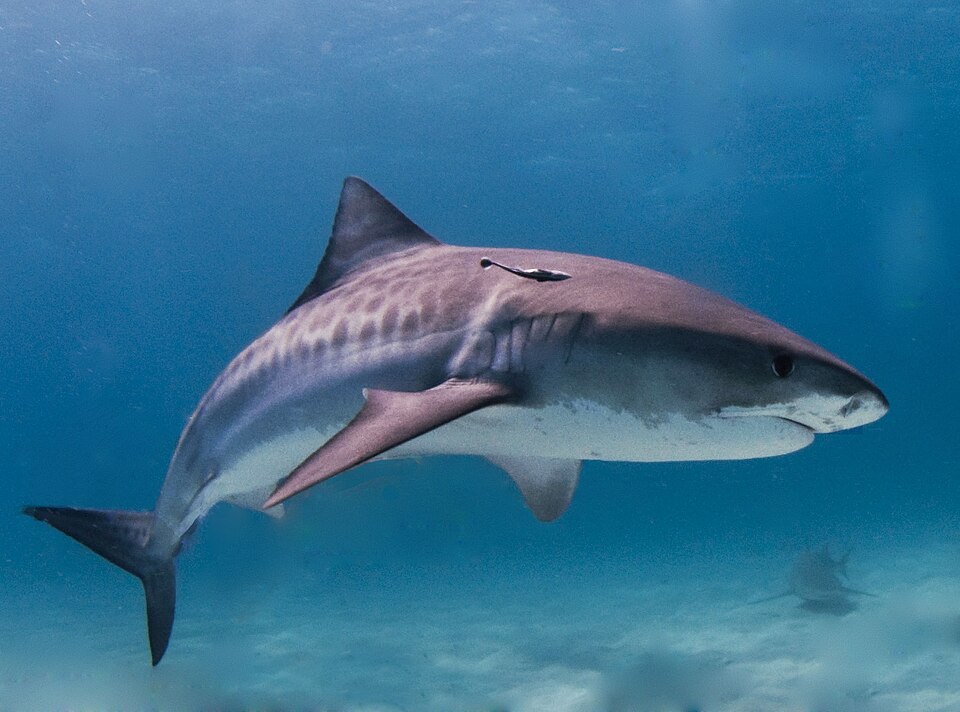
Species account
Summary
Galeocerdo cuvier is a shark of the family Galeocerdonidae, order Carcharhiniformes [1]. It is a large predator with a broad diet that lives in tropical and warm-temperate waters, both coastal and open-sea [2].
In Hawaii, individuals of up to 464 cm total length have been measured [3]. The IUCN rates it Near Threatened [4]. In Peru it is on the checklist of the coast's chondrichthyans [5] and appears in fishery landings [6].
Distribution and habitat
It occurs worldwide in tropical and warm-temperate coastal and pelagic waters; in the western Indian Ocean it ranges from the Red Sea to the east coast of South Africa and around Madagascar [2].
In Western Australia, 11 sharks fitted with satellite tags spent most of their time in water of 23 to 26 °C, although they met temperatures of 6 to 33 °C. Most stayed 30 to 188 days near the coast where they were tagged, and one travelled more than 4000 km in 517 days [7].
For the shark tracked for 517 days, the chance of being in a core of its home range was higher in shallow water, although it crossed areas deeper than 5000 m and dived to about 380 m in tropical latitudes [7].
Biology
Females grow larger than males. In Hawaii, 420 sharks of 88 to 464 cm total length were caught between 1993 and 2013; females averaged 296.8 cm and males 248.5 cm, and only 2 individuals exceeded 450 cm [3].
According to that study's introduction, average litters are 30 to 50 pups, born at 80 to 90 cm, and breeding is triennial [3]. Gestation lasts 15 to 16 months and in Hawaii births occur in September and October; litters of 3 to 82 embryos have been reported [8].
Growth is fast. Using tag-recapture data, the Hawaii model gives an average of 340 cm at 5 years and a mean maximum size of 403 cm; the fastest growers reach 400 cm at 5 years and 444 cm [3]. Of 420 tagged sharks, 50 (11.9%) were recaptured, and one turned up about 5000 km away, in the Gulf of California [3].
Ecology
It is a generalist. In South Africa the stomach contents of 778 sharks were examined, 628 of which held food, and 192 distinct prey items were identified, from small shrimps to whales [2].
Diet changes with size: reptiles, birds, mysticetes (baleen whales) and large sharks gain importance in larger sharks, while rays and bony fishes lose it. The turtles include Chelonia mydas and Caretta caretta, and the birds include the Cape gannet [2].
Large sharks move to feeding areas farther from shore, and their calculated trophic position ranges from 3.6 to 5.0 depending on the method [2]. At Raine Island, Australia, the tagged sharks on average stayed concentrated around the green turtle nesting colony throughout the year, although their movements were not closely linked to those of the turtles [9].
Conservation
Human relevance
In Hawaii there were 165 unprovoked bites between January 1995 and October 2024; 77 (47%) were attributed to this species and 32 of all of them happened in October, one of the two birthing months [8].
In South Africa human remains turned up in the stomachs of 2 sharks of 2.1 and 2.3 m, and the authors suggest that sharks of about 203 cm total length or more are potentially the greatest threat to people [2].
Where to see it in Peru
The 2015 updated checklist of chondrichthyans of the southeast Pacific off Peru includes it [5]. An analysis of Peruvian landings from 1950 to 2010, with species-level data from 1996 to 2010, counts it among the species recorded in the fishery [6].
Neither source names sites or seasons where it is seen by divers, so there is no confirmed place to give [5],[6].
References (9)
- WoRMS Editorial Board (2026). Galeocerdo cuvier (Péron & Lesueur, 1822). World Register of Marine Species. https://www.marinespecies.org/aphia.php?p=taxdetails&id=105799 (accessed 2026-10-25)
- Dicken, M.L., Hussey, N.E., Christiansen, H.M. et al. (2017). Diet and trophic ecology of the tiger shark (Galeocerdo cuvier) from South African waters. PLoS ONE, e0177897. doi:10.1371/journal.pone.0177897 (accessed 2026-10-25)
- Meyer, C.G., O'Malley, J.M., Papastamatiou, Y.P. et al. (2014). Growth and Maximum Size of Tiger Sharks (Galeocerdo cuvier) in Hawaii. PLoS ONE, e84799. doi:10.1371/journal.pone.0084799 (accessed 2026-10-25)
- Ferreira, L.C., Simpfendorfer, C. (2018). Galeocerdo cuvier: Ferreira, L.C. & Simpfendorfer, C. The IUCN Red List of Threatened Species 2019: e.T39378A2913541. doi:10.2305/IUCN.UK.2019-1.RLTS.T39378A2913541.EN (accessed 2026-10-25)
- Cornejo, R., Vélez-Zuazo, X., González-Pestana, A. et al. (2015). An updated checklist of Chondrichthyes from the southeast Pacific off Peru. Check List, 1809. doi:10.15560/11.6.1809 (accessed 2026-10-25)
- Gonzalez-Pestana, A., Kouri J., C., Velez-Zuazo, X. (2016). Shark fisheries in the Southeast Pacific: A 61-year analysis from Peru. F1000Research, 164. doi:10.12688/f1000research.4412.2 (accessed 2026-10-25)
- Ferreira, L.C., Thums, M., Meeuwig, J.J. et al. (2015). Crossing Latitudes—Long-Distance Tracking of an Apex Predator. PLoS ONE, e0116916. doi:10.1371/journal.pone.0116916 (accessed 2026-10-25)
- Meyer, C.G. (2026). ‘Sharktober’: tiger shark parturition drives seasonality in shark bite incidents in Hawaiian waters. Frontiers in Marine Science. doi:10.3389/fmars.2025.1587902 (accessed 2026-10-25)
- Fitzpatrick, R., Thums, M., Bell, I. et al. (2012). A Comparison of the Seasonal Movements of Tiger Sharks and Green Turtles Provides Insight into Their Predator-Prey Relationship. PLoS ONE, e51927. doi:10.1371/journal.pone.0051927 (accessed 2026-10-25)