
Marine life guide of Peru · Inachoididae
Collodes tenuirostris
Collodes tenuirostris Rathbun, 1894
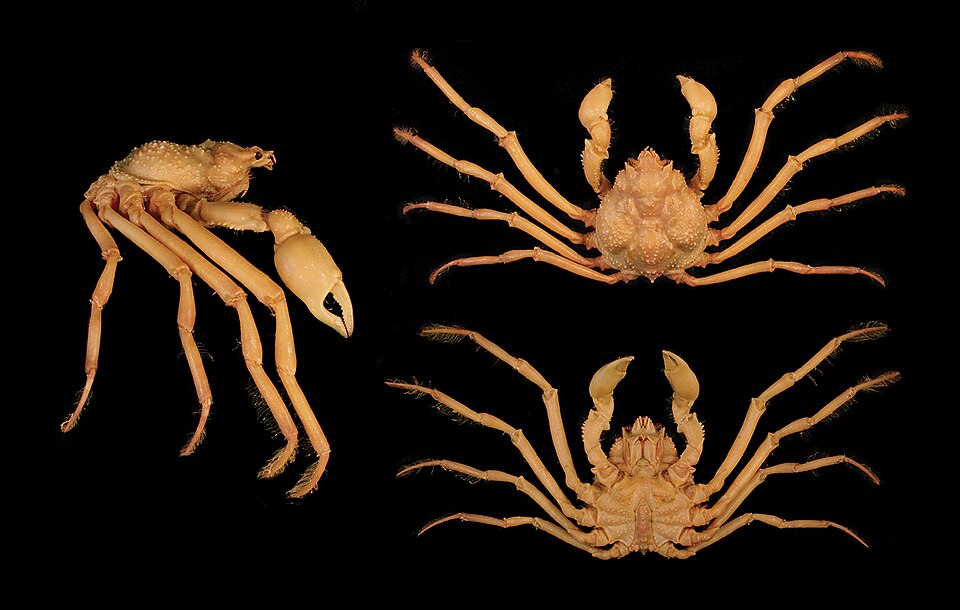
Species account
Summary
Collodes tenuirostris is a spider crab of the family Inachoididae, described by Mary J. Rathbun from material dredged in the Gulf of California; the type locality is Puerto Lobos, Sonora [1],[2]. The original publication is cited as 1893 in the literature and WoRMS gives 1894 [2],[3]. It has been recorded in the eastern Pacific, from Mexico to northern Peru, in examined material from muddy bottoms [2].
The genus Collodes has species on both sides of the Americas: for example, Collodes tuerkayi was described from the western Atlantic [4], and Colavite and colleagues list 15 described species, among them Collodes anartius from northern Peru [2].
Identification and similar species
According to Rathbun, the carapace is slightly hairy and granulate, with unequal granules, the largest on the summit of the branchial regions. It bears 4 median spines with capitate tips: one at the end of the rostrum, one gastric, one cardiac and one directed obliquely backward and upward on the first abdominal segment. In young specimens the rostral spine is bifid at the tip, and this split can persist up to about 12 mm of carapace length [1].
The chelipeds are slender, with about 8 stout spinules along the outer margin of the merus. The walking legs are long and hairy, and the hairs hold a lot of mud [1]. A male from Paita (Piura) measured about 36 mm in carapace length and 30 mm in width [2].
In Peru it can be mistaken for Collodes anartius, which looks similar in the carapace and in the postorbital spines [2]. In Collodes tenuirostris the dactylus of leg 5 is the same length as the propodus or shorter, the dactyli of legs 2 to 5 carry very small spines underneath (sometimes worn), and the spine on the first abdominal segment is usually longer [2].
Other described features: the basal antennal article has an inner lamina ending in a lobe and an outer margin cut into numerous denticles; the male sternum is granulate on its most protuberant parts, and the female abdomen is rough, with numerous but separated granules [1]. Compared with the similar species, the ischium and carpus of the third maxilliped are sparsely granulate, the fourth sternite of the male has an inflated projection, and the fingers of the male cheliped have well-defined teeth up to the distal gap [2].
Similar species
- Collodes anartius: In Collodes anartius the dactylus of leg 5 is longer than the propodus and the dactyli of legs 2 to 5 are smooth underneath; in Collodes tenuirostris the dactylus is equal or shorter and bears tiny spines [2].
Distribution and habitat
Rathbun gave the range as the west coast of Baja California and the Gulf of California, at depths of 36 to 145 fathoms [1]. The holotype comes from Puerto Lobos, Sonora, at 66 m [2].
Colavite and colleagues also examined specimens from Costa Rica (Gulf of Nicoya, 25 m), Panama (Gulf of Panama), Ecuador (Manabi, 185 m) and Peru [2].
In Peru, the material from cruise 16 of the R/V Anton Bruun (June 1966) includes specimens west of Paita, Piura, between 79 and 91 m and between 118 and 133 m. The authors note that on the Peruvian coast Collodes tenuirostris lives at shallower depths than Collodes anartius, found between 118 and 457 m [2].
Biology
The Peruvian lot from 79 to 91 m held 4 males, 5 ovigerous females and 1 juvenile female [2]. Egg-bearing females were also collected in the Gulf of Nicoya (2 females, July 1979) and in the Gulf of Panama (4 females, April 1967) [2].
Rathbun measured a male of about 19 mm carapace length and 15 mm width, and a female 17 mm long and 13 mm wide [1].
Ecology
The species lives on muddy bottoms and has the habit of camouflaging completely in the sediment, which makes it hard to separate from Collodes anartius, which shares the substrate [2].
Rathbun noted that the hairs on the legs held large quantities of mud [1].
On the Peruvian coast depth helped separate the two species in the examined material: Collodes tenuirostris between 79 and 133 m, Collodes anartius between 118 and 457 m, overlapping between 118 and 133 m [2].
References (4)
- Rathbun, M.J. (1925). The spider crabs of America. Bulletin of the United States National Museum. doi:10.5479/si.03629236.129.i (accessed 2026-10-25)
- Colavite, J. (2019). Three new species and a new genus of majoid crabs from the eastern Pacific (Decapoda, Brachyura). ZooKeys. doi:10.3897/zookeys.825.32271 (accessed 2026-10-25)
- DecaNet eds. (2026). Collodes tenuirostris Rathbun, 1894. World Register of Marine Species. https://www.marinespecies.org/aphia.php?p=taxdetails&id=441977 (accessed 2026-10-25)
- Santana, W. (2017). A new western Atlantic species of Collodes Stimpson (Decapoda, Brachyura, Inachoididae). Crustaceana. doi:10.1163/15685403-00003639 (accessed 2026-10-25)