
Marine life guide of Peru · Scolopacidae
Baird's sandpiper
Calidris bairdii (Coues, 1861)
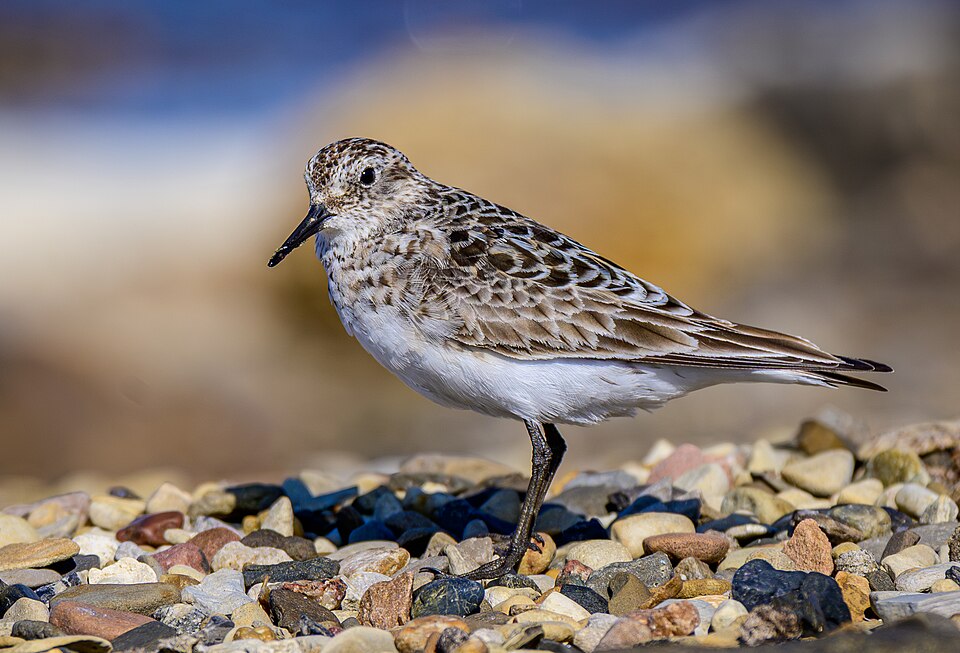
Species account
Summary
Calidris bairdii is a shorebird of the family Scolopacidae; WoRMS accepts the name with the authority Coues (1861) [1]. In Peru it is recorded as a Nearctic migrant on the San Andrés beaches, in Pisco [2]. It is a long-distance migrant, and in spring it crosses the Great Plains of North America [3]. The IUCN lists it as Least Concern [4].
Distribution and habitat
It is a long-distance migrant: the migration distance index between its breeding and wintering areas is 16.7 (in thousands of km), close to that of Calidris fuscicollis (17.2) and somewhat higher than that of Calidris himantopus (15.0) [3].
In Peru, a bird inventory of the seashore at San Andrés, in the district of San Andrés, bordered on the south by Paracas and its national reserve, in Pisco province, classes it as a Nearctic migrant and assigns it to the sandy beaches and to the stony and rocky ones [2].
In the model of spring migration through the Great Plains, the authors place it among the shorebirds with a more easterly distribution, mostly long-distance migrants [3].
Biology
Among the early migrants of the Great Plains, this species begins its northbound flights before April [3].
In a review of Arctic studies, Saalfeld and Lanctot list it among the early-laying, conservative species, as on Bylot Island, in Canada. They also cite that, at sites in northeast Greenland and on Herschel Island, species of this type, this one among them, advanced their laying dates by 0.4 to 1.0 days per year [5].
Ecology
Conservation
The IUCN lists it as Least Concern [4]. According to the Great Plains study, its population trend is unknown [3].
In the eastern Canadian Arctic (Rasmussen lowlands and Foxe Basin), the species' occupancy in the surveyed plots fell from 6.2 % in 1994-1997 to 0 % in 2019. The authors count it among the colder-breeding species, with a temperature index of 1.2 °C, and note it may have been seen less because its range shifted northward [6].
A climate model for the Great Plains projects, as an average over five models and the spring-migration dates, an increase of 0.029 in its probability of occurrence between 1981-2010 and 2041-2070 [3].
Where to see it in Peru
References (6)
- WoRMS Editorial Board (2026). Calidris bairdii (Coues, 1861). World Register of Marine Species. https://www.marinespecies.org/aphia.php?p=taxdetails&id=159048 (accessed 2026-10-25)
- Pulido-Capurro, V. (2025). Las aves de la orilla marina de San Andrés, Pisco, Ica. The Biologist (Lima), 55-70. doi:10.62430/rtb20252311926 (accessed 2026-10-25)
- Reese, G.C., Skagen, S.K. (2017). Modeling nonbreeding distributions of shorebirds and waterfowl in response to climate change. Ecology and Evolution, 1497-1513. doi:10.1002/ece3.2755 (accessed 2026-10-25)
- BirdLife International (2024). Calidris bairdii: BirdLife International. The IUCN Red List of Threatened Species 2024: e.T22693404A261755965. doi:10.2305/IUCN.UK.2024-2.RLTS.T22693404A261755965.en (accessed 2026-10-25)
- Saalfeld, S.T., Lanctot, R.B. (2017). Multispecies comparisons of adaptability to climate change: A role for life-history characteristics?. Ecology and Evolution, 10492-10502. doi:10.1002/ece3.3517 (accessed 2026-10-25)
- Anderson, C.M., Fahrig, L., Rausch, J. et al. (2023). Climate-related range shifts in Arctic-breeding shorebirds. Ecology and Evolution, e9797. doi:10.1002/ece3.9797 (accessed 2026-10-25)