
Marine life guide of Peru · Ampeliscidae
Ampelisca pugetica
Ampelisca pugetica Stimpson, 1864
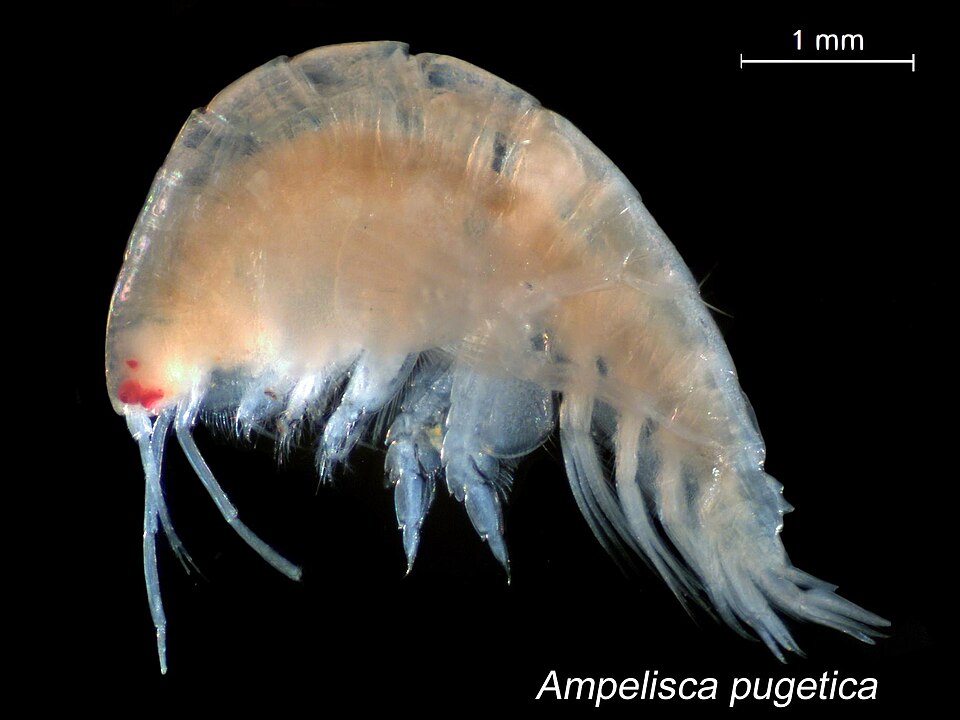
Species account
Summary
Ampelisca pugetica is an amphipod of the family Ampeliscidae that Stimpson described in 1864 from specimens collected in Puget Sound, Washington State [1]. It is known along the Pacific coast of the Americas from Baja California to Peru, at depths of 9 to 183 m according to a checklist of the Eastern Tropical Pacific [2]. WoRMS accepts it as a valid species [3].
Etymology
Stimpson described the species in 1864 from specimens collected in Puget Sound, Washington [1]. The specific epithet most probably refers to that locality, although the sources reviewed do not explain the name. In 1908 Holmes described Ampelisca californica from California specimens, which Barnard regarded as a synonym of Ampelisca pugetica [1].
Identification and similar species
Barnard described the female with the head shorter than the first three body segments, an incised anterior head margin and two pairs of eyes [1].
The third pleon segment has its lower posterior angle drawn out into a large tooth, and the fourth segment bears a saddle-shaped dorsal carina with a vertical posterior margin [1].
The female Barnard measured reached 16 mm and the male 11 mm. The male differs in a deeper notch between pleon segments 3 and 4, a shallower carina, broader rami on uropod 3 and tufts of setae on the antennal peduncles [1].
In a key to three similar species, this one is recognised by a coxa 3 with no concavity on its anterior margin, a pereopod 7 carpus with a bifid lobe and a propodus that is not inflated, a mandible spine row of 11 or 12 spines and an outer plate of maxilla 1 with 11 robust setae [2]. A species described from the Gulf of Mexico, at about 480 m depth, resembles Ampelisca pugetica and Ampelisca mexicana [4].
Similar species
- Ampelisca mexicana: It has a concavity on the anterior margin of coxa 3, an inflated propodus, 7 or 8 spines in the mandible row and 9 robust setae on the outer plate of maxilla 1 [2].
Distribution and habitat
Barnard assembled specimens from the Pacific coast of the Americas between Puget Sound and Peru; for this species he recorded many stations around the Channel Islands and the southern California coast, at 10 to 275 fathoms, plus Baja California at 21 to 41 fathoms and the Gulf of California from the shore down to 45 fathoms [1].
A checklist of the Eastern Tropical Pacific species of Ampelisca gives its distribution as Baja California to Peru, at depths of 9 to 183 m [2].
Biology
Barnard observed that young individuals of 7 to 9 mm have only 3 or 4 setae in the apical notches of the telson lobes and a very shallow depression on the carina of the fourth pleon segment [1].
Some specimens with longer antennae and no brood plates, unlike typical females, might be intersexes, in Barnard's view [1].
Ecology
References (4)
- Barnard, J.L. (1954). Amphipoda of the family Ampeliscidae collected in the Eastern Pacific Ocean by the Velero III and Velero IV. Allan Hancock Pacific Expeditions 18(1), 1-137. https://archive.org/details/allanhancockpaci18alla (accessed 2026-10-25)
- Ortiz, M., Winfield, I., González-Salazar, J. (2021). A new species of Ampelisca (Crustacea: Amphipoda: Ampeliscidae) from Santa Margarita Island, west of the Baja California Peninsula, Mexico. Revista Mexicana de Biodiversidad, e923421. doi:10.22201/ib.20078706e.2021.92.3421 (accessed 2026-10-25)
- WoRMS Editorial Board (2026). Ampelisca pugetica Stimpson, 1864. World Register of Marine Species. https://www.marinespecies.org/aphia.php?p=taxdetails&id=423026 (accessed 2026-10-25)
- Soliman, A., Wicksten, M.K. (2007). Ampelisca mississippiana: a new species (Crustacea: Amphipoda: Gammaridea) from the Mississippi Canyon (Northern Gulf of Mexico). Zootaxa, 45-54. doi:10.11646/zootaxa.1389.1.3 (accessed 2026-10-25)