
Marine life guide of Peru · Pomacentridae
Panamic sergeant major
Abudefduf troschelii (Gill, 1862)
- Names in Peru
- Castañeta manchada
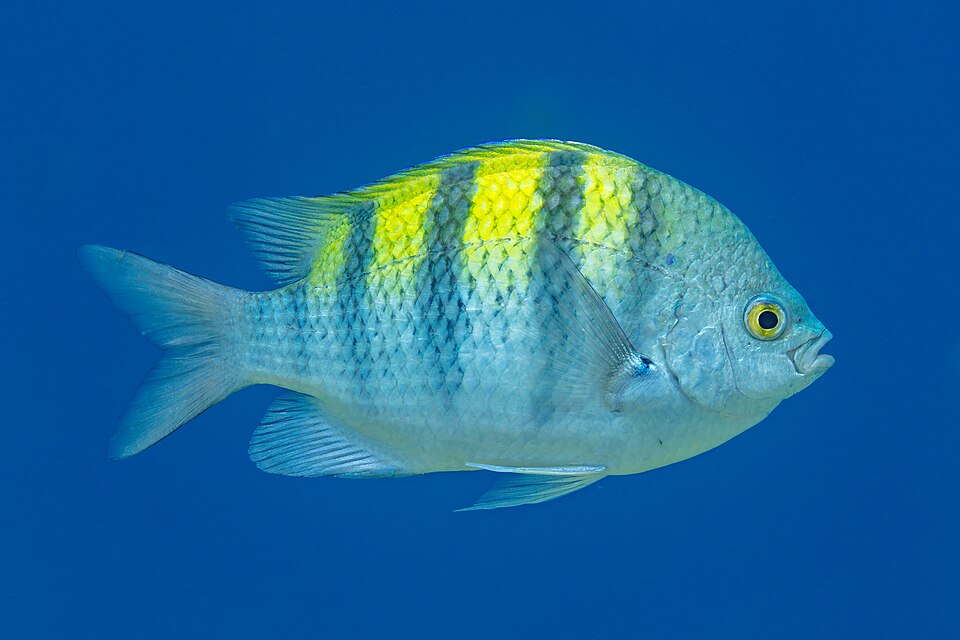
Species account
Summary
Abudefduf troschelii is a fish of the family Pomacentridae (damselfishes), living on shallow rocky and coral reefs of the tropical eastern Pacific [1],[2]. Its name recorded for Peru is «castañeta manchada» [2]. It is known from southern California to Peru, including the Galápagos Islands [3]. It lives in schools that feed on plankton and, in the breeding season, males defend a nest on the rocky bottom [4]. Its global IUCN Red List category is Least Concern [5].
Identification and similar species
The body is short, deep and compressed from the sides, with 13 spines and 12 to 13 soft rays in the dorsal fin, 2 spines and 10 to 13 soft rays in the anal fin, and a black spot at the base of the pectoral fin [2].
It reaches at most 20 cm total length according to FishBase, and up to 22.9 cm according to the checklist of fishes of California and Mexico [2],[3]. In a breeding colony in the Bay of La Paz (Mexico) the males averaged 13.54 cm, with a range of 10.98 to 17.3 cm [4].
As the breeding season begins, males leave the school and their colour changes from yellow, darkening to a bluish tone, known as nuptial colouration [4].
Similar species
- Abudefduf concolor: Abudefduf concolor also lives in the eastern Pacific, but belongs to a group of Abudefduf that feeds mostly from the bottom, whereas Abudefduf troschelii is among the plankton-feeding species [6].
Distribution and habitat
Campbell and colleagues treat it as an eastern Pacific species [6]. FishBase places it throughout the Gulf of California and from Bahía San Juanico (Baja California) south to northern Peru, spanning roughly 32° N to 18° S, plus the Galápagos and other oceanic islands [2]. The checklist by Love and colleagues takes it from King Harbor (southern California) to Pucusana, Peru, citing Chirichigno and Vélez (1998) [3]. The two sources do not fully agree on the southern limit [2],[3].
It lives on rocky and coral reefs at depths of 1 to 12 m according to FishBase, which describes it as a warm-water tropical species with little tolerance of temperature change [2]. The California and Mexico checklist gives it from the intertidal zone down to 15 m [3]. The breeding colony studied at La Paz occupied a continuous rocky reef at 1 to 5 m depth [4].
Biology
It is oviparous. The eggs are demersal and stick to the substrate; the male guards and aerates them [2]. In the Gulf of California breeding begins in early summer and continues through summer into autumn [2].
When the breeding season starts, males prepare and defend a territory, court females and receive clutches from one or several of them. According to Solís-Mendoza and colleagues, citing earlier work, a male's reproductive period lasts 7 to 11 days and includes about 3 days of spawning, and larvae hatch 4 to 5 days after spawning [4].
In a study carried out from 19 September to 4 October 2016 in the Bay of La Paz, 31 males caring for eggs were followed: 21 nested in 5 groups, with the nearest neighbour 70.8 cm away on average, and 10 nested alone, 296.4 cm from their nearest neighbour [4]. Group males lost a smaller part of their clutch: 40 % of the eggs laid in group nests reached the end of the care period, against 1 % in solitary nests [4].
On average, males spent about 70 % of their time guarding the nest and about 25 % absent, and the mean hatching success of the population was 27 % [4]. The authors cite earlier work estimating paternity theft by sneaker males at about 50 % in this species [4].
Ecology
It is diurnal and moves in schools at mid-water, without defending a territory outside the breeding season; it feeds mainly on plankton [4]. FishBase adds that it also grazes benthic invertebrates and reef algae and gives it a trophic level of 3.0 [2]. Adults usually form large aggregations [2].
Predation on eggs is heavy: almost all the eggs of solitary males (89 %) were lost before hatching, and predation took 99 % of the egg area in solitary nests against 60 % in group nests [4].
In the genus's family tree, Abudefduf troschelii is the closest relative of the ancestor of Abudefduf saxatilis and Abudefduf hoefleri, Atlantic species, and the split between that lineage and the Pacific one was estimated at 2.4 million years (interval 0.75 to 4.9) [6].
Conservation
Health, toxicological and chemical relevance
Not medical advice. For a sting, a poisoning or an allergy, seek medical care.
FishBase classes it as harmless to people [2].
Where to see it in Peru
In Peru, the checklist by Love and colleagues (2021) records its presence as far as Pucusana, relying on the marine fish key of Chirichigno and Vélez (1998), and gives it from the intertidal zone down to 15 m depth [3].
References (6)
- WoRMS Editorial Board (2026). Abudefduf troschelii (Gill, 1862). World Register of Marine Species. https://www.marinespecies.org/aphia.php?p=taxdetails&id=273702 (accessed 2026-10-25)
- Froese, R., Pauly, D. (2026). Abudefduf troschelii, Panamic sergeant major. FishBase. https://www.fishbase.se/summary/Abudefduf-troschelii.html (accessed 2026-10-25)
- Love, M.S., Bizzarro, J.J., Cornthwaite, A.M. et al. (2021). Checklist of marine and estuarine fishes from the Alaska–Yukon Border, Beaufort Sea, to Cabo San Lucas, Mexico. Zootaxa, 1-285. doi:10.11646/zootaxa.5053.1.1 (accessed 2026-10-25)
- Solís-Mendoza, M., Chassin-Noria, O., Pérez Hernández, C.L. et al. (2023). Reproductive benefits and reduced investment in parental care behavior associated with reproductive groups of males in Abudefduf troschelii. PeerJ, e15804. doi:10.7717/peerj.15804 (accessed 2026-10-25)
- Allen, G.R., Robertson, R., Rivera, R. et al. (2007). Abudefduf troschelii: Allen, G.R., Robertson, R., Rivera, R., Edgar, G., Merlen, G., Zapata, F. & Barraza, E. The IUCN Red List of Threatened Species 2010: e.T183397A8106267. doi:10.2305/IUCN.UK.2010-3.RLTS.T183397A8106267.en (accessed 2026-10-25)
- Campbell, M.A., Robertson, D.R., Vargas, M.I. et al. (2018). Multilocus molecular systematics of the circumtropical reef-fish genus Abudefduf (Pomacentridae): history, geography and ecology of speciation. PeerJ, e5357. doi:10.7717/peerj.5357 (accessed 2026-10-25)